
02Decision first
Who should buy this unusual brewer?
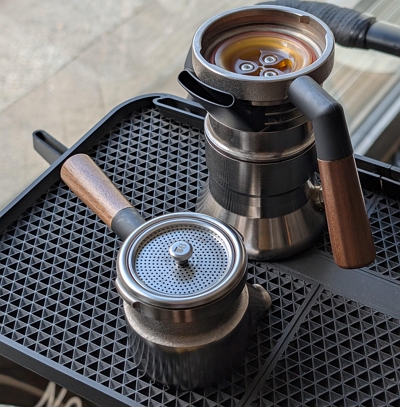
The 9Barista Mk.2 makes the most sense when three conditions overlap: you drink straight espresso, you normally make one cup at a time, and you have a real reason to avoid a conventional machine. That reason may be a tiny kitchen, a camper, a boat, unreliable wall power or a desire to own a compact mechanical device with replaceable parts. If those conditions do not overlap, the same money buys broader capability elsewhere.
03First week
Set up the stove and safety routine before chasing flavor
Give cooling a physical home. A shallow bowl of cool water may be part of a repeat-shot routine if the official instructions allow the relevant parts to be cooled that way, but the point is not to race. The body contains boiling water and pressure. Remove it from the heat if the expected sequence does not occur, stay clear of any vent, and do not attempt to open it until it is fully depressurized and safe to touch. Tom’s Guide’s Mk.2 reviewer described damaging a single-use release element during an early mistake, which is one reviewer’s experience rather than a failure rate. It is still a useful warning to learn the safety system before improvising.
Next, calibrate the stove with inexpensive medium-roast coffee. Fill within the official 110–120 ml range, use a consistent 17–20 g dose, distribute and tamp level, then place the brewer in the same position at the same power. Time from heat-on to the first visible coffee. If the process overruns the manual’s limit, remove heat and diagnose only after cooling. More fire is not the default cure for a basket ground too fine.
04Cup performance
Consistency is the feature, control is the tradeoff
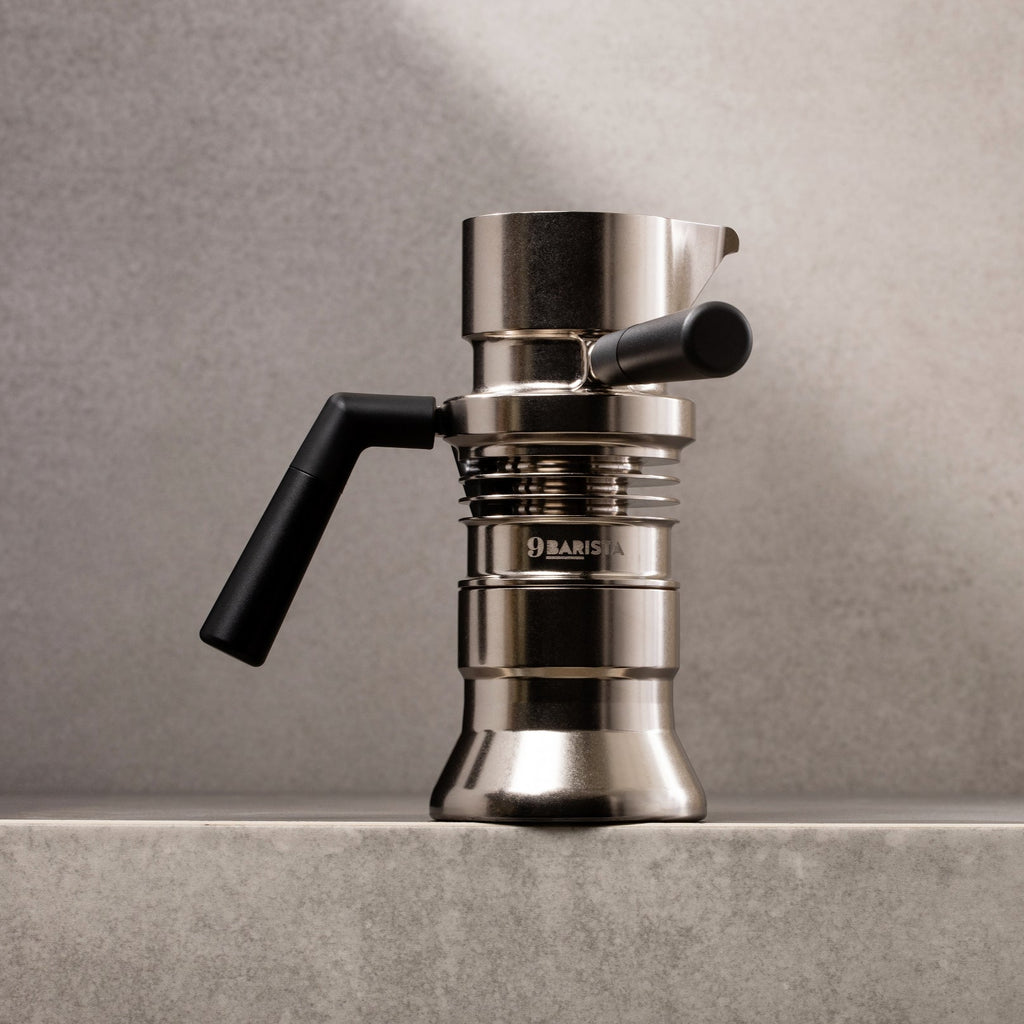
Independent coverage broadly agrees that the result is legitimate espresso. Tom’s Guide used the Mk.2 Pro for about a month and praised the coffee and repeatability. Lance Hedrick’s Mk.2 review is valuable because the mechanism, preparation and cup can be seen rather than accepted from a product page. James Hoffmann, Bon Appétit and The Drive evaluated the original generation, so their observations support the concept and workflow but cannot verify every Mk.2 material or safety revision. A one-year owner account likewise reports consistent use, while explicitly noting that small grind errors can choke the machine.
Espresso assessment
Espresso: fixed conditions shift the work to the grinder
9Barista controls the water side of the recipe for you. The company specifies about 9 bar and 93°C, while the basket accepts 17–20 g and the collected output is normally around 40–45 g. That leaves coffee, dose, distribution and grind as the useful daily controls.
This is not automatically limiting. A stable target can be liberating when you want a familiar espresso every morning. It becomes restrictive when a very light coffee asks for a different temperature, longer preinfusion or intentionally declining pressure.
| Signal | What the evidence says | Buying consequence |
|---|---|---|
| Regulated brew stage | 9Barista documents a mechanical twin-boiler system that reaches approximately 9 bar and controls brew water near 93°C. | Treat it as an espresso brewer with a fixed operating point, not as a moka pot and not as a profiling machine. |
| 53 mm basket | The current Standard uses a 53 mm basket; Pro includes an IMS precision basket and naked portafilter. | A capable espresso grinder and careful puck preparation remain essential even though the brewer regulates pressure. |
| Independent cup reports | Tom’s Guide evaluated a Mk.2 Pro for roughly a month; Lance Hedrick demonstrated the Mk.2. Older Hoffmann, Bon Appétit and The Drive work covers the same core concept but not every Mk.2 revision. | The evidence supports the concept, while generation labels should stay attached to any observation. |
| One output window | The official target is approximately 40–45 g from a 17–20 g dose. | Buy it for a compact double-espresso style result, not for one-touch singles, long drinks or freely selected brew ratios. |
Evidence note: Flavor descriptions in cited reviews remain those reviewers’ observations. Coffeedant has not verified extraction temperature, pressure or taste on a test unit.
05No integrated system
Milk is N/A, but your drink plan still has to add up
This is why the absence affects the verdict even though N/A does not reduce the calculated score. A straight-espresso buyer should not see an arbitrary zero for a feature never promised. A daily cappuccino buyer should not use the healthy overall number as proof of equal fitness. The drink plan, not the average, settles that question.
Milk assessment
Milk: N/A is an honest limitation, not a hidden zero
There is no milk hardware to assess. That makes the category not applicable to the brewer’s score, yet it matters immediately if cappuccinos or flat whites are part of your routine.
A separate electric frother is simple but usually produces a different texture from a steam wand. A standalone steamer can be more capable, but it erodes the space and simplicity argument that makes 9Barista appealing.
| Signal | What the evidence says | Buying consequence |
|---|---|---|
| No integrated milk path | The official product and guide describe espresso brewing only. | A straight-espresso buyer loses nothing; a milk-drink buyer is choosing a two-device station. |
| Separate heat task | Any milk device runs outside the 9Barista cycle. | You may overlap tasks with the right separate tool, but the combined workflow and electrical needs depend on that tool. |
| Score treatment | The rating model excludes N/A categories from the average. | Do not read the overall score as proof that 9Barista serves milk-drink households as well as a six-function machine. |
Evidence note: Milk is excluded from the numerical average. The verdict still penalizes the absent function whenever the intended buyer makes milk drinks.
06Daily cadence
A satisfying first cup and a slow second one
For one drink, the work can feel coherent: grind during or before filling, tamp, heat, pour and rinse. There is no tank to top up for the week, no group to warm for half an hour and no drip tray. For the second drink, every strength becomes a constraint. The first hot dose assembly has to be cooled and made safe; spent coffee and remaining water have to be cleared; seals and threads need clean seating; the chamber is refilled and a new puck prepared. A two-year owner follow-up describes reliable twice-daily use but also places back-to-back brewing among the practical limits. Other owners say the rinse is under a minute once learned. Both can be true: the cleaning motions are brief, while the thermal reset still interrupts service.
Workflow assessment
Workflow: the second drink is the real test
The published 3–6 minute cold cycle sounds competitive with warming a traditional boiler machine. It does not describe grinding, puck preparation, stove adjustment, cooling, disassembly or the next drink.
The first cup is the machine’s strongest use case. A queue exposes the thermal reset: the hot brewer must become safe enough to handle and refill before the same process begins again.
| Signal | What the evidence says | Buying consequence |
|---|---|---|
| Cold start | Official guidance gives approximately 3–6 minutes from cold and 25–30 seconds for the visible extraction phase. | Good for a prepared one-cup routine; not instant and dependent on the stove. |
| Heat source variability | Gas, electric and induction arrangements deliver heat differently; induction requires the selected adaptor. | Expect to learn a repeatable stove setting and position rather than copying another owner’s number blindly. |
| Back-to-back reset | The guide requires removing heat and cooling before safe reopening; owner reports repeatedly flag the second shot as the weak point. | Two independent drinkers should rehearse the queue before choosing this as the only household brewer. |
| Cleaning | The basket and parts are rinsed after use, with periodic scale care and replaceable seals. | The individual cleanup is simple, but it sits inside every repeat cycle. |
07Long ownership
Parts access is more persuasive than vague heirloom language
The stronger ownership evidence is the official parts catalog. Seals, thermal and safety components, baskets, handles, portafilter parts and cleaning products are listed directly. Compatibility must be read line by line. At least one official portafilter listing explicitly distinguishes Mk.1 from Mk.2 fit, so the brand name alone is not enough when ordering.
Build assessment
Build: serviceable hardware with safety responsibilities
Mk.2 changes are mostly about durability and service rather than a new cup format. 9Barista lists harder nickel-plated ECOBrass, a steatite ceramic thermal break, anodized chimney components and a thicker 3 mm boiler O-ring.
That is encouraging evidence, not a promise of indefinite life. The warranty excludes consumables, scale damage, misuse and unauthorized parts, and it is limited to eligible original purchasers.
| Signal | What the evidence says | Buying consequence |
|---|---|---|
| Primary construction | 9Barista lists nickel-plated ECOBrass, 304 stainless steel, anodized aluminium, silicone, PTFE and PEI in the current product. | Expect a compact but heavy object whose value rests partly on machining and material choice. |
| Mk.2 revisions | The company identifies harder brass, a ceramic thermal break, anodized components and a revised boiler seal. | Do not apply every Mk.1 wear report directly to Mk.2, but keep older reports as context for the platform. |
| Parts catalog | Official listings include seals, safety components, handles, portafilters, baskets and other service items, with compatibility notes. | Order by exact generation; some Mk.1 and Mk.2 portafilter parts are not interchangeable. |
| Warranty | New Mk.2 machines have a five-year limited warranty under the published eligibility and exclusion terms. | Direct or authorized purchase has practical value; secondhand coverage is not equivalent. |
Evidence note: Independent reviewers praise the construction, but no credible population-level failure data establish a service-life figure. “Built to last” remains a design intention, not a measured lifespan.

08Mechanical design
Understanding what the twin boilers do, and do not do
The lower chamber turns stove heat into the pressure that an electric machine would obtain from a pump. A valve delays the brew phase until the system reaches its operating point. Heat exchange then brings the water delivered to the puck toward the published brew temperature instead of sending unrestricted boiling water through the coffee. The upper path ends in the basket and collector where the shot can be poured.
Features assessment
Features: one sophisticated job and almost nothing extra
Heat drives a lower boiler until a valve opens at the designed pressure, then heat exchange controls the brew water before it crosses the coffee. That mechanical choreography replaces a pump, electronic PID and user interface.
The elegance is real. So is the absence of a timer, temperature menu, pressure gauge, saved recipes, water spout, cup warmer and steam wand. The right owner sees focus. The wrong owner sees a costly brewer with missing tools.
| Signal | What the evidence says | Buying consequence |
|---|---|---|
| Automatic mechanical regulation | The twin-boiler arrangement creates pressure and manages brew temperature without electronics. | There is no app or control panel to fail, but there is also no user-set brew temperature. |
| Standard and Pro choices | Pro changes the portafilter, basket, basket cap and handles rather than the base brewing principle. | Choose Pro for workflow and basket preferences, not for a higher published pressure or larger drink. |
| Stove adapters | The order flow pairs the machine with an induction adaptor or heat-transfer plate according to stove type. | Select the correct option at checkout; portability still assumes a compatible heat source. |
09Buying decision
The complete budget includes the grinder and every missing function
Value is strongest for a person who would otherwise buy both a compact manual system and a travel solution. It is weakest for someone seduced by the mechanism but who makes two oat lattes every morning. In that household, a Bambino Plus or dual-boiler machine is not less serious. It is simply aligned to the job.
Value assessment
Value: price the requirement, not the novelty
The US direct page showed a from-price of $750 on the review date. Configuration choices can lift the total, and a grinder remains mandatory. Milk drinkers also need separate hardware.
A lower-priced electric semi-automatic usually adds hot water and steam. A manual lever can add pressure control and quicker repeats. Neither duplicates the 9Barista combination of small storage, stove operation and automatic mechanical brew regulation.
| Signal | What the evidence says | Buying consequence |
|---|---|---|
| Direct price | 9Barista’s US storefront showed “From $750” when checked September 15, 2026. | Compare configured totals, not older launch prices repeated in reviews. |
| Five-year warranty | Eligible new Mk.2 purchases receive published five-year limited coverage. | The premium carries more ownership support than many niche manual brewers, subject to territory and exclusions. |
| Full setup | An espresso grinder, scale and perhaps milk hardware sit outside the box. | The machine price is not the complete route to the drinks shown in your plan. |
| Alternative capability | Electric Bambino-class machines add steam; Robot and Flair-class levers add manual control. | Pay the Mk.2 premium only when its particular constraints solve your particular space or power problem. |
10Closest choices
9Barista versus compact pump and manual machines
The fastest shortlist separates regulated operation from manual control. 9Barista fixes pressure and temperature mechanically. A Cafelat Robot or Flair 58 lets your hands shape pressure and makes the next dose without cooling a stove boiler. A Bambino Plus trades the all-metal mechanical object for wall-powered speed and milk capability. A Gaggia Classic-style machine asks for more warm-up and counter room but becomes a conventional espresso station.
| Machine | Price position | The quick decision |
|---|---|---|
| 9Barista Mk.2 | From $750 direct on check date | Choose for one compact, stove-powered and mechanically regulated espresso. |
| Breville Bambino Plus | Lower machine price in the US at last Coffeedant check | Choose for fast wall-powered espresso and automatic milk. |
| Cafelat Robot | Premium manual lever class | Choose for direct pressure control and easier repeat dosing. |
| Flair 58 | Premium manual lever class | Choose for a 58 mm manual platform and profiling. |
DetailsOpen the technical and workflow comparison
| Machine | Dimensions | Heating | Coffee setup | Milk workflow | Best fit |
|---|---|---|---|---|---|
| 9Barista Mk.2 | About 7 in tall and 7.5 in across the handle in independent measurement; verify configured kit | External stove, published 3–6 minute cold cycle | 53 mm basket, fixed brew conditions, roughly 40–45 g output | None; separate device required | One straight espresso with minimal counter occupation |
| Breville Bambino Plus | Compact appliance plus separate grinder | ThermoJet with very short claimed ready time | 54 mm, manual puck preparation, programmable volumes | Automatic or manual wand, sequential with brew | Everyday lattes and easier shared use |
| Cafelat Robot | Narrow lever body; kettle and grinder live beside it | Kettle water, manual thermal management | Manual lever pressure and user-selected ratio | None; separate device required | Hands-on straight espresso and pressure exploration |
| Flair 58 | Taller lever frame plus kettle and grinder | Electrical group preheat plus kettle on current electric version | 58 mm basket and manual pressure profile | None; separate device required | Enthusiasts who want control more than packing density |
Dimensions and prices vary by version and territory. Published readiness never includes grinding, puck preparation, milk or cleanup. Confirm current product pages before purchase.
11Four routes
Choose the station that matches the drink queue
Start with number of drinks, milk frequency and appetite for control. These four cards are decision routes, not a ranking of engineering prestige.
Best fit here
9Barista Mk.2
For one straight espresso, a compatible stove and a buyer who values compact mechanical regulation.
Read the 9Barista decisionMilk convenience
Breville Bambino Plus
For quick lattes, automatic frothing and a conventional electric morning routine.
Read the Bambino Plus reviewManual pressure
Cafelat Robot
For repeatable manual lever shots without a stove pressure vessel or integrated milk.
See the Cafelat Robot58 mm ecosystem
Flair 58
For a larger manual setup with preheating assistance and direct pressure profiling.
See the Flair 5812Quick reference
9Barista Mk.2 FAQ
Does the 9Barista Mk.2 make real espresso?
The manufacturer specifies approximately 9 bar and 93°C through a 53 mm espresso basket, and multiple independent reviewers report espresso-style results. Coffeedant did not independently measure pressure, temperature or taste.
How long does one shot take?
The current product page publishes about 3–6 minutes from cold and 25–30 seconds of visible extraction. Grinding, preparation, cooling and cleanup add time, and the stove changes the result.
What changes between Standard and Pro?
The base brewer is the same. Pro adds a naked portafilter, IMS precision basket, stainless basket cap and aluminium handles; Standard uses a conventional portafilter, standard basket, silicone cap and wooden handles.
Why is Milk marked N/A?
There is no milk system to test, so a numerical milk score would be fictional. N/A is excluded from the average, while the verdict and buying guidance still account for the cost and work of a separate milk device.
What is the biggest unknown?
There is no population-level durability or failure-rate data for Mk.2. Parts access and a five-year eligible-purchase warranty are positive, but they do not prove a particular lifespan.
Will it work on my stove?
Choose the stove option that matches your hob and confirm the current compatibility guidance before ordering. Do not assume that a kit intended for gas or electric contact heat will behave the same way on induction.
See the machine in use
An independent video perspective
Lance Hedrick
Is THIS the Best Espresso Machine?: 9Barista Mk2 Full Review
A detailed independent Mk.2 demonstration. Any tasting or measurement shown belongs to the creator; Coffeedant did not reproduce the test.
Watch on YouTubeWhy I trust the verdict
What the evidence lets me say with confidence
I separated current Mk.2 documentation from earlier 9Barista coverage, checked the US direct price and availability on September 15, 2026, and compared manufacturer claims with independent Mk.2 demonstrations, older-platform reviews and three different owner-discussion pools. No taste, pressure, temperature or durability statement is presented as a Coffeedant test result.
Check the evidence
Sources and further reading
- 9Barista Mk.2 official US product page
Current variants, price, operating claims, materials, box contents and stove options; checked September 15, 2026.
- 9Barista: How the Mk.2 works
Manufacturer explanation of the twin-boiler pressure and temperature system.
- 9Barista Mk.2 getting-started and safety guidance
Official fill, preparation, heat, cooling and safety sequence.
- 9Barista refund and warranty policy
Five-year Mk.2 limited warranty, original-purchaser terms, consumables and exclusions.
- 9Barista official spare parts
Current replacement-part catalog; exact Mk.1/Mk.2 compatibility must be checked.
- Tom’s Guide: 9Barista Espresso Machine Mk.2 review
Independent Mk.2 Pro use over roughly one month, including workflow and an early safety-component incident.
- Lance Hedrick: 9Barista Mk.2 full review
Independent Mk.2 technical and cup demonstration; selected video.
- James Hoffmann: The 9Barista Espresso Machine review
Independent original-generation demonstration; useful for the core system, not a source for Mk.2 revisions.
- Bon Appétit: 9Barista espresso maker review
Independent original-generation daily-use account; generation limitation retained.
- The Drive: 9Barista hands-on review
Independent hands-on and camping-stove context for the original-generation platform.
- 9Barista Espresso Machine: one year later
Individual long-term owner account with weight, scale care and consistency observations; anecdotal.
- Coffeetime: two-year follow-up with 9Barista
Forum owner follow-up covering twice-daily use, seal replacement and repeat-shot limitations.
- r/9Barista owner discussion pool
Dedicated community pool with multi-owner use and maintenance reports; self-selected and anecdotal.
- r/espresso: Robot versus 9Barista discussion
Comparison discussion from a broader espresso community; opinions vary and are not controlled tests.
- Trustpilot: 9Barista customer review pool
Separate customer-service and purchase-experience pool; not a reliability denominator.
The buying decision
Final verdict: buy the single-cup rhythm, not just the mechanism
The 9Barista Mk.2 solves a difficult brief with uncommon elegance: genuine high-pressure espresso conditions from a compact, non-electric mechanism. Current materials, direct parts and the eligible five-year warranty make the premium easier to understand. Once the grind is right, fixed operating conditions can turn the daily shot into a reassuring ritual rather than a control-panel exercise.
Its limitations are equally fundamental. One approximately 40–45 g extraction, a hot reset, no milk and no brew profiling define every day of ownership. Milk is N/A in the score because the hardware does not exist, but the verdict still treats its absence as decisive. Buy it for one straight espresso where space or power genuinely matters. For a shared latte routine, faster repeat drinks or experimental light-roast control, choose the alternative designed for that job.
Check 9Barista price