
02Start with the decision
Pippa 4100 in one honest frame
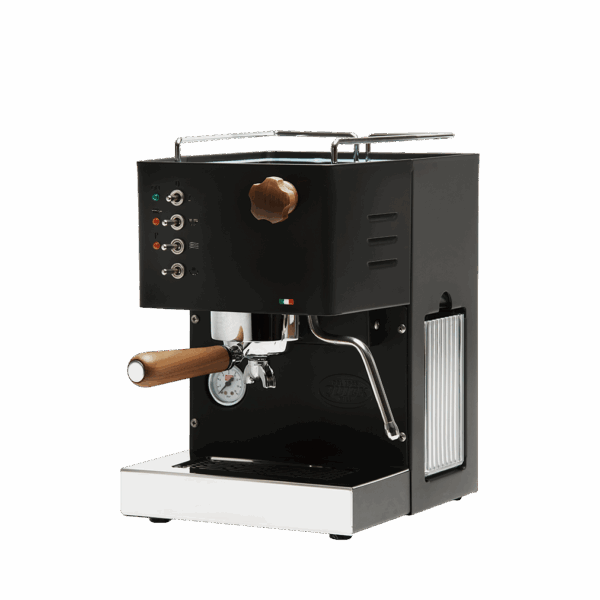
The Quick Mill Pippa 4100 is a reservoir-fed semi-automatic with one 0.45 L insulated brass boiler, separate coffee and steam thermostats plus safety reset thermostat, ring brew group, seller-listed 58 mm portafilter, vibration pump, front pressure gauge, lever switches, power and heating lights, external expansion-valve access, multidirectional anti-burn steam and hot-water wand and 1.8 L side-access tank. The Product schema and scores refer to the current Quick Mill Pippa platform in the North American 120 V configuration commonly sold as Pippa 4100, with Whole Latte Love SKU 29515 as the dated US market anchor. The global manufacturer page lists both 120 V and 200–240 V support and 1280 W, while North American sellers list 1000 W. Painted finishes, wood accents, gauge faces, accessory bundles, older production and owner modifications are not silently combined. That identity matters because two machines can promise the same drink while asking for completely different work before and after it. The useful first question is not whether Pippa 4100 can make coffee. It is whether its heating, preparation, milk, water, and cleaning sequence matches the way the household will actually use it. [source] [source] [source]
The strongest reason to choose it: Pippa packages a traditional brass-boiler, 58 mm manual workflow into a narrow stainless body with side tank access and straightforward controls. The main reason to pause: It omits PID control and uses one boiler for both coffee and steam, so repeatability and multi-drink pace depend on technique and patience. Those two statements explain the rating more accurately than a long feature list. A high score in one dimension does not erase a compromise elsewhere, and the overall rating should be read with the six category scores rather than alone.
03The first week
Set up the whole station, not only the machine
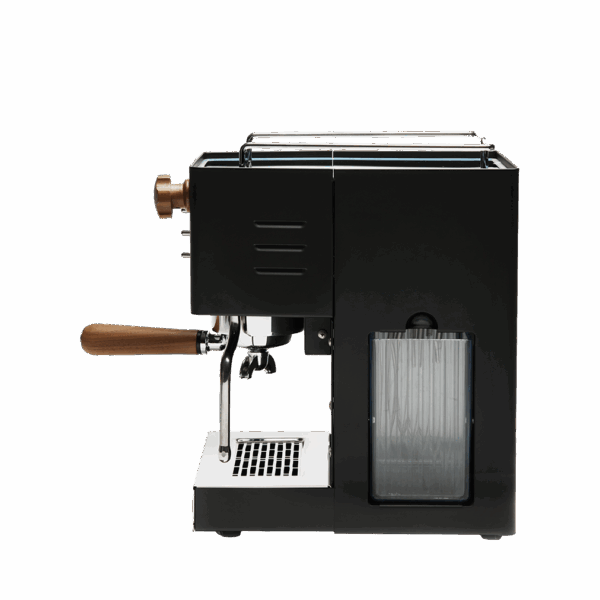
Confirm the exact Pippa identity, 120 V rating plate, plug, retailer authorization, finish, gauge scale and included baskets before first use. Inspect the side reservoir, tray, portafilter, group seal, switches, steam knob, wand and cord. Follow the delivered manual for filling and boiler priming; never energize a dry boiler. Allow the boiler, group, portafilter and cup to stabilize beyond the first heating light. A 246 mm body is narrow, but the 336 mm depth, 375 mm height, portafilter swing and side tank still need clearance. [source] [source]
04Rating deep dive
Espresso: control the variables the machine leaves to you
Pippa offers the familiar advantages of a 58 mm basket and manual shot control, but no temperature setpoint or shot timer. Homegrounds and iDrinkCoffee demonstrations treat it as a capable entry-level prosumer machine while emphasizing manual technique and the single-boiler limitation. Dose, distribution, tamp, grind, roast, water, basket and warm state still determine the cup. The front gauge is useful feedback only after its regional scale and purpose are confirmed; it does not measure beverage yield. Coffeedant did not taste coffee or measure temperature, pressure, flow, noise, heat-up or extraction. [source] [source]
Espresso assessment
Espresso evidence translated into daily use
The Pippa 4100 score is an editorial judgment from documented design, independent demonstrations, owner context, and the dated market position. It is not a bench result from Coffeedant.
| Signal | What the evidence says | Buying consequence |
|---|---|---|
| Brew architecture | 0.45 L insulated brass boiler. | A 0.45 L brass boiler, seller-listed 58 mm portafilter and manual pressure feedback form a capable traditional espresso base. |
| Control available | 58 mm seller-listed portafilter. | No PID means brew-temperature repeatability depends on warm-up, thermostat state and a consistent routine. |
| Recipe consequence | No user temperature setting. | Treat this as part of the Pippa 4100 buying decision, not a promise of identical results in every kitchen. |
Evidence note: Unknowns stay unknown. Variations in coffee, water, milk, setup, firmware, regional package, wear, and technique can change the experience described by these sources.
05Rating deep dive
Milk: speed only matters when texture stays controllable
The multidirectional anti-burn wand can texture milk after the boiler reaches steam temperature. Artisti demonstrates a full espresso-and-latte sequence, and iDrinkCoffee positions the machine for occasional milk drinks. Those demonstrations prove operation, not a universal steam time or texture result. One 0.45 L boiler means no simultaneous brewing and steaming, and consecutive cappuccinos require switching, waiting, purging and returning the boiler safely toward brew conditions. [source] [source]
Milk assessment
Milk evidence translated into daily use
The Pippa 4100 score is an editorial judgment from documented design, independent demonstrations, owner context, and the dated market position. It is not a bench result from Coffeedant.
| Signal | What the evidence says | Buying consequence |
|---|---|---|
| Steam or milk system | Manual steam and hot-water wand. | The anti-burn multidirectional wand can texture milk with conventional manual control. |
| Operator input | One boiler for brew and steam. | The single boiler makes every espresso-to-steam and steam-to-brew transition sequential. |
| Queue consequence | Best for one or two milk drinks. | Treat this as part of the Pippa 4100 buying decision, not a promise of identical results in every kitchen. |
Evidence note: Unknowns stay unknown. Variations in coffee, water, milk, setup, firmware, regional package, wear, and technique can change the experience described by these sources.
06Rating deep dive
Workflow: count every touch from cold start to a clean counter
A disciplined session starts with the tank filled, the boiler primed and the portafilter locked in while the machine stabilizes. Weigh and prepare the basket, observe the heating cycle, start and stop the brew switch manually, then judge the shot by time, mass and taste rather than gauge pressure alone. For milk, switch to steam, wait for readiness, purge condensation, texture a modest pitcher, wipe and purge immediately, then refill and cool the boiler according to the manual. There is no volumetric stop, grinder, programmable pre-infusion, PID display or app. [source] [source]
Workflow assessment
Workflow evidence translated into daily use
The Pippa 4100 score is an editorial judgment from documented design, independent demonstrations, owner context, and the dated market position. It is not a bench result from Coffeedant.
| Signal | What the evidence says | Buying consequence |
|---|---|---|
| Cold-start routine | Simple lever switches. | Lever switches and a side-access tank keep the physical workflow clear and cabinet friendly. |
| Drink sequence | Side-access 1.8 L tank. | Manual shot stopping, thermostat timing and boiler recovery require active attention. |
| Cleanup load | No timer or volumetric stop. | Treat this as part of the Pippa 4100 buying decision, not a promise of identical results in every kitchen. |
Evidence note: Unknowns stay unknown. Variations in coffee, water, milk, setup, firmware, regional package, wear, and technique can change the experience described by these sources.
07Rating deep dive
Build and service: judge access, support, and failure response
Quick Mill specifies full stainless bodywork, an insulated brass boiler, ring brew group, vibration pump, thermostat protection and a side-access reservoir. Current colored versions add painted panels and wood details, while seller descriptions of 304 stainless refer most clearly to the mirror-finish version. The external expansion valve is a service and adjustment feature, not an invitation to chase pressure without suitable tools and guidance. Internal parts still face heat, scale, seals and mains electricity, so service access does not equal maintenance-free ownership. [source] [source]
After each session, flush the group briefly, remove coffee from the basket and shower area, wipe and purge the wand, empty the tray and refresh the tank. Follow the delivered manual and qualified service guidance for backflushing, detergent and descaling; seller records say backflushing is supported, but chemistry and frequency must fit the actual machine and water. Test water rather than guessing. Changes in heat cycling, flow, pressure, leaks or steam deserve diagnosis. Boiler, thermostat, valve, pump and mains work belongs with a competent technician.
Build assessment
Build evidence translated into daily use
The Pippa 4100 score is an editorial judgment from documented design, independent demonstrations, owner context, and the dated market position. It is not a bench result from Coffeedant.
| Signal | What the evidence says | Buying consequence |
|---|---|---|
| Core construction | Full stainless body in mirror finish. | Stainless bodywork, brass boiler and conventional service parts are credible ownership strengths. |
| Access and care | Insulated brass boiler. | Scale, seals, thermostats and pump wear still depend on water, use and service quality. |
| Support boundary | Safety reset thermostat. | Treat this as part of the Pippa 4100 buying decision, not a promise of identical results in every kitchen. |
Evidence note: Unknowns stay unknown. Variations in coffee, water, milk, setup, firmware, regional package, wear, and technique can change the experience described by these sources.
08Rating deep dive
Features: separate daily help from brochure decoration
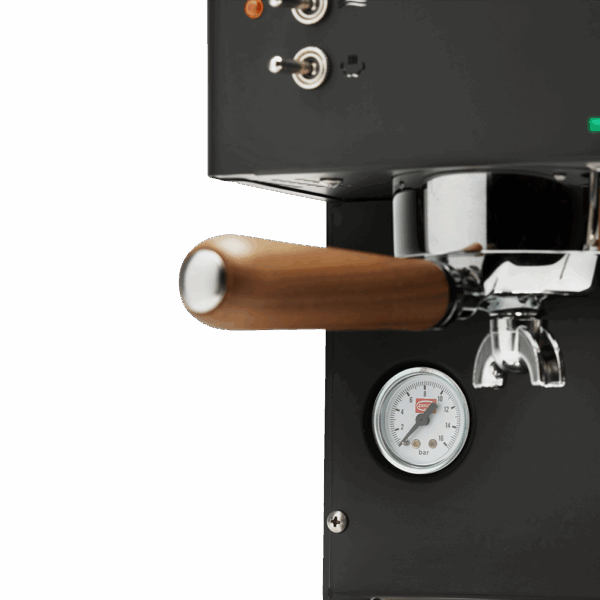
The useful equipment is intentionally analog: pressure gauge, lever switches, indicator lights, side tank, cup rail, manual steam/hot-water wand and external expansion-valve access. Quick Mill explicitly says there is no PID. The current official page does not document programmable pre-infusion, automatic dosing, shot timer, temperature display, direct plumbing, rotary pump, automatic milk, grinder or connectivity. Owner videos that adjust pressure or add controls describe modified units, not included capability. [source] [source]
Features assessment
Features evidence translated into daily use
The Pippa 4100 score is an editorial judgment from documented design, independent demonstrations, owner context, and the dated market position. It is not a bench result from Coffeedant.
| Signal | What the evidence says | Buying consequence |
|---|---|---|
| Useful control | Pressure gauge. | Gauge, expansion-valve access, 58 mm tools and a proper wand cover the useful manual essentials. |
| Missing control | External expansion-valve access. | PID, timer, dosing automation, plumbing and connectivity are absent. |
| Buyer relevance | No PID. | Treat this as part of the Pippa 4100 buying decision, not a promise of identical results in every kitchen. |
Evidence note: Unknowns stay unknown. Variations in coffee, water, milk, setup, firmware, regional package, wear, and technique can change the experience described by these sources.
09Rating deep dive
Value: compare complete ownership on the same date
At a US$999 sold-out reference, Pippa competes against PID-equipped single boilers and cheaper legacy platforms. Its value rests on compact Italian metalwork, side-access water, 58 mm tools and a pleasant manual interface, not a superior feature count. Compare Profitec GO when PID and a shot timer matter, Lelit Victoria for electronic assistance, Gaggia Classic Evo Pro for a larger parts and modification community, and Quick Mill Orione for lower-mass thermoblock simplicity. Add an espresso-capable grinder, scale, fitted tamper, water management and service to the real budget. [source] [source]
Value assessment
Value evidence translated into daily use
The Pippa 4100 score is an editorial judgment from documented design, independent demonstrations, owner context, and the dated market position. It is not a bench result from Coffeedant.
| Signal | What the evidence says | Buying consequence |
|---|---|---|
| Checked price | US$999 current reference. | The US$999 reference buys compact Italian construction and a satisfying tactile workflow. |
| Total station | Sold out when checked. | Sold-out status and PID rivals make local price, warranty and service decisive. |
| Long-term fit | Grinder and maintenance budget still required. | Treat this as part of the Pippa 4100 buying decision, not a promise of identical results in every kitchen. |
Evidence note: Unknowns stay unknown. Variations in coffee, water, milk, setup, firmware, regional package, wear, and technique can change the experience described by these sources.
10Put the alternatives beside it
Pippa 4100 versus the closest practical choices
A useful comparison keeps architecture and buyer intent visible. A cheaper product may demand more technique, a faster product may expose fewer controls, and a traditional product may ask for more warmup and care. The rows below summarize the decision rather than pretending every specification carries equal weight.
| Machine | Price position | The quick decision |
|---|---|---|
| Quick Mill Pippa 4100 | US$999 current sold-out reference | Choose compact styling and a traditional brass-boiler workflow when manual temperature timing is acceptable. |
| Profitec GO | Higher-feature compact single-boiler class | Choose PID temperature control and a shot timer for easier repeatability. |
| Lelit Victoria | Compact PID single-boiler class | Choose electronic assistance, PID and programmable functions in a compact stainless body. |
| Gaggia Classic Evo Pro | Entry manual single-boiler class | Choose a lower-cost traditional platform with a broad owner, parts and modification ecosystem. |
DetailsOpen the technical and workflow comparison
| Machine | Dimensions | Heating | Coffee setup | Milk workflow | Best fit |
|---|---|---|---|---|---|
| Quick Mill Pippa 4100 | 246 W × 336 D × 375 H mm | 0.45 L thermostat-controlled brass single boiler | 58 mm seller-listed portafilter and gauge | Sequential manual steam wand | Hands-on espresso with occasional milk |
| Profitec GO | Compact deep chassis | PID-controlled single boiler | 58 mm group with pressure adjustment | Sequential manual steam | Buyers prioritizing temperature control |
| Lelit Victoria | Narrow stainless chassis | PID single boiler | 58 mm group with electronic controls | Sequential manual steam | More guidance without moving to two boilers |
| Gaggia Classic Evo Pro | Compact traditional chassis | Single boiler | 58 mm commercial-style group | Sequential steam mode | Budget-conscious tinkerers |
Choose the temperature and milk workflow first. Pippa, GO, Victoria and Classic are all single boilers, but GO and Victoria add PID control, while Classic emphasizes a lower-cost, widely understood platform. Then compare actual voltage, stock, warranty, dimensions, water and local service rather than transferring one region’s package.
11Owner evidence in proportion
What owner discussions add, and what they cannot prove
Owner discussions consistently value the finish, narrow body, conventional accessories and strong results once grind and warm-up are managed. Recurring questions concern thermostat cycling, heat-up beyond the ready light, pressure adjustment, cooling the boiler after steam, accessory fit and whether a PID rival offers better value. Several owners report satisfying results, but self-selected posts cannot establish average temperature stability, failure rate or service life.
Community evidence spans different voltages, finishes, gauges, retailer packages, water conditions and owner adjustments. One thermostat fault thread is a repair example, not an incidence rate. A pressure-adjustment video shows access, not a safe universal setting. Match the rating plate, dial, manual and internal configuration before applying another owner’s recipe or diagnosis.
12Choose by routine
Four routes from this decision
There is no universal upgrade path. Choose the card that fixes the most important daily mismatch, then read the full review before treating it as a recommendation for your counter, coffee, region, and budget.
PID-focused alternative
Profitec GO
Choose explicit temperature control and a shot timer when repeatability matters more than Pippa styling and side-tank access.
Read Profitec GO reviewElectronic compact route
Lelit Victoria
Choose PID control and electronic assistance in another compact 58 mm single-boiler format.
Read Lelit Victoria reviewParts and mod ecosystem
Gaggia Classic Evo Pro
Choose a familiar lower-cost boiler platform when parts, accessories and community documentation matter most.
Read Gaggia Classic Evo Pro reviewSame-brand thermoblock
Quick Mill Orione 3000
Choose faster water heating and a lighter compact machine when occasional milk and thermostat technique remain acceptable.
Read Quick Mill Orione review13Questions before buying
Pippa 4100 FAQ
Does Quick Mill Pippa have a PID?
No. Quick Mill explicitly lists PID as absent. Separate coffee and steam thermostats control the single boiler.
What is the current Pippa price?
Whole Latte Love displayed US$999, reduced from US$1,095, on September 24, 2026, but marked the machine sold out. Regional stock and prices differ.
Can Pippa brew espresso and steam milk simultaneously?
No. One 0.45 L boiler serves both functions at different temperatures, so espresso and milk preparation are sequential.
How long does Pippa take to heat?
Retailers describe a sub-ten-minute boiler heat, but the group, portafilter and cup also need thermal preparation. Coffeedant does not claim one measured ready time.
What size is the current Pippa?
Quick Mill lists 246 mm wide, 336 mm deep, 375 mm high and 14 kg. Some North American listings publish rounded dimensions and lower weights.
Does Pippa use a 58 mm portafilter?
Current North American retailers list a 58 mm commercial-style portafilter. Confirm delivered baskets and tamper fit before buying accessories.
Can the brew pressure be adjusted?
Seller and owner evidence show external expansion-valve access, but adjustment should follow the exact manual or qualified service guidance. There is no safe universal setting.
What water should I use?
Use tested water that fits the delivered manual and qualified local service guidance. Avoid guessing: unsuitable water can create scale or corrosion risk.
See the machine in use
An independent video perspective
iDrinkCoffeeCanada
Quick Mill Pippa Review: Best Entry-Level Italian Espresso Machine?
Unique independent current-model video covering controls, espresso preparation, steaming, positioning and buyer fit. It is not Coffeedant testing, a current-price source or a universal performance measurement.
Watch on YouTubeWhy I trust the verdict
What the evidence lets me say with confidence
I began with the exact model identity and official documentation, then separated factory claims from independent observation and self-selected owner reports. Conflicting regional or revision details were not averaged. Price was checked on September 24, 2026; stock, finishes, tax and warranty can change. Video supplies visual context, not Coffeedant testing. Community material informs questions, never failure rates. Missing measurements and long-term incidence data remain unknown.
Check the evidence
Sources and further reading
- Quick Mill official current Pippa page
Current identity, no-PID status, boiler, group, pump, safety, controls, tank, dimensions, weight, power, voltage, finish and official media checked September 24, 2026.
- Homegrounds independent Pippa review
Independent review covering single-boiler workflow, 58 mm tools, PID and pre-infusion omissions, pressure-valve access, heat-up context and comparisons. Claims remain attributed.
- iDrinkCoffeeCanada independent Pippa review video
Unique video published January 28, 2025 covering current Pippa controls, espresso, steam, positioning and buyer fit. It is not Coffeedant testing.
- Whole Latte Love Pippa listing
US$999 sale price from US$1,095, sold-out status, SKU 29515, 120 V retail specifications, package, warranty and current availability checked September 24, 2026.
- iDrinkCoffee Pippa returned-unit listing
North American construction, 0.45 L boiler, ULKA pump, 1.8 L tank, thermostat and external valve cross-check. A returned unit is not normal new-stock price evidence.
- Artisti Coffee Roasters Pippa evaluation
Retailer-led unboxing, espresso and milk demonstration covering controls, accessories, wand and drink workflow. Taste impressions and package details remain attributed.
- Reddit first-month Pippa owner thread
Self-selected owner context on setup satisfaction, grinder pairing and early workflow. It provides no controlled performance or reliability denominator.
- Reddit Pippa review thread
Self-selected owner discussion used for recurring warm-up, espresso, steam and value questions. Experiences are not failure-rate data.
- Home-Barista Pippa thermostat repair thread
Single repair discussion used only to identify thermostat diagnosis questions and service boundaries; it does not establish incidence or a universal repair.
- Owner Pippa pressure-valve video
User-generated demonstration of external pressure-valve access. It does not establish a safe universal setting or stock measured pressure.
- Kitchen Barista 2026 Quick Mill comparison
Dated July 24, 2026 Canadian MSRP and feature comparison across Pippa and newer Quick Mill machines. Regional price and seller claims remain attributed.
- Quick Mill official Pop-Up page
Current same-brand comparison for a PID-equipped single boiler with newer control features. It does not change Pippa specifications.
- Profitec official GO page
Current PID single-boiler comparison used to separate Pippa styling and analog simplicity from temperature-controlled alternatives.
The buying decision
Choose Pippa for tactile simplicity, not hidden temperature automation
Pippa is a coherent manual machine: brass boiler, conventional 58 mm tools, side tank, pressure gauge, simple switches and a capable wand in a compact body.
Its omissions define the ownership experience. There is no PID or shot stop, one boiler handles coffee and steam, and regional specifications must be confirmed before purchase.
Buy only after confirming exact voltage, rating plate, gauge, stock, warranty and service. Choose GO or Victoria for temperature control, Classic for a lower-cost ecosystem, or Orione for a lighter thermoblock route.
Check US price and availability