
02Start with the decision
GO original generation in one honest frame
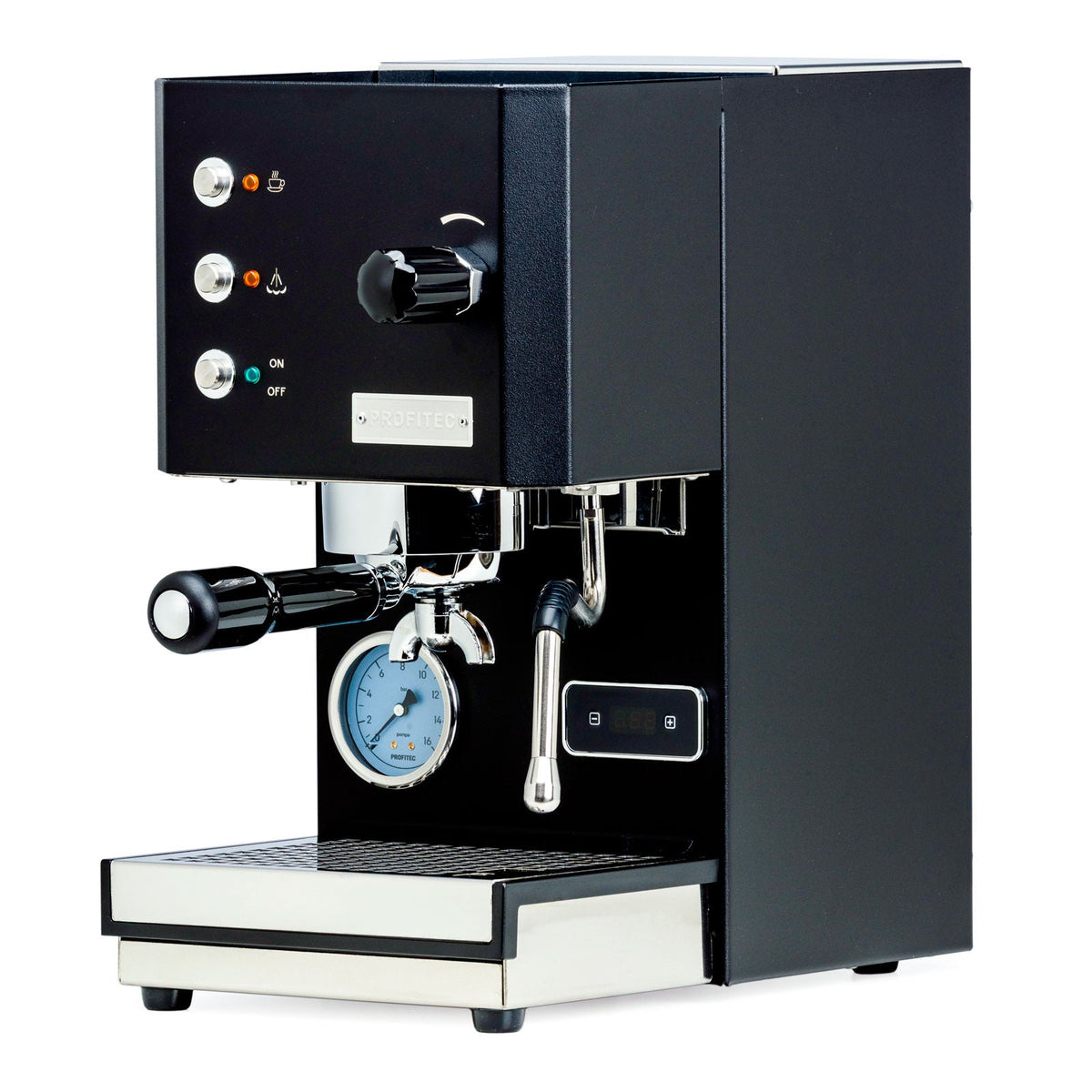
The Profitec GO original generation is a reservoir-fed, vibration-pump, PID-controlled single-boiler machine with a compact heated ring group, 58 mm commercial-format portafilter, three-way solenoid, front brew-pressure gauge, automatic shot timer, articulated steam wand and externally reachable expansion-valve adjustment. The Product schema, scores and $1,199 benchmark refer to the original-generation US GO still listed by Clive Coffee and Whole Latte Love. GO 2.0’s OLED display, programmable pre-infusion, timed dosing, cleaning program, last-shot recall, automatic post-steam cooling and revised controls are excluded. The red original GO also differs from other colors in the 2025 US running update. That identity matters because two machines can promise the same drink while asking for completely different work before and after it. The useful first question is not whether GO original generation can make coffee. It is whether its heating, preparation, milk, water, and cleaning sequence matches the way the household will actually use it. [source] [source] [source]
The strongest reason to choose it: It combines the controls most espresso-focused buyers otherwise add later: PID temperature, shot time, pressure feedback and accessible OPV adjustment. The main reason to pause: One boiler cannot brew and steam together, and the new GO 2.0 makes an unlabeled generation comparison unreliable. Those two statements explain the rating more accurately than a long feature list. A high score in one dimension does not erase a compromise elsewhere, and the overall rating should be read with the six category scores rather than alone.
03The first week
Set up the whole station, not only the machine
Confirm the box, rating plate and retailer invoice identify the original US GO and 115 V service. Ask whether the selected color has the 2025 tray and reservoir-lid update, then inventory the portafilters, baskets, blind basket, brush and manual. Leave top room to remove the reservoir, rear room for the cord, front room for the portafilter and tray, and side room to articulate the steam wand. Use water inside the retailer or manufacturer specification, rinse as the manual directs, install the portafilter during heat-up and follow the displayed flush request before the first recipe. Do not copy GO 2.0 menu instructions. [source] [source]

04Rating deep dive
Espresso: control the variables the machine leaves to you
The original GO combines a PID, 58 mm group, pressure gauge, shot timer and externally accessible OPV. That supports a disciplined recipe built around coffee dose, beverage mass, time, temperature and pressure ceiling. Coffee Kev reported strong original-GO espresso control and noted that the display offset affects how set temperature relates to group behavior. Those are attributed observations, not Coffeedant measurements. The gauge is pump-pressure feedback, not a measurement inside the coffee puck, and a pressure target cannot repair uneven distribution or an unsuitable grind. [source] [source]
Espresso assessment
Espresso evidence translated into daily use
The GO original generation score is an editorial judgment from documented design, independent demonstrations, owner context, and the dated market position. It is not a bench result from Coffeedant.
| Signal | What the evidence says | Buying consequence |
|---|---|---|
| Brew architecture | PID sets brew temperature. | PID temperature, a shot timer, pressure feedback and an accessible OPV support a clear 58 mm espresso recipe. |
| Control available | Display times pump-on duration. | No automatic pre-infusion or volumetric stop, and the gauge does not measure pressure inside the puck. |
| Recipe consequence | Scale and suitable grinder remain essential. | Treat this as part of the GO original generation buying decision, not a promise of identical results in every kitchen. |
Evidence note: Unknowns stay unknown. Variations in coffee, water, milk, setup, firmware, regional package, wear, and technique can change the experience described by these sources.
05Rating deep dive
Milk: speed only matters when texture stays controllable
Pressing steam mode raises the same boiler used for brewing, so milk service is sequential. The articulated wand and two-hole tip can texture a small pitcher, but the routine includes purging water, waiting for steam temperature, steaming, wiping and purging the wand, then cooling the boiler through a flush before another espresso. Owner discussions split between satisfactory daily cappuccinos and frustration with power, wand angle or back-to-back pitchers. Skill, milk volume, steam setpoint and version details matter, so no universal steam time is claimed. [source] [source]
Milk assessment
Milk evidence translated into daily use
The GO original generation score is an editorial judgment from documented design, independent demonstrations, owner context, and the dated market position. It is not a bench result from Coffeedant.
| Signal | What the evidence says | Buying consequence |
|---|---|---|
| Steam or milk system | One boiler handles brew and steam. | Adjustable steam temperature and an articulated wand can handle one small milk drink with manual texture control. |
| Operator input | Purge before and after texturing. | The boiler must change modes and cool again, making repeated milk service slow and technique-sensitive. |
| Queue consequence | Cool through the documented refill and flush routine. | Treat this as part of the GO original generation buying decision, not a promise of identical results in every kitchen. |
Evidence note: Unknowns stay unknown. Variations in coffee, water, milk, setup, firmware, regional package, wear, and technique can change the experience described by these sources.
06Rating deep dive
Workflow: count every touch from cold start to a clean counter
The original GO’s front controls are deliberately direct: power, brew, steam, a PID display and two setting keys. Fast Heat Up deliberately overshoots and requests a flush to warm the group and portafilter; this is a sequence, not proof that every component has stabilized at the first ready signal. The timer starts with pump activation, while a scale remains necessary for beverage mass. The top-fill reservoir, removable tray and compact width suit a small station, but overhead access and limited cup clearance belong in the fit check. [source] [source]
Workflow assessment
Workflow evidence translated into daily use
The GO original generation score is an editorial judgment from documented design, independent demonstrations, owner context, and the dated market position. It is not a bench result from Coffeedant.
| Signal | What the evidence says | Buying consequence |
|---|---|---|
| Cold-start routine | 210 mm cabinet width. | Fast Heat Up, direct buttons, shot timing and visible pressure keep an espresso-first morning concise. |
| Drink sequence | Top reservoir needs clearance. | Flush prompts, top filling, a separate scale and brew-to-steam transitions remain part of the routine. |
| Cleanup load | Timer does not stop the shot. | Treat this as part of the GO original generation buying decision, not a promise of identical results in every kitchen. |
Evidence note: Unknowns stay unknown. Variations in coffee, water, milk, setup, firmware, regional package, wear, and technique can change the experience described by these sources.
07Rating deep dive
Build and service: judge access, support, and failure response
The machine weighs about 12.9 kg and uses a steel cabinet around a brass boiler, ring group, copper and stainless plumbing, vibration pump and replaceable conventional components. The parts diagram is useful repair evidence but does not guarantee local stock or inexpensive labor. US retailer specifications conflict over 0.3 versus 0.4 L boiler volume, 2.8 versus 3.0 L tank and 900 versus 1200 W. The review retains the manufacturer’s 115 V/900 W record and labels the capacity conflict rather than inventing a merged specification. [source] [source]
Purge and wipe the steam wand immediately after milk. Empty the drip tray before it reaches the internal relief outlet, rinse the reservoir, backflush with water routinely and use detergent only at the documented interval. Keep the group gasket, screen, baskets and portafilter clean. Use scale-safe water rather than routine acid descaling without exact guidance. Disconnect power before service, and use a qualified technician for electrical faults, leaks, failed heating, abnormal pump behavior or safety-valve problems.
Build assessment
Build evidence translated into daily use
The GO original generation score is an editorial judgment from documented design, independent demonstrations, owner context, and the dated market position. It is not a bench result from Coffeedant.
| Signal | What the evidence says | Buying consequence |
|---|---|---|
| Core construction | About 12.9 kg. | A heavy steel cabinet, brass boiler and published parts diagram support conventional inspection and repair. |
| Access and care | Three-way solenoid and vibration pump. | Parts documentation does not establish failure incidence, local stock, labor price or remaining life. |
| Support boundary | 2025 tray and lid vary by color and stock. | Treat this as part of the GO original generation buying decision, not a promise of identical results in every kitchen. |
Evidence note: Unknowns stay unknown. Variations in coffee, water, milk, setup, firmware, regional package, wear, and technique can change the experience described by these sources.

08Rating deep dive
Features: separate daily help from brochure decoration
The useful original-GO set is PID brew and steam temperature control, automatic shot timer, Fast Heat Up, pressure gauge, accessible OPV, ECO mode, cleaning reminder, 58 mm portafilter, three-way solenoid and manual steam. It does not provide programmable pre-infusion, time-dosed auto stop, OLED menus, last-shot recall, automatic boiler cooling, a dedicated hot-water wand or simultaneous milk service. Those missing functions define the GO 2.0 and higher-category comparisons. [source] [source]
Features assessment
Features evidence translated into daily use
The GO original generation score is an editorial judgment from documented design, independent demonstrations, owner context, and the dated market position. It is not a bench result from Coffeedant.
| Signal | What the evidence says | Buying consequence |
|---|---|---|
| Useful control | PID and shot timer. | The original GO includes the espresso controls that matter most without requiring aftermarket modification. |
| Missing control | Gauge and accessible OPV. | GO 2.0 adds pre-infusion, dosing and automation that this scored generation lacks. |
| Buyer relevance | No dedicated hot-water outlet. | Treat this as part of the GO original generation buying decision, not a promise of identical results in every kitchen. |
Evidence note: Unknowns stay unknown. Variations in coffee, water, milk, setup, firmware, regional package, wear, and technique can change the experience described by these sources.
09Rating deep dive
Value: compare complete ownership on the same date
Clive Coffee displayed the original GO at $1,199 in black, red, blue and yellow with Add to Cart on September 24, 2026. Whole Latte Love also displayed $1,199 and three-year parts-and-labor coverage, with a note that black now ships with the updated tray and that non-red colors receive the 2025 update. The price buys factory controls and conventional service access, but it also approaches the cost of machines with automatic pre-infusion or faster milk workflows. Compare total grinder, water, scale, pitcher and care costs, not the machine alone. [source] [source]
Value assessment
Value evidence translated into daily use
The GO original generation score is an editorial judgment from documented design, independent demonstrations, owner context, and the dated market position. It is not a bench result from Coffeedant.
| Signal | What the evidence says | Buying consequence |
|---|---|---|
| Checked price | Clive displayed Add to Cart at $1,199. | $1,199 buys a compact factory-controlled 58 mm platform with current US dealer support. |
| Total station | Whole Latte Love displayed $1,199 and three-year coverage. | The same budget deserves comparison against automatic pre-infusion, dual-thermoblock and used dual-boiler options. |
| Long-term fit | Generation and color must be confirmed. | Treat this as part of the GO original generation buying decision, not a promise of identical results in every kitchen. |
Evidence note: Unknowns stay unknown. Variations in coffee, water, milk, setup, firmware, regional package, wear, and technique can change the experience described by these sources.
10Put the alternatives beside it
GO original generation versus the closest practical choices
A useful comparison keeps architecture and buyer intent visible. A cheaper product may demand more technique, a faster product may expose fewer controls, and a traditional product may ask for more warmup and care. The rows below summarize the decision rather than pretending every specification carries equal weight.
| Machine | Price position | The quick decision |
|---|---|---|
| Profitec GO original | $1,199 checked Sep 24 | Choose direct PID, shot timing and pressure adjustment for an espresso-first routine. |
| Lelit Victoria PL91T | Similar premium single-boiler class | Compare programmable pre-infusion and LELIT58 controls in another compact single boiler. |
| Rancilio Silvia | Lower base machine price | Choose the long service history and simpler thermostat design when factory PID control is not essential. |
| Gaggia Classic Evo Pro | Lower entry traditional class | Spend less for a compact 58 mm platform if you accept fewer factory controls and exact-generation checks. |
DetailsOpen the technical and workflow comparison
| Machine | Dimensions | Heating | Coffee setup | Milk workflow | Best fit |
|---|---|---|---|---|---|
| Profitec GO original | 8.3 W × 14.3 D × 15.0 H in without portafilter | PID brass single boiler | 58 mm group, gauge, timer and OPV | Sequential manual steam | Compact controlled espresso |
| Lelit Victoria PL91T | Compact stainless single boiler | PID brass single boiler | 58 mm group with LCC controls | Sequential manual steam | Pre-infusion and menu control |
| Rancilio Silvia | Compact traditional single boiler | Thermostat single boiler | 58 mm group, no factory PID | Sequential manual steam | Established service ecosystem |
| Gaggia Classic Evo Pro | Compact box-style body | Thermostat single boiler | 58 mm group, no factory PID | Sequential manual steam | Budget and modification paths |
Compare exact generation, voltage, color, running changes, warranty and stock. The original GO and GO 2.0 share a name but not a control set, while US retailer specification cells conflict on boiler size, tank size and wattage.
11Owner evidence in proportion
What owner discussions add, and what they cannot prove
Longer-term owner threads repeatedly praise espresso control, compact weight, fast practical readiness and access to replaceable parts. Repeated cautions concern the single-boiler delay, steam technique, cup clearance, reservoir or tray rattle, display buttons and version-specific parts. These patterns help form an inspection and workflow checklist. They cannot establish a defect rate, prove service life or predict what another owner will taste.
Retail reviews and forum threads are self-selected. They mix original production, 2025 running changes, colors, countries, grinders, water, recipes and user experience. A two-year report can reveal a concrete owner experience but not population reliability. Diagnoses are rarely technician-confirmed, and praise from a retailer page has a commercial context.
12Choose by routine
Four routes from this decision
There is no universal upgrade path. Choose the card that fixes the most important daily mismatch, then read the full review before treating it as a recommendation for your counter, coffee, region, and budget.
Programmable pre-infusion
Lelit Victoria
Compare another compact PID single boiler when automatic pre-infusion and menu controls matter.
Read Lelit Victoria reviewLong service history
Rancilio Silvia
Choose a simpler established platform when factory PID and pressure feedback are optional.
Read Rancilio Silvia reviewLower-cost 58 mm route
Gaggia Classic Evo Pro
Spend less if you accept fewer factory controls and a more version-sensitive buying process.
Read Gaggia Classic Evo Pro reviewCategory checklist
Best single-boiler machines
Compare warm-up, temperature control, steam transitions, service access and grinder budget.
Read single-boiler guide13Questions before buying
GO original generation FAQ
Is this review about Profitec GO 2.0?
No. It scores the original GO still sold by current US specialists. GO 2.0 arrived in Europe in June 2026 and adds a different display and automation.
How fast does the original Profitec GO heat up?
Fast Heat Up deliberately overshoots and requests a cooling flush. US retailers describe roughly six to nine minutes for that ready sequence, but Clive also lists 15 minutes as warm-up. Treat the prompt as a workflow aid, not a Coffeedant measurement of full thermal equilibrium.
Does Profitec GO have pre-infusion?
The original generation has no programmable automatic pre-infusion. GO 2.0 adds programmable pre-infusion, so confirm the generation before relying on that feature.
Can Profitec GO steam milk well?
It can manually texture one small pitcher after changing to steam mode. Results depend on purge, steam temperature, milk volume and technique, and repeated drinks remain slower than on a dual boiler.
Can Profitec GO brew and steam simultaneously?
No. Its single boiler changes between brew and steam temperature, then needs a cooling and refill routine before espresso resumes.
Does Profitec GO include a grinder?
No. Budget for an espresso-capable burr grinder, scale, suitable water, milk pitcher if needed and cleaning supplies.
Is the 2025 updated drip tray on every Profitec GO?
Whole Latte Love says the update applies to non-red colors and specifically excludes red in its checked listing. Older inventory and photos may also show the previous design, so ask the seller.
What should I verify before buying?
Confirm original GO versus GO 2.0, 115 V rating plate, color-specific updates, included portafilters and baskets, warranty, return terms, seller authorization and current stock.
See the machine in use
An independent video perspective
Coffee Kev
Profitec Go Review 2025 + Pro Barista Coffee Making Demo
Independent hands-on video of the original Profitec GO, including espresso preparation, PID workflow and milk steaming. Coffee Kev uses affiliate links and sells coffee, so commercial interests are explicit; the video does not establish reliability or another unit’s performance.
Watch on YouTubeWhy I trust the verdict
What the evidence lets me say with confidence
I began with the exact model identity and official documentation, then separated factory claims from independent observation and self-selected owner reports. Conflicting regional or revision details were not averaged. Price was checked on September 24, 2026; stock, finishes, tax and warranty can change. Video supplies visual context, not Coffeedant testing. Community material informs questions, never failure rates. Missing measurements and long-term incidence data remain unknown.
Check the evidence
Sources and further reading
- Profitec GO product record
Manufacturer dimensions, weight, US 115 V/900 W record and official downloads. The live line has transitioned toward GO 2.0, so original-only claims are cross-checked against the manual and US listings.
- Profitec current home and GO 2.0 boundary
Manufacturer’s current promotion of GO 2.0, used to prevent successor features from being assigned to the original US GO.
- Profitec authorized dealer locator
Official statement that Profitec products are sold through its dealer network; useful for seller verification rather than performance.
- Original Profitec GO user manual
Specialist-hosted manufacturer manual for setup, PID menus, Fast Heat Up, ECO, cleaning, safety and original-generation operation.
- Original Profitec GO parts diagram
Nine-page exact-model exploded parts record for service planning; not evidence of stock, price or reliability.
- Clive Coffee current original GO listing
US $1,199 Add to Cart, current colors, 0.3 L boiler record, setup resources, returns and product media checked September 24, 2026.
- Whole Latte Love current original GO listing
US $1,199 display, three-year warranty, 2025 tray and lid update with red exception, and exact-model media checked September 24, 2026. Its 0.4 L and 1200 W cells conflict with other records.
- Coffee Kev original Profitec GO review
Hands-on review and workflow discussion published in 2026, including the 0.3 L boiler dispute, PID offset, steaming and original-generation limitations.
- CoffeeGeek Profitec GO first look
Independent February 19, 2025 inspection and category comparison; treated as one sample, not a reliability study.
- Kaffeemacher purchased GO 2.0 test
Independent June 2026 successor test used only to identify GO 2.0 changes and market timing; its measured results are not transferred to the original GO.
- Two-year Profitec GO owner discussion
Self-selected reports about PID control, build, steam limits, buttons and repair access. Useful questions, not defect incidence.
- Profitec GO fit and milk-workflow discussion
Self-selected owner experiences about cappuccinos, back-to-back use, wand technique and overheating caution. It cannot establish frequency or diagnosis.
- Coffee Kev original Profitec GO video
Unique hands-on video published September 28, 2025, showing espresso preparation, original controls and milk workflow. Affiliate and coffee-sales interests are disclosed.
The buying decision
Buy the original GO for its control set, not because the GO 2.0 name is nearby
The original Profitec GO remains a coherent espresso-first machine. PID temperature, shot timing, pressure feedback and accessible OPV adjustment arrive in a compact 58 mm platform without requiring modifications.
The single boiler is the real limit: milk service is sequential, cooling back matters and several drinks expose the wait. Versioning now adds another task because 2025 color updates and the 2026 GO 2.0 do not apply uniformly to US stock.
Choose it when the exact original US unit, warranty and $1,199 package are verified and most drinks are espresso. Choose Victoria for programmed pre-infusion, Silvia for a simpler established platform, or Gaggia for a lower entry price.
Check the current US GO offer