
01Start with the routine
Choose the control system and milk pace before choosing the finish
Profitec
GO original generation
A compact espresso-first machine whose controls still work, but whose generation now needs checking
Read the review →A single-boiler machine uses one heated vessel for brew water and steam. That architecture is compact and understandable, but it cannot hold brew and steam conditions at the same time. The buying decision is therefore not whether the machine can texture milk. It is how often the owner will change modes, how clearly the machine communicates the change, and whether the pause still fits the household routine.
Choose a factory PID when repeatable setpoint adjustment matters. Choose a thermostat machine when a lower entry price, familiar service path or manual temperature routine is acceptable. A pressure gauge helps diagnose pump resistance but does not measure extraction quality. A shot timer helps repeat a recipe but does not correct grind size or puck preparation. Treat each control as one part of a measured workflow.
For straight espresso, all four shortlisted machines can support a disciplined recipe when paired with an espresso-capable grinder. For milk, count drinks rather than reading boiler wattage as a ranking. One cappuccino is a different task from four flat whites. If several milk drinks are normal, a heat-exchanger or dual-boiler design may be a better use of the complete budget.
02Quick comparison
Four single boilers with four different control packages
| Machine | Complete setup | Milk | Best fit | |
|---|---|---|---|---|
| GO original generationCurrent US original GO, 115 V retailer stock; excludes GO 2.0 | Current specialist price $1,199 PID single-boiler espresso machine | No. One brass boiler handles both jobs sequentially, so the machine must heat for steam and then cool back to brew temperature. | Best fit: Espresso-first buyers who want PID temperature control and visible pressure without modifying a machine | Review → |
| Classic Pro E24Current North American Classic Pro E24, 110-120V | $549.00 Single-boiler semi-automatic espresso machine | No. The single dual-use boiler changes temperature between brewing and steaming. | Best fit: A compact, repairable brass-boiler 58 mm platform that preserves grinder budget | Review → |
| Silvia V6Silvia | $995.00 Semi-automatic espresso machine, single boiler | Possible, but the brew-to-steam-to-refill sequence makes the second drink the key trial. | Best fit: Hands-on owner who enjoys a repeatable temperature routine | Review → |
| Classika PIDCLASSIKA-PID | $1,649.00 E61 single-boiler espresso machine | No. Its single boiler changes from brew temperature to steam temperature and back. | Best fit: Straight-espresso drinker wanting E61 ritual with digital temperature control | Review → |
Open the detailed comparison
| Machine | Grinder | Maintenance | Avoid if | Decision |
|---|---|---|---|---|
| GO original generation | A separate espresso-capable grinder is required unless the reviewed machine is an integrated automatic. | About 2.8 L removable reservoir; manufacturer dimensions 210 × 362 × 381 mm without portafilter and 210 × 410 × 381 mm with it | Avoid if: You make several milk drinks back to back or require simultaneous brewing and steaming | Buy the original US Profitec GO when a 58 mm group, front PID with shot timer, visible brew pressure and top-access OPV matter more than simultaneous brewing and steaming. Clive Coffee displayed the black, blue, red and yellow original GO at $1,199 with Add to Cart on September 24, 2026. Profitec launched GO 2.0 in Europe in June 2026, so confirm the generation, color-specific 2025 updates, voltage, included portafilters and warranty before comparing prices. |
| Classic Pro E24 | A separate espresso-capable grinder is required unless the reviewed machine is an integrated automatic. | Routine cleaning is owner work; boiler, pressure, mains-voltage and internal-water repairs need qualified diagnosis | Avoid if: No PID, shot timer or simultaneous steam, so consistency depends on routine and grinder quality | Choose the Classic Pro E24 for a compact, repairable brass-boiler 58 mm platform that preserves grinder budget. Skip it when no pid, shot timer or simultaneous steam, so consistency depends on routine and grinder quality conflicts with the normal drink routine. |
| Silvia V6 | A separate espresso-capable grinder is required unless the reviewed machine is an integrated automatic. | 2 L removable reservoir | Avoid if: You expect a numeric brew-temperature setting | The Silvia is still a convincing, serviceable single boiler for someone who wants to learn its thermostat rhythm. At the $995 US price checked September 15, 2026, a buyer who really wants factory temperature control should compare the Profitec GO before planning a day-one PID modification. |
| Classika PID | A separate espresso-capable grinder is required unless the reviewed machine is an integrated automatic. | About 2.8 L | Avoid if: Two or more milk drinks are a routine order | Choose Classika PID when straight espresso, E61 temperature control, a shot timer, and the option to add manual flow control matter more than fast milk service. Skip it when you need simultaneous brewing and steaming or assume every seller includes the flow-profile valve. |
Prices were checked September 25, 2026. Tax, color, stock, seller, bundles and promotions can change. Compare the complete station, not the machine-only number.
03Scope and evidence
How the shortlist was chosen and what was left out
Inclusion criteria: each machine had to be a current, clearly identified single-boiler model with a permanent Coffeedant review, official documentation, independent context, a manual steam path and enough owner evidence to explain recurring questions without inventing reliability rates. The shortlist also had to represent meaningfully different decisions.
Exclusion criteria: dual boilers, heat exchangers, thermoblock-only appliances, discontinued models with unclear support and machines whose exact regional identity could not be verified were left out. A machine was not promoted because it was heavy, polished or described as commercial. Those traits do not establish temperature stability, cup quality or service access.
Drink queue
Count the actual drinks and whether milk follows every shot.
Task ownership
Name who dials in, steams, cleans and responds to prompts.
Complete budget
Include grinder, scale, water and care from the first day.
Upgrade path
Decide whether components should improve independently.
04Exact models and costs
Compare the delivered system, not a family name
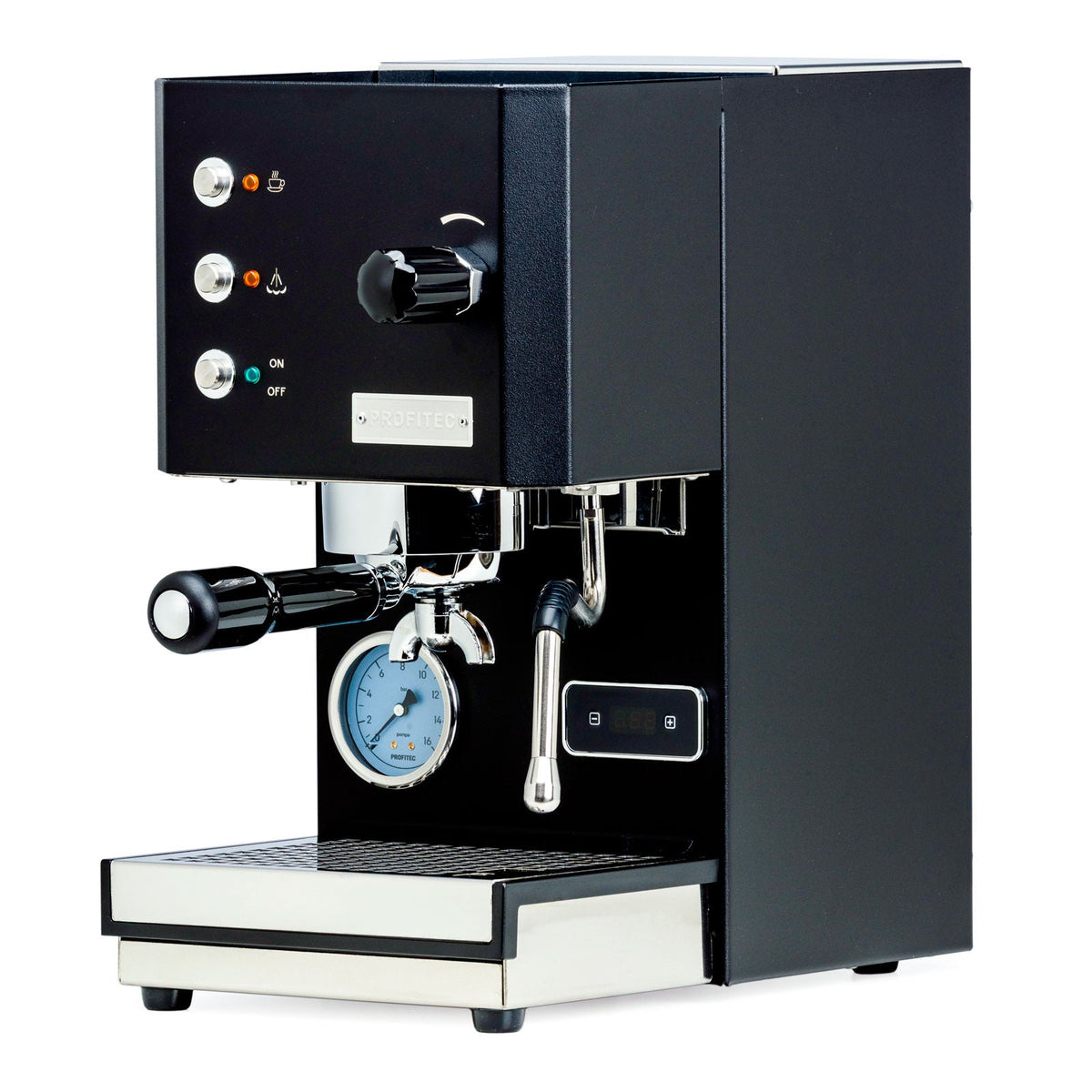
Profitec GO original generation
Current US original-generation price checked: Current specialist price $1,199. Clive Coffee displayed the original GO at $1,199 with Add to Cart on September 24, 2026. Whole Latte Love also displayed $1,199 with a three-year parts-and-labor warranty, but stock and color selection can vary. GO 2.0 European prices are not treated as US original-GO prices. Price context checked September 24, 2026.
- Scored generation
- Original GO sold by current US specialists, not the GO 2.0 introduced in Europe in June 2026
- Brew system
- PID-controlled brass single boiler, 58 mm ring group, vibration pump, three-way solenoid and automatic shot timer
- Pressure control
- Front brew-pressure gauge and externally accessible OPV below the cup tray; adjust only with a suitable blind basket and documented procedure
- Water and fit
- About 2.8 L removable reservoir; manufacturer dimensions 210 × 362 × 381 mm without portafilter and 210 × 410 × 381 mm with it
- Electrical record
- Official product record lists the US version at 115 V and 900 W; verify the rating plate because regional listings and retailer wattage cells conflict
Gaggia Classic Pro E24
Gaggia North America direct price: $549.00. Current new North American E24 listing; color, tax, stock and warranty vary Price context checked September 23, 2026.
- Exact identity
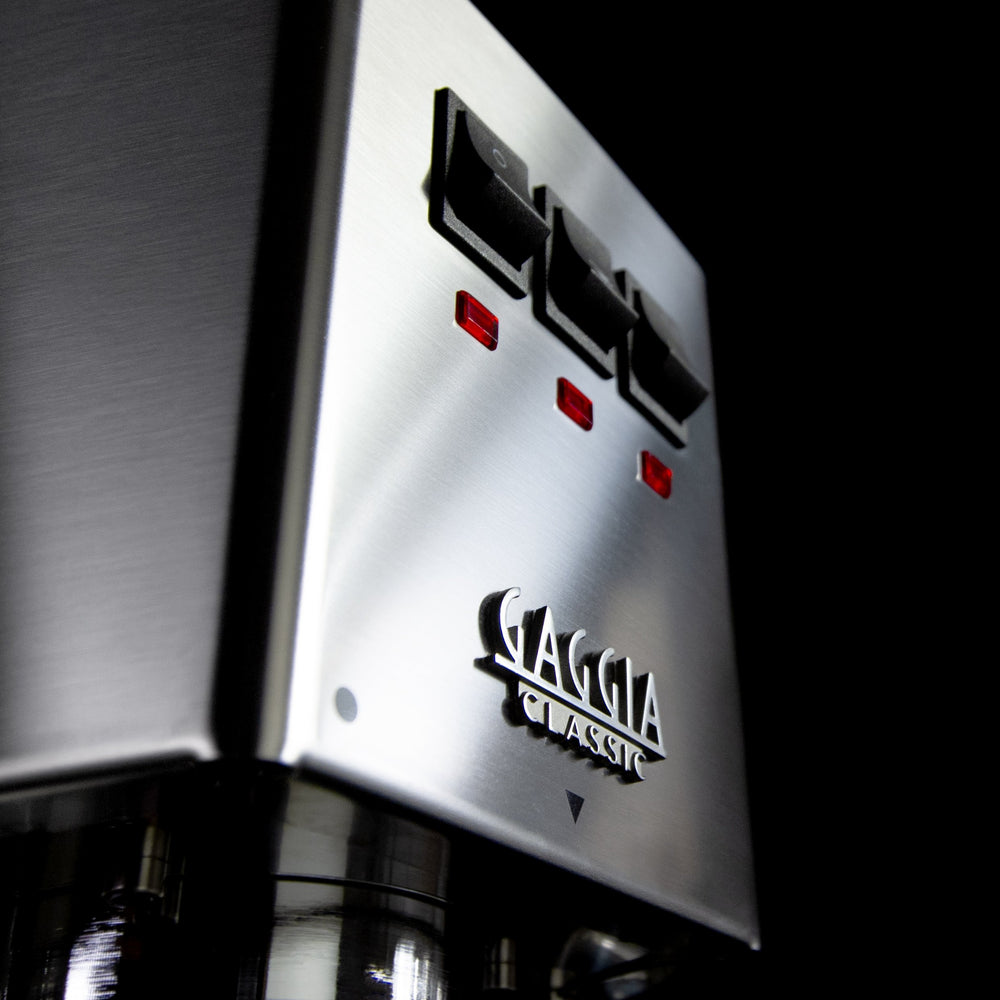
- Current North American Classic Pro E24 with lead-free brass 3.5 oz boiler, 58 mm stainless portafilter, nine-bar OPV calibration and 110-120V power. This is not the coated-boiler 2023 Evo.
- Heating
- Single 3.5 oz lead-free brass dual-use boiler with embedded heater and thermostat control
- Brew path
- 58 mm group and portafilter, nine-bar OPV calibration and three-way solenoid without a factory PID
- Milk system
- Commercial-style rotating stainless wand with insulated grip and two-hole tip; brew and steam happen in sequence
- Controls
- Three mechanical rocker switches and indicator lights; shot timing and temperature routine remain manual
Rancilio Silvia V6
Checked US retailer price: $995.00. New machine; refurbished listing separately showed $895 Price context checked September 15, 2026.
- Heating
- 0.3 L single coffee/steam boiler
- Group
- Commercial-style brass group, 58 mm portafilter
- Water
- 2 L removable reservoir
- Controls
- Four manual rocker switches; steam knob
- Size
- Approx. 235 W × 340 H × 290 D mm
ECM Classika PID
Observed US specialist price: $1,649.00. Flow-control package, finish, freight, tax and warranty vary Price context checked September 18, 2026.
- Heating
- 0.75 L stainless-steel single boiler
- Group
- ECM E61-style brew group
- Temperature control
- PID with shot-counter display
- Warmup feature
- Fast Heat-Up mode; official figure about 11 minutes
- Pump
- Low-noise vibration pump
05Drink workflow
Milk and espresso pace reveal the real architecture
Profitec GO original generation
Pressing steam mode raises the same boiler used for brewing, so milk service is sequential. The articulated wand and two-hole tip can texture a small pitcher, but the routine includes purging water, waiting for steam temperature, steaming, wiping and purging the wand, then cooling the boiler through a flush before another espresso. Owner discussions split between satisfactory daily cappuccinos and frustration with power, wand angle or back-to-back pitchers. Skill, milk volume, steam setpoint and version details matter, so no universal steam time is claimed. [source] [source]
Gaggia Classic Pro E24
Commercial-style rotating stainless wand with insulated grip and two-hole tip; brew and steam happen in sequence Purge condensate, introduce air early, establish circulation, stop before overheating, then wipe and purge immediately. [source] [source] [source] [source] Milk performance is a combination of heat delivery, air control, circulation, recovery, cleaning, and operator attention. A fast system can frustrate a beginner if it gives little time to correct position, while a slower system can frustrate a household making several drinks.
Use cold milk, a consistent quantity, and the recommended vessel or container. With a manual wand, purge condensate, add a controlled amount of air near the beginning, then position for circulation and stop before overheating. With an automatic milk path, start from a conservative documented setting, keep the sensor or hose arrangement consistent, and change temperature or texture one step at a time. Alternative milks differ by formulation, not only plant type.
The cleaning step belongs in the milk rating. Wipe and purge a wand immediately. Rinse or refrigerate a removable container as directed. Complete any prompted milk-path rinse instead of postponing it. Dried milk can narrow openings, change texture, create odors, and turn a convenient system into a recurring maintenance problem.
Rancilio Silvia V6
Switching to steam raises the same small boiler from brewing duty to steam duty. Reviewers generally find useful steam authority for home drinks, but the system must heat up, the wand must be purged, and the boiler must be refilled after steaming. Whole Latte Love’s commercial review and Coffee Chronicler’s independent account frame the wait differently; both still describe a sequential workflow. [source] [source]
For one cappuccino, sequence can be simple: pull espresso, switch to steam, wait for readiness, purge condensate, texture milk, wipe and purge the wand, switch steam off, then run water until the boiler is safely refilled. For a second milk drink, the time and temperature transitions compound. The Silvia is not a small café production machine merely because its wand looks commercial.
Beginners should start with cold milk at a repeatable level in the same pitcher. Introduce air briefly near the beginning, then keep the tip positioned to roll the milk until the pitcher becomes appropriately hot. Plant drinks vary in formulation, so the same sound and timing may not repeat. Nothing in this research supports a precise steaming time for every pitcher, and this review does not pretend otherwise.
If the household makes two flat whites every morning, place the price difference to the Silvia Pro X beside the value of hundreds of boiler transitions per year. If milk is occasional, the V6’s simpler architecture may be the more honest purchase.
ECM Classika PID
Steam comes from the same 0.75 L boiler used for brewing. It can texture a pitcher with good manual control, but reaching steam temperature, purging, steaming, refilling, and cooling the boiler back to brew state make repeated milk drinks slow. [source] [source] [source] [source] Milk performance is a combination of heat delivery, air control, circulation, recovery, cleaning, and operator attention. A fast system can frustrate a beginner if it gives little time to correct position, while a slower system can frustrate a household making several drinks.
Use cold milk, a consistent quantity, and the recommended vessel or container. With a manual wand, purge condensate, add a controlled amount of air near the beginning, then position for circulation and stop before overheating. With an automatic milk path, start from a conservative documented setting, keep the sensor or hose arrangement consistent, and change temperature or texture one step at a time. Alternative milks differ by formulation, not only plant type.
The cleaning step belongs in the milk rating. Wipe and purge a wand immediately. Rinse or refrigerate a removable container as directed. Complete any prompted milk-path rinse instead of postponing it. Dried milk can narrow openings, change texture, create odors, and turn a convenient system into a recurring maintenance problem.
06Long-term fit
Ownership costs include water, cleaning, access and time
Single-boiler ownership rewards a written routine. Warm the group and portafilter, keep the dose and yield visible, purge condensation before milk, wipe and purge the wand immediately, then refill or cool the boiler as the manual directs. Skipping the return-to-brew step can create confusing temperature behavior and, on some designs, unnecessary stress.
Ongoing costs include the grinder, suitable water, cleaning products, seals, baskets, occasional service and the time spent changing modes. Follow the exact manufacturer water guidance rather than assuming distilled, softened or bottled water is automatically safe. Confirm local warranty and paid service before purchase; a conventional layout can be repairable without guaranteeing local parts or affordable labor.
Profitec GO original generation ownership context
Longer-term owner threads repeatedly praise espresso control, compact weight, fast practical readiness and access to replaceable parts. Repeated cautions concern the single-boiler delay, steam technique, cup clearance, reservoir or tray rattle, display buttons and version-specific parts. These patterns help form an inspection and workflow checklist. They cannot establish a defect rate, prove service life or predict what another owner will taste.
Retail reviews and forum threads are self-selected. They mix original production, 2025 running changes, colors, countries, grinders, water, recipes and user experience. A two-year report can reveal a concrete owner experience but not population reliability. Diagnoses are rarely technician-confirmed, and praise from a retailer page has a commercial context.
Gaggia Classic Pro E24 ownership context
Owner discussions repeatedly cover grinder choice, temperature routine, steam transition, scale control, OPV behavior, modifications and exact-generation parts. [source] [source] Repeated themes are useful because they point to the moments a specification page rarely explains: filling awkwardly under cabinets, learning a milk path, clearing a prompt, waiting between jobs, hearing a pump, or finding local service.
Listings and owner posts often collapse Classic, Pro, Evo, E24 and GT. They are not interchangeable evidence, and anecdotes cannot establish a failure rate for Current North American Classic Pro E24, 110-120V. Forum participants choose to post, machines and regions differ, and a thread can overrepresent either enthusiastic early ownership or a difficult fault. One report can prove that an event happened to one person. It cannot show how often it happens across all units.
Use owner evidence to create questions. Ask the seller to demonstrate tank access, cleaning, milk disassembly, saved settings, grinder adjustment, error recovery, and the exact warranty route. Ask a service provider whether the specific model and revision are supported. Those answers turn anecdote into a practical pre-purchase check.
07After delivery
Verify the exact unit and stabilize one routine
On delivery, match the model code, voltage and included accessories to the order. Photograph the rating plate, inspect for shipping damage, read the exact manual and preserve the return window. Set up suitable water before scale begins accumulating.
Use one fresh coffee, one dose and one target yield while learning. Change grind before changing several variables. Record settings and taste in plain language. For milk, repeat one quantity and pitcher before judging steam performance. Finish every session with the documented cleaning sequence.
Profitec GO original generation workflow
The original GO’s front controls are deliberately direct: power, brew, steam, a PID display and two setting keys. Fast Heat Up deliberately overshoots and requests a flush to warm the group and portafilter; this is a sequence, not proof that every component has stabilized at the first ready signal. The timer starts with pump activation, while a scale remains necessary for beverage mass. The top-fill reservoir, removable tray and compact width suit a small station, but overhead access and limited cup clearance belong in the fit check. [source] [source]
Gaggia Classic Pro E24 workflow
Three mechanical rocker switches and indicator lights; shot timing and temperature routine remain manual Count grinder work, warmup, puck preparation, extraction, steam transition or overlap, knock-out and cleanup. [source] [source] [source] Marketing often times one internal event, such as heater readiness, while the owner experiences the whole drink. Grinding, dosing, warming, extracting, steaming, refilling, rinsing, knocking out coffee, wiping, and returning milk all belong in the clock.
Map the station before purchase. Confirm cabinet clearance, tank and bean access, door or brew-unit travel, portafilter movement, carafe removal, drip-tray path, cord location, ventilation, grinder footprint, and a safe landing place for wet parts. A machine can fit by published dimensions and still be awkward under a cabinet or beside a wall.
The most revealing home trial is the busiest normal order from a cold start. Make it in the sequence people actually request it, then restore the machine to a clean ready state. If the routine feels coherent, the workflow score is meaningful. If one repeated task causes resentment, a rival with a lower headline specification may deliver more value every day.
08Owner context
Owner reports create an inspection list, not a failure rate
Use owner accounts to identify unclear controls, cleaning friction, access constraints and service questions. Confirm specifications with official documentation and preserve uncertainty when regional packages conflict.
09Four bounded recommendations
Choose by best fit and keep the avoid-if guidance visible
Profitec GO original generation
Buy the original US Profitec GO when a 58 mm group, front PID with shot timer, visible brew pressure and top-access OPV matter more than simultaneous brewing and steaming. Clive Coffee displayed the black, blue, red and yellow original GO at $1,199 with Add to Cart on September 24, 2026. Profitec launched GO 2.0 in Europe in June 2026, so confirm the generation, color-specific 2025 updates, voltage, included portafilters and warranty before comparing prices.
Evidence boundary: This is a research-led assessment, not Coffeedant testing. The original GO manual, parts diagram and current US specialist listings establish the scored machine. Profitec’s current site and Kaffeemacher’s purchased GO 2.0 test define the successor boundary rather than supplying features to the original. Coffee Kev and CoffeeGeek provide attributed hands-on original-GO context. Retail reviews and forum discussions are self-selected and cannot establish failure rates, measured performance or expected life.
- Best fit: Espresso-first buyers who want PID temperature control and visible pressure without modifying a machine
- Best fit: One-person or two-person routines with occasional small milk drinks
- Best fit: Compact kitchens that can still provide top access to the reservoir
- Avoid if: You make several milk drinks back to back or require simultaneous brewing and steaming
- Avoid if: You expect GO 2.0 pre-infusion, timed dosing, OLED controls or automatic post-steam cooling
- Avoid if: You need a dedicated hot-water wand, plumb-in operation or an included grinder
Gaggia Classic Pro E24
Choose the Classic Pro E24 for a compact, repairable brass-boiler 58 mm platform that preserves grinder budget. Skip it when no pid, shot timer or simultaneous steam, so consistency depends on routine and grinder quality conflicts with the normal drink routine.
Evidence boundary: A compact, repairable brass-boiler 58 mm platform that preserves grinder budget The central trade-off is no pid, shot timer or simultaneous steam, so consistency depends on routine and grinder quality
- Best fit: A compact, repairable brass-boiler 58 mm platform that preserves grinder budget
- Best fit: A buyer who already budgets for a capable grinder
- Best fit: Hands-on espresso preparation and immediate wand cleaning
- Avoid if: No PID, shot timer or simultaneous steam, so consistency depends on routine and grinder quality
- Avoid if: You want bean-to-cup automation
- Avoid if: You will not verify the exact generation before buying
Rancilio Silvia V6
The Silvia is still a convincing, serviceable single boiler for someone who wants to learn its thermostat rhythm. At the $995 US price checked September 15, 2026, a buyer who really wants factory temperature control should compare the Profitec GO before planning a day-one PID modification.
Evidence boundary: A durable manual machine whose operating ritual must be part of the appeal.
- Best fit: Hands-on owner who enjoys a repeatable temperature routine
- Best fit: Buyer prioritizing conventional serviceable construction
- Best fit: Mostly espresso or one milk drink at a time
- Avoid if: You expect a numeric brew-temperature setting
- Avoid if: Several milk drinks must be made quickly
- Avoid if: The machine consumes the grinder budget
ECM Classika PID
Choose Classika PID when straight espresso, E61 temperature control, a shot timer, and the option to add manual flow control matter more than fast milk service. Skip it when you need simultaneous brewing and steaming or assume every seller includes the flow-profile valve.
Evidence boundary: One of the clearest espresso-first ECM choices, with excellent control and build discipline inside the unavoidable limits of a single boiler.
- Best fit: Straight-espresso drinker wanting E61 ritual with digital temperature control
- Best fit: Owner interested in adding genuine manual flow profiling
- Best fit: Premium single-boiler buyer who makes only occasional milk drinks
- Avoid if: Two or more milk drinks are a routine order
- Avoid if: You need direct plumbing or a rotary pump
- Avoid if: You expect a flow-control valve to be in every Classika box
GO original generation
Best fit: Espresso-first buyers who want PID temperature control and visible pressure without modifying a machine
Avoid if: You make several milk drinks back to back or require simultaneous brewing and steaming
Read the full review →Gaggia · Current North American Classic Pro E24, 110-120VClassic Pro E24
Best fit: A compact, repairable brass-boiler 58 mm platform that preserves grinder budget
Avoid if: No PID, shot timer or simultaneous steam, so consistency depends on routine and grinder quality
Read the full review →Rancilio · SilviaSilvia V6
Best fit: Hands-on owner who enjoys a repeatable temperature routine
Avoid if: You expect a numeric brew-temperature setting
Read the full review →ECM · CLASSIKA-PIDClassika PID
Best fit: Straight-espresso drinker wanting E61 ritual with digital temperature control
Avoid if: Two or more milk drinks are a routine order
Read the full review →10Visible answers
Single-boiler machines FAQ
Which Profitec GO is reviewed?
The original-generation GO still sold by current US specialists at $1,199, not the GO 2.0 introduced in Europe in June 2026.
Does it have a PID?
Yes. The front display sets brew and steam temperatures and becomes a shot timer while the pump runs.
What exact Classic Pro E24 is reviewed?
Current North American Classic Pro E24 with lead-free brass 3.5 oz boiler, 58 mm stainless portafilter, nine-bar OPV calibration and 110-120V power. This is not the coated-boiler 2023 Evo.
Does it include a grinder?
No. Budget for an espresso-capable grinder, scale and suitable water.
The one-line decision?
Buy it for manual simplicity and serviceability, not because you expect modern temperature control.
Current US price?
$995 new at the checked retailer on September 15, 2026; offers can change.
Is flow control included?
Not universally. ECM sells the E61 Flow Profile Valve as an accessory, while some retailers bundle or preinstall it. Confirm the invoice.
Can Classika brew and steam at once?
No. Its single boiler changes from brew temperature to steam temperature and back.
See one shortlisted workflow
Independent product context
Coffee Kev
Profitec Go Review 2025 + Pro Barista Coffee Making Demo
Independent hands-on video of the original Profitec GO, including espresso preparation, PID workflow and milk steaming. Coffee Kev uses affiliate links and sells coffee, so commercial interests are explicit; the video does not establish reliability or another unit’s performance.
Watch on YouTubeHow the guide was built
Exact models, existing evidence ledgers and type-appropriate comparison
I checked current official product pages, exact manuals or support routes, dated prices and regional model codes for all four recommendations on September 25, 2026. I then compared independent hands-on evaluations and owner discussions, using each for the question it can answer. Manufacturer documents control identity and specified operation. Independent reviews add observed workflow. Owner accounts identify questions but do not establish failure rates.
This is a research-led buying guide, not a Coffeedant side-by-side test. I did not invent measurements, transfer specifications between generations, treat a retailer review pool as representative, or rank the machines with an arbitrary score. The shortlist is intentionally small because it represents four different divisions of labor. Prices are dated observations, and buyers should confirm the exact model, seller, voltage, bundle, warranty and return terms.
Check the evidence
Sources and further reading
- Profitec GO product record
Manufacturer dimensions, weight, US 115 V/900 W record and official downloads. The live line has transitioned toward GO 2.0, so original-only claims are cross-checked against the manual and US listings.
- Profitec current home and GO 2.0 boundary
Manufacturer’s current promotion of GO 2.0, used to prevent successor features from being assigned to the original US GO.
- Profitec authorized dealer locator
Official statement that Profitec products are sold through its dealer network; useful for seller verification rather than performance.
- Original Profitec GO user manual
Specialist-hosted manufacturer manual for setup, PID menus, Fast Heat Up, ECO, cleaning, safety and original-generation operation.
- Gaggia: Classic Pro E24
Official identity, architecture, materials, capacity, controls and regional product information.
- Gaggia Classic Pro E24 manual
Official setup, operation, steam, cleaning, safety and troubleshooting instructions.
- Gaggia North America direct price
$549.00 context recorded September 23, 2026; stock, tax, condition and warranty can change.
- Independent review: Classic Pro E24
Independent workflow and comparison context; specifications remain anchored to Gaggia.
- Rancilio North America: Silvia
Current US product identity, controls, 0.3 L boiler, 2 L reservoir, 58 mm group and included hardware.
- Rancilio: Silvia / Silvia E user manual (2024)
Regional electrical variants, dimensions, startup, brewing, steaming, hot-water and cleaning instructions.
- Rancilio North America: Silvia information sheet
Manufacturer specification cross-check for the current North American machine.
- Rancilio North America: support
Manufacturer service contact and technical-support route; local warranty terms should be confirmed with the seller.
- ECM: Classika PID
Official current identity, boiler, PID, timer, fast heat-up, pump, care features, tank, dimensions, weight, and images.
- ECM: Classika PID manual
Official setup, PID, brew, steam, cleaning, safety, water, ECO, and troubleshooting guidance.
- Whole Latte Love: ECM Classika PID
$1,649 observed US specialist context checked September 18, 2026; package and price can change.
- Clive Coffee: ECM Classika PID
Independent specialist specifications and workflow comparison used to cross-check the current retail proposition.
The buying decision
Choose the routine the household will repeat
Choose Profitec GO when a factory PID, shot timer and pressure feedback matter more than simultaneous milk service. Choose Gaggia Classic Pro E24 when a lower-cost 58 mm platform and upgrade ecosystem matter more than factory temperature control. Choose Rancilio Silvia when traditional construction and stronger manual steam justify a thermostat workflow. Choose ECM Classika when premium espresso-first build and PID control matter enough to accept its higher price.
If the household regularly prepares several milk drinks, the right conclusion may be to leave the category. No accessory turns one boiler into two independent heat systems.