

02The decision in one minute
The Duo is compelling when speed and simultaneous work solve a real problem
The Duo combines a 58 mm portafilter, adjustable temperature and pressure, a gauge, and manual preparation with two on-demand thermoblocks. One supplies brewing and the other steam, so both jobs can overlap without keeping two boilers hot.
That architecture suits repeated milk drinks, but the $2,095 current US model requires a suitable 20 A setup and competes with established boiler machines. Confirm the exact V3, circuit, space, seller support, and returns before deciding whether short startup matters more than boiler steam reserve. Older V1 and V2 reviews inform workflow, not current output or durability. [1]
03Before the first coffee
Treat electrical fit, water, grinder, and thermal routine as part of installation
The current US Duo is rated 120 V and 2000 W with a NEMA 5-20 plug. An included 15 A adapter changes plug compatibility, while Clive's V2 evidence reports lower steam performance. Confirm the branch circuit with the seller or an electrician and include any installation work in the budget. [1] [7]
Ascaso lists 11.125 inches wide, 12.375 deep, and 14.75 high, about 16.5 inches deep with the portafilter. Leave access for the 67 oz tank, cord, cup rail, tray, and handle. A capable grinder and 0.1 g scale matter more than immediate accessory upgrades; verify the supplied basket set because packages change.
Learn the water's hardness and alkalinity instead of assuming every bottled water is suitable. Prime and rinse as the manual directs, then warm the locked portafilter and cup consistently before judging the first shot. [8] [3]
04Espresso performance
The controls are genuinely useful, but they cannot rescue preparation
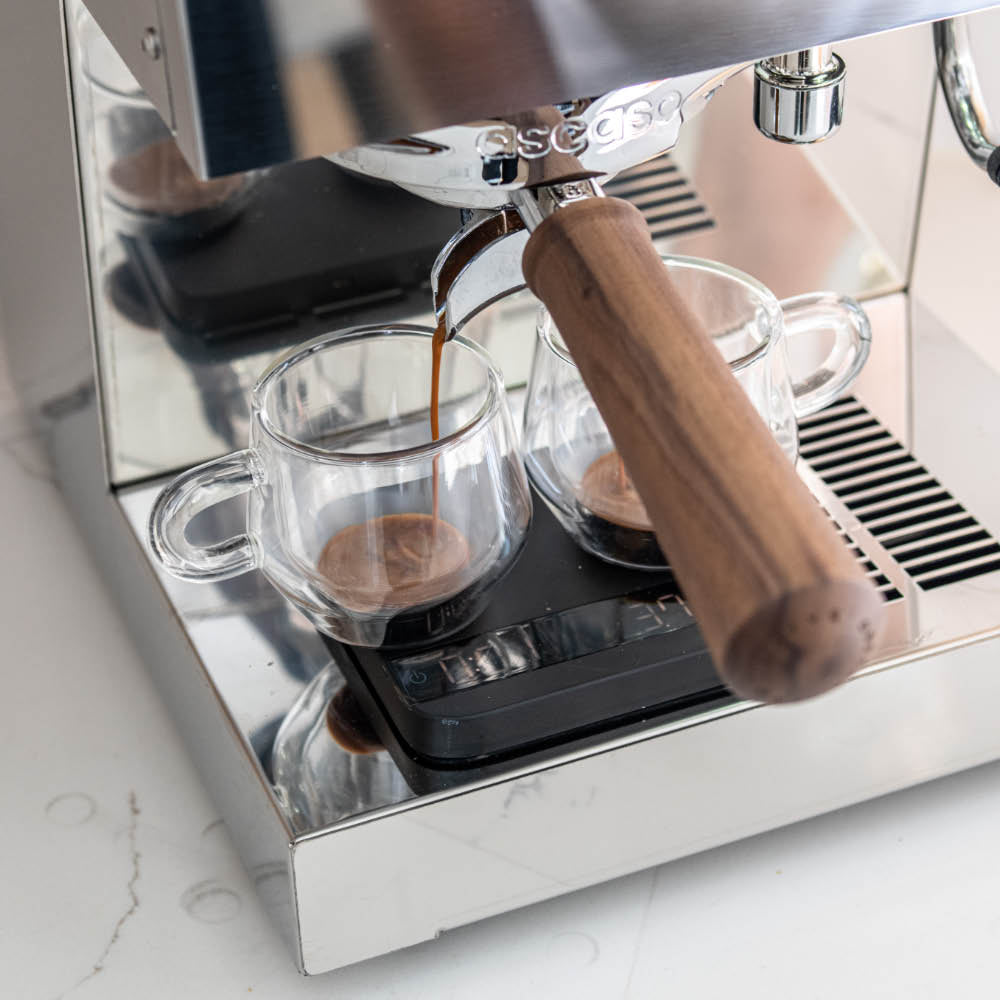
Current Steel documentation lists adjustable brew temperature, programmable pre-infusion, two volumetric doses, a timer, gauge, and adjustable OPV. These controls can refine a stable recipe, but none measures extraction quality. The flowmeter counts water rather than beverage mass, so use a scale while programming. [2] [1]
For a medium roast, 18 g in and about 36 g out is editorial starting guidance, not a Duo test. Improve distribution and grind finer for a fast sharp shot; grind coarser for a slow dry one. Change temperature only after dose and yield repeat.
Ascaso publishes a tight stability claim, while Coffeeness and Lance Hedrick support the platform's espresso capability under different older samples and protocols. That convergence is useful, not a current-V3 laboratory result. Confirm exact fit before buying third-party 58 mm accessories. [9] [10]
Espresso assessment
What the brew controls establish, and what remains yours to solve
The Duo supplies useful controls, not an automatic quality guarantee. Grinder quality, coffee, distribution, dose and measured yield still create the extraction.
| Signal | What the evidence says | Buying consequence |
|---|---|---|
| Current control platform | Official sources document one-degree PID adjustment, programmable pre-infusion, volumetrics, a timer, gauge and adjustable OPV around a 58 mm group. | A good fit for someone who will actually record recipes and change one variable at a time. |
| Temperature claim | Ascaso publishes a tight stability claim for the Steel platform, but the packet lacks an independent standardized current-US-V3 group test. | Treat the claim as promising manufacturer evidence, not a measured Coffeedant result. |
| Volumetric behavior | The flowmeter stops at saved water volume rather than beverage mass; puck and bypass behavior can change output. | Use a scale to establish and periodically audit the programmed buttons. |
Evidence note: Recipe examples in the article are editorial starting points, not Coffeedant tests or factory settings.
05Steam and milk
Separate steam makes the queue faster, not identical to a large boiler
The second thermoblock lets steam overlap extraction, the Duo's defining advantage over Uno. The cool-touch wand and one-hole tip remain manual: purge, introduce air early, create a roll, then wipe and purge immediately.
The older official FAQ and Coffeeness describe less force than strong boiler steam. Clive found better V2 output on a true 20 A supply than through the adapter. These sources support the tradeoff but not one universal steaming time. [4] [7] [9]
Ordinary lattes benefit from control and overlap. Large pitchers or cafe-like pace favor a strong boiler. Keep milk type, quantity, jug, and temperature consistent before changing the steam setting; hotter does not automatically produce finer texture.
Milk assessment
Steam performance depends on supply, quantity, and technique
The Duo removes the Uno waiting step by dedicating a second thermoblock to steam. That changes pace more reliably than it predicts texture.
| Signal | What the evidence says | Buying consequence |
|---|---|---|
| Simultaneous operation | Official documentation identifies two independent thermoblocks for brewing and steam. | Choose the Duo over the Uno when milk work regularly overlaps extraction. |
| 20 A operation | The current US listing specifies 2000 W and a NEMA 5-20 plug; dealer material reports stronger V2 steam on the intended supply. | Confirm the circuit before using steam performance as the reason to buy. |
| Boiler comparison | Ascaso FAQ and independent review context describe capable texture with less force than a strong boiler. | Prioritize control and overlap, or choose a boiler machine for maximum reserve. |
06Daily pace
Fast readiness is real, but the full workflow still needs a warm portafilter and a plan
Published readiness ranges from about one minute to 3:30, while Clive separates roughly three-minute shot capability from about ten minutes for broader stabilization. The sources describe different generations and endpoints, so use a repeatable locked-portafilter routine rather than one universal claim. [2] [1] [4] [7]
Two dose buttons, timer, gauge, cup warmer, and lights reduce daily friction. Verify saved output by scale. Beginners can pull then steam before learning to overlap both jobs; simultaneous capability is an option, not a requirement.
Rinse the basket and group, wipe the gasket and wand, purge safely, and empty the tray. Backflushing removes coffee oils while descaling targets minerals, so follow the current manual and actual water conditions.
Workflow assessment
Judge the complete drink, not the first readiness light
The Duo can be ready much faster than many conventional machines, but the display, brew water, group, portafilter and cup do not all reach the same state at the same instant.
| Signal | What the evidence says | Buying consequence |
|---|---|---|
| Published readiness | Current global, current US, older FAQ and dealer sources range from about one minute to several minutes depending on revision and endpoint. | Use a personal repeatable warm-up protocol rather than advertising one universal time. |
| Drink queue | Independent circuits let extraction and milk overlap. | The time benefit grows with each milk drink and matters less for one straight espresso. |
| Programmed controls | Two doses, timer, pre-infusion and standby settings reduce repeated button work. | Program only after verifying the output by scale with a stable recipe. |
07Construction and service
The exterior feels substantial, while the long-term evidence stays incomplete
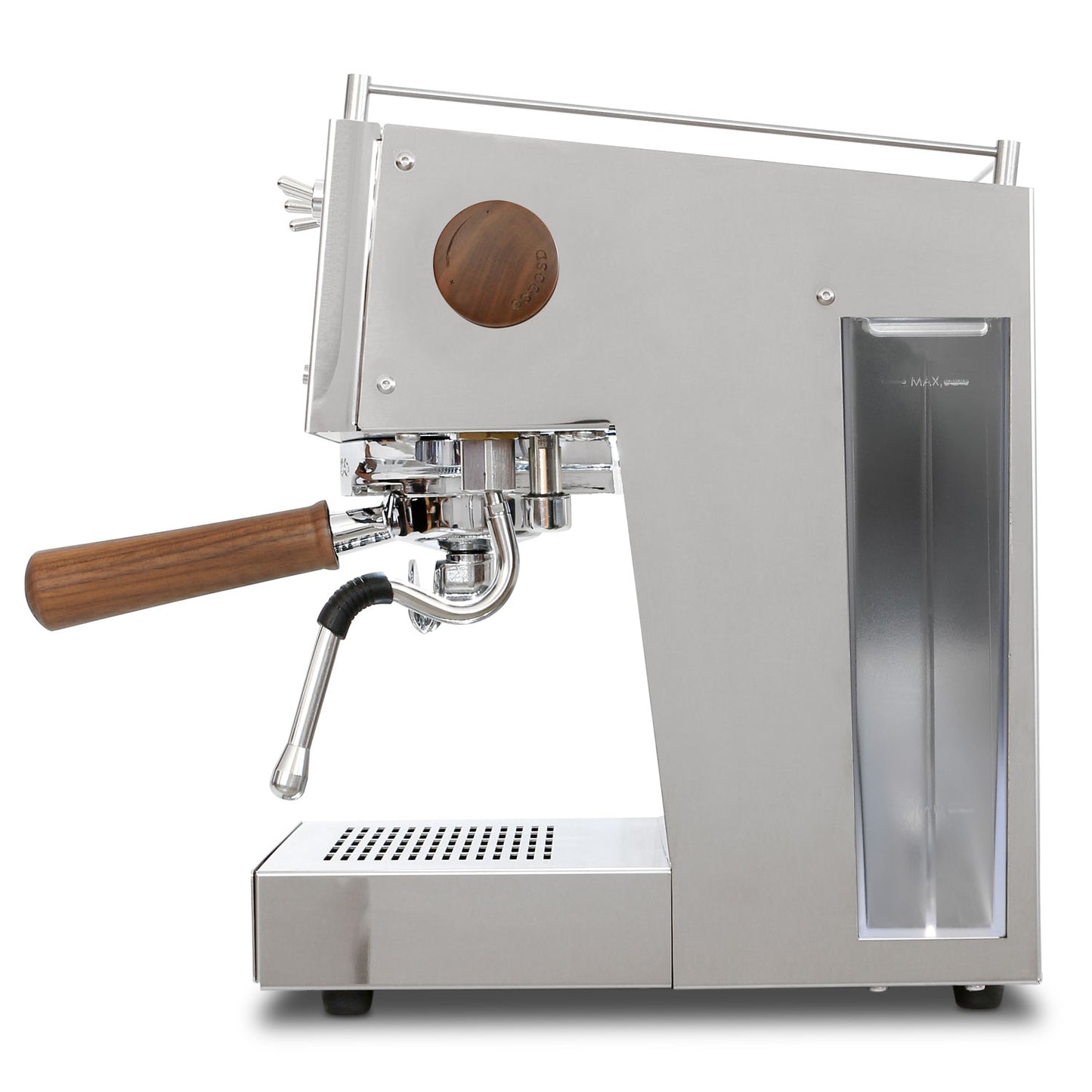
The current US description combines metal panels, walnut controls, a 58 mm group, stainless-lined aluminum thermoblocks, and about 31.8 pounds of weight in an 11-inch-wide body. That supports a premium impression, not a lifespan claim. [1]
Ascaso USA publishes support resources and selected parts, but that does not prove every V3 component or local repair is available. The product page states 12 months generally and advertises five years for thermoblocks and groups; exclusions include wear, scale, water damage, misuse, and unauthorized work. [5] [6] [12]
Owner reports identify inspection questions, not failure odds. Keep proof of purchase, use suitable water, avoid unauthorized modifications, and ask how local service works. A used unit should demonstrate cold start, espresso, simultaneous steam, hot water, programmed stopping, pressure response, and leak-free operation.
Build assessment
Premium materials do not remove the need to investigate service
Build has two parts: what can be observed and specified at purchase, and what can be repaired economically years later. The evidence is stronger for the first than the second.
| Signal | What the evidence says | Buying consequence |
|---|---|---|
| Chassis and touch points | Official sources list a steel or stainless case, walnut handles, substantial weight and a 58 mm group. | Expect a stable premium appliance, while checking finish care and exact color in person. |
| Parts evidence | Ascaso USA publishes resources and sells selected home espresso components. | Ask about the exact V3 part and labor path; a collection page is not comprehensive availability. |
| Reliability evidence | Owner reports are mixed and self-selected, with no representative current-V3 failure dataset. | Do not convert anecdotes into a lifespan promise or failure percentage. |
Evidence note: The build score does not assume a service life. No controlled longevity study was found.
08Controls that matter
PID, pre-infusion, volumetrics, pressure adjustment, and statistics reward a disciplined recipe
Current documentation lists one-degree brew adjustment, steam temperature, two volumetric selections, programmable pre-infusion, timer, standby, statistics, gauge, and OPV. It is broad control without a touchscreen. [2]
Stabilize dose, distribution, grind, and yield before temperature or pre-infusion. Interpret pressure under flow rather than chasing a blind-basket peak, and follow current authorized guidance before OPV work. [4]
Volumetrics and the timer simplify repeat drinks but do not replace a scale. Record one reliable baseline, change one variable, and do not transfer Duo Plus photographs or features to the standard Duo PID.
Features assessment
Useful controls become valuable in a deliberate order
The Duo offers enough adjustment to solve real espresso problems. It also offers enough adjustment to make troubleshooting harder if several settings move together.
| Signal | What the evidence says | Buying consequence |
|---|---|---|
| PID and steam temperature | Current documentation provides adjustable brew and steam temperatures. | Tune temperature after grind, dose and yield are stable. |
| Gauge and OPV | The machine shows brew pressure and provides pressure adjustment. | Interpret pressure under flow and avoid unauthorized adjustment during warranty. |
| Volumetrics and timer | Two saved water volumes and an extraction timer support repeat routines. | Audit beverage mass periodically because water volume is not cup weight. |
09Price and ownership value
At $2,095, the Duo must earn its price through workflow rather than specifications alone
Ascaso USA listed the black V3 at $2,095 on September 17, 2026. Confirm revision, plug, color, package, and seller. Add a capable grinder, scale, suitable water, care supplies, wear parts, and any electrical work; the broad included basket and cleaning kit limits immediate accessory spending. [1]
Value is strongest when simultaneous steam removes a daily wait. Espresso-only buyers can preserve much of the brew platform with the Steel Uno PID. The Lelit Elizabeth and Silvia Pro X instead offer dual boilers; the Profitec Pro 400 offers an E61 heat-exchanger routine.
No representative lifespan, repair-cost, or resale dataset was found. Get local service, shipping, parts, and warranty answers in writing rather than treating a five-year component headline as full ownership coverage.
Value assessment
Count installation, grinder, maintenance, and support before calling it value
At this price, the Duo competes with machines that make a different promise. Its strongest return is time and flexibility during an ordinary milk-drink queue.
| Signal | What the evidence says | Buying consequence |
|---|---|---|
| Current machine price | Ascaso USA listed the current black V3 at $2,095 on the check date. | Verify color, revision, plug, included accessories and seller before comparing discounts. |
| Installation | The current US model specifies 2000 W and NEMA 5-20, with an adapter-related steam compromise in dealer evidence. | Add any electrical assessment or work to the acquisition budget. |
| Long-term cost | Warranty terms and selected parts are published, but representative repair cost, lifespan and resale data are absent. | Treat ownership return as uncertain and investigate local service. |
10Choose by constraint
Steel Duo PID versus Uno PID, Lelit Elizabeth, and Silvia Pro X
These machines can all make serious home espresso. They differ most in electrical demand, heating architecture, milk cadence, warm-up behavior, and how much manual control the household actually wants to use.
| Machine | Price position | The quick decision |
|---|---|---|
| Ascaso Steel Duo PID | $2,095 current US listing | Choose fast dual-circuit work if a suitable 20 A setup is available. |
| Ascaso Steel Uno PID | $1,695 official US reference; new stock unclear | Choose the brew controls and lower draw when milk is occasional. |
| Lelit Elizabeth | Check current dealer price | Choose compact dual boilers and programmable pre-infusion. |
| Rancilio Silvia Pro X | Check current dealer price | Choose dual boilers, strong manual milk work, and simple controls. |
DetailsOpen the technical and workflow comparison
| Machine | Dimensions | Heating | Coffee setup | Milk workflow | Best fit |
|---|---|---|---|---|---|
| Ascaso Steel Duo PID | 11.125 × 12.375 × 14.75 in; about 31.8 lb | Two thermoblocks; current US 2000 W | 58 mm; PID, gauge, OPV, pre-infusion, timer, volumetrics | Simultaneous; thermoblock steam | Frequent milk drinks with short startup priorities |
| Ascaso Steel Uno PID | About 10.5 × 12.5 × 15 in on US listing; verify revision | One thermoblock; 1050 W US listing | 58 mm; PID, gauge, OPV, pre-infusion, timer, volumetrics | Sequential; mode change and recovery | Espresso-first use and one drink at a time |
| Lelit Elizabeth | Verify current regional specification | Dual boiler | 58 mm; PID and programmable functions | Simultaneous; stored boiler steam | Compact traditional dual-boiler shoppers |
| Rancilio Silvia Pro X | Verify current regional specification | Dual boiler | 58 mm; dual PID and soft-infusion control | Simultaneous; boiler steam | Buyers prioritizing steam and familiar service architecture |
The Ascaso figures and prices reflect the cited current US listings checked September 17, 2026. Rival prices, dimensions, electrical needs, accessories and warranties must be checked for the exact regional model before purchase.
The quick answer is workload-based. Choose Duo for overlapping espresso and milk with short startup. Choose Uno for espresso-first use and lower draw. Choose Elizabeth or Silvia Pro X when dual-boiler behavior and local boiler-machine service matter more than thermoblock speed.
11Living with the machine
A simple maintenance map prevents most avoidable ambiguity
Daily care
Rinse the basket and group, wipe and purge the wand, and empty the tray. Keep coffee cleaning separate from mineral treatment.
Backflushing and water
The older FAQ suggests weekly backflushing at two or three drinks daily, but the current manual, cleaner, water, and use should set the routine. Descale only on suitable guidance. [4]
Changed pressure or flow
Check coffee age, grind, dose, basket, screen, and water before touching the OPV. Pressure without a known flow state and recipe is incomplete evidence.
Service and unknowns
Document symptoms, leaks, sounds, serial, purchase date, and water practice. Stop for electrical concerns or uncontrolled leaks. Representative V3 failure rates, temperature curves, steam output, repair costs, and comprehensive parts availability remain unknown.
12Four sensible directions
Choose the machine that removes your actual bottleneck
Best Ascaso fit for milk
Ascaso Steel Duo PID
Keep the Duo when simultaneous espresso and steam, fast startup, and 58 mm control justify the 20 A requirement.
Stay with the DuoEspresso-first alternative
Ascaso Steel Uno PID
Choose one thermoblock and lower draw when straight espresso dominates and milk can wait.
Read the Uno reviewCompact dual boiler
Lelit Elizabeth
Compare a traditional dual-boiler layout with programmable functions and stored steam.
Read the Elizabeth reviewManual dual-boiler route
Rancilio Silvia Pro X
Compare substantial boiler steam and a deliberately hands-on 58 mm workflow.
Read the Silvia Pro X review13FAQ
Ascaso Steel Duo PID questions, answered
Is the Ascaso Steel Duo PID a dual boiler?
No. It has two thermoblocks, one for brewing and one for steam. The circuits can operate together, but their thermal behavior and service layout differ from two boilers.
Can the Steel Duo PID brew and steam at the same time?
Yes. Independent brew and steam thermoblocks enable simultaneous use. The current US machine performs best on the intended 20 amp supply.
Can I use the supplied 15 amp adapter?
Ascaso supplies one with the current US listing, but dealer evidence reports reduced steam performance. Verify circuit suitability and local electrical guidance rather than treating the adapter as a full-performance conversion.
How long does the Steel Duo PID take to heat?
Published figures describe different generations and readiness points, from roughly one minute to several minutes. A dealer suggests around three minutes for a shot and closer to ten for full thermal stabilization. Use a repeatable portafilter-warming routine.
Does the volumetric control measure espresso weight?
No. It counts water flow and stops at a programmed volume. Puck resistance and bypass flow affect the beverage, so verify output with a scale.
What warranty does Ascaso USA provide?
The current product page states 12 months generally and advertises five years for thermoblocks and groups. Read the full terms, exclusions, labor and shipping conditions, seller eligibility, and transfer rules before relying on that headline.
See the machine in use
An independent video perspective
Lance Hedrick
Ascaso Steel Duo PID Review
Independent long-term review of an older personally owned Steel Duo PID. Watch for workflow and ownership analysis, while keeping V3 electrical and current product differences separate.
Watch on YouTubeWhy I trust the verdict
What the evidence lets me say with confidence
This is a research-led review, not a Coffeedant hands-on test. I checked current Ascaso US and global specifications, the official manual and FAQs, support and warranty records, independent reviews, and owner discussions.
V1, V2, current US V3, and Duo Plus evidence is kept separate. Price was checked September 17, 2026. Coffeedant did not measure performance or durability, and owner posts do not establish reliability rates.
Check the evidence
Sources and further reading
- Ascaso USA Steel Duo PID product page
Primary source for the current US V3 price, 120 V power, NEMA 5-20 plug, stated dimensions, tank, controls, materials, accessories, warranty headline and manufacturer claims. It does not independently verify performance or longevity.
- Ascaso global Steel range and 2026 specification sheet
Primary source for the current family architecture, control range, nominal dimensions, thermoblock count and global feature claims. Regional voltage, package and configuration can differ.
- Ascaso Steel user manual
Official 2022 shared manual for operation, programming, cleaning, water and safety. Some electrical figures predate the current US V3 listing, so the selected machine label and current product page control.
- Ascaso USA Steel Duo FAQ
Official support document for the two-block workflow, older heat-up guidance, flowmeter, OPV and cleaning context. It appears to describe an earlier generation and is not used as a current V3 performance guarantee.
- Ascaso USA Steel Duo resources
Primary support index for manuals and product help. Presence of resources does not prove local technician coverage or future parts supply.
- Ascaso USA home espresso parts collection
Official evidence that Ascaso USA sells selected replacement components. It is not evidence that every V3 internal part is stocked, compatible or economical to install.
- Clive Coffee, Ascaso Steel Duo overview
Dealer-authored performance and workflow context, including V2 20 A versus adapter behavior and staged warm-up. Commercial interest, tested revision and protocol limit generalization.
- Clive Coffee Steel Duo setup guide
Dealer setup context for plug, initial flush and water. Its introductory machine-type wording is not used to classify the Duo, and water advice must be adapted to local chemistry.
- Coffeeness Ascaso Steel Duo review
Independent review context for espresso, heat-up, build and steam impressions. Sample generation, grinder, coffee and test method differ from the current US V3.
- Lance Hedrick, Ascaso Steel Duo PID Review
Embedded independent video published June 20, 2024, based on an older personally owned non-Plus machine. Useful for long-term workflow critique, not a specification source for current V3 or Plus models.
- Ascaso USA warranty terms and conditions
Primary source for exclusions, transfer limits and claim conditions. Exact remedy and statutory rights depend on the selected seller, region and problem.
- r/espresso owner discussion about the Steel Duo
Self-selected owner anecdotes used to identify questions about noise, steam, controls and ownership. It is not a representative survey or failure-rate dataset.
- r/Ascaso discussion of the Lance Hedrick review
Community context that helps separate older Duo evidence from later Plus changes. Claims remain anecdotal and may reflect regional or modified machines.
The buying decision
The bottom line
Buy the Ascaso Steel Duo PID if your kitchen has the right electrical setup and your normal use includes enough milk drinks to benefit from simultaneous steam. It combines short startup, serious 58 mm preparation, temperature and pre-infusion control, and a compact body in a way few machines do.
Skip it if you want the strongest boiler steam, a proven owner-service path, or a simple 15 A installation with no caveat. At $2,095, the Duo is not valuable merely because it is fast. It earns its price only when its particular pace and control fit the drinks you make every week.
Check Ascaso USA price