
02The decision in plain English
A durable classic whose missing PID defines the purchase
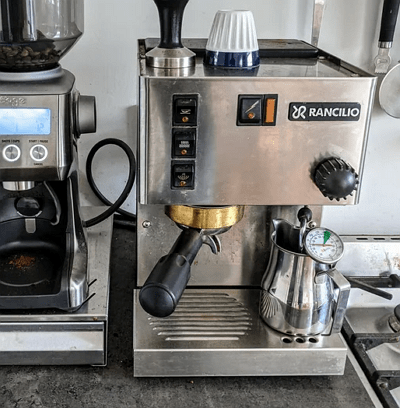
The Rancilio Silvia remains appealing because the basic machine is unusually legible. A rocker switch turns on the 0.3-liter brew-and-steam boiler. Another starts extraction through a commercial-size 58 mm group. Two more direct boiler water either through the steam wand or into the cup. There is no screen, guided recipe or automatic milk program between the operator and the hardware. That directness is the charm, and it is also the work.
The exact machine here is the current US Rancilio Silvia V6/M-family listing, product ID CD-EM-000011. Rancilio’s North American page describes the brass group, 58 mm portafilter, stainless wand and two-liter removable reservoir. The current 2024 manual spans Silvia and Silvia E electrical variants; UK and European articles often discuss the Silvia E, whose energy behavior and mains specification should not be silently transferred to a US purchase. [source] [source] [source]
At the US retailer check on September 15, 2026, a new Silvia was listed at $995 and a refurbished example at $895. That makes the modern question harder than the machine’s long history suggests. The buyer is no longer choosing between a Silvia and disposable entry hardware. Around this price, a Profitec GO can add factory PID control and a pressure gauge, while the Silvia Pro X changes the entire workflow with dual boilers. [source] [source]
My short verdict: buy the Silvia if its repairable, conventional architecture is part of what you want and you are willing to learn a temperature routine. Do not buy it merely because it has a reputation for being “serious.” A good grinder, accurate dose, repeatable yield and sensible heat management matter more than the badge.
03The first seven days
Build a routine before chasing upgrades
Week one should be deliberately boring. Confirm that the reservoir is seated and filled, prime the boiler as the manual directs, and never energize an empty boiler. Let the machine, locked-in portafilter and cup become thoroughly warm. Rancilio gives operating instructions, but it does not promise that the brew switch lamp is a complete recipe for stable espresso temperature. Independent reviewers converge on the need for a repeatable heating and flush routine even when they disagree about the ideal timing. [source] [source] [source]
- Days 1 and 2: learn safe filling, brewing, boiler refill after steam, and immediate wand wiping. Use one familiar medium-roast coffee.
- Days 3 and 4: weigh the dry dose and beverage. Change only grind size until flow and taste become repeatable.
- Days 5 and 6: choose one temperature-surf sequence, write it down, and repeat it rather than improvising from the indicator lamp.
- Day 7: make two drinks in the order your household actually wants. That exercise reveals whether the single boiler is a pleasant ritual or an avoidable queue.
A capable espresso grinder belongs in the base budget. The Silvia’s conventional basket and unassisted pressure make grind quality visible. If the $995 machine leaves only token money for a grinder, step down to the Breville Bambino or buy the grinder first. A scale that reads to 0.1 gram, a small steaming pitcher, cleaning detergent and suitable water are more useful early purchases than a precision shower screen or decorative wood kit.
The manual’s water-hardness target is about 89 ppm. That is not an invitation to pour distilled water into the machine, and hardness alone does not describe all scale risk. Ask the retailer or a local water specialist about a recipe appropriate to the boiler and your water supply. The owner who treats water as an operating input usually has an easier maintenance story than the owner who waits for restricted flow or a noisy boiler.

04Rating deep dive
Espresso: control arrives through technique, not a menu
The Silvia has the foundation for very good espresso: a stable metal group once warmed, a commercial-diameter portafilter, an unpressurized basket path and enough conventional hardware to make puck preparation matter. None of that automatically chooses a brew temperature. A thermostat cycles a small boiler across a range; the operator decides when in that cycle to brew. That is why two honest Silvia reviews can report different experiences without either being careless.
Start with 17 to 18 grams only if the supplied basket comfortably accepts it. Target about twice that mass in the cup, then use taste and flow to move the grind. Sour and fast usually asks for finer grinding or better puck preparation. Dry, slow and harsh usually asks for coarser grinding or a lower dose. Temperature should be the next controlled variable, not the first excuse for every bad shot.
Light roasts expose the limitation. They often benefit from repeatable higher brew temperatures and longer ratios, yet stock Silvia gives neither a numeric set point nor preinfusion programming. A practiced owner can work around the thermostat cycle. A PID can reduce uncertainty, but an aftermarket installation has cost, electrical-safety and warranty consequences. Buyers who already know they want a PID should compare the factory-equipped GO rather than rationalize an immediate modification. [source] [source] [source]
The machine is better understood as a manual instrument than a beginner shortcut. It rewards a notebook and punishes simultaneous changes. Its espresso ceiling can remain high, but the path to a repeatable Tuesday-morning shot is longer than with a factory PID.
Espresso assessment
What controls the cup
The grinder and preparation establish the shot; the thermostat cycle adds a second repeatability problem.
Treat temperature surfing as a documented routine, not a mystical trick.
| Signal | What the evidence says | Buying consequence |
|---|---|---|
| 58 mm group | Conventional basket format and brass group are documented. | Easy access to tools, but tools do not replace puck preparation. |
| No numeric PID | Stock controls expose switches rather than a set point. | Choose a repeatable timing routine or a factory-PID rival. |
| Independent disagreement | Reviewers differ on ease and timing. | Expect technique and coffee choice to change the experience. |
Evidence note: No Coffeedant shot measurements are claimed.
05Rating deep dive
Milk: real steam, followed by a necessary boiler reset
Switching to steam raises the same small boiler from brewing duty to steam duty. Reviewers generally find useful steam authority for home drinks, but the system must heat up, the wand must be purged, and the boiler must be refilled after steaming. Whole Latte Love’s commercial review and Coffee Chronicler’s independent account frame the wait differently; both still describe a sequential workflow. [source] [source]
For one cappuccino, sequence can be simple: pull espresso, switch to steam, wait for readiness, purge condensate, texture milk, wipe and purge the wand, switch steam off, then run water until the boiler is safely refilled. For a second milk drink, the time and temperature transitions compound. The Silvia is not a small café production machine merely because its wand looks commercial.
Beginners should start with cold milk at a repeatable level in the same pitcher. Introduce air briefly near the beginning, then keep the tip positioned to roll the milk until the pitcher becomes appropriately hot. Plant drinks vary in formulation, so the same sound and timing may not repeat. Nothing in this research supports a precise steaming time for every pitcher, and this review does not pretend otherwise.
If the household makes two flat whites every morning, place the price difference to the Silvia Pro X beside the value of hundreds of boiler transitions per year. If milk is occasional, the V6’s simpler architecture may be the more honest purchase.
Milk assessment
Steam strength is only half the milk story
The same boiler must change jobs, so readiness and recovery belong in the rating.
Immediate cleaning protects both hygiene and wand performance.
| Signal | What the evidence says | Buying consequence |
|---|---|---|
| Steam mode | Manual switch and valve provide operator control. | Milk texture depends on technique. |
| One small boiler | Brew and steam temperatures are sequential. | The second latte takes planning. |
| Refill procedure | Manual operation returns water to the boiler after steam. | Skipping shutdown housekeeping risks the machine. |
Evidence note: Steaming time varies with milk, pitcher, fill and technique.
06Rating deep dive
Workflow: the second drink is the real audition
A single espresso fits the Silvia well after warmup: grind, distribute, tamp, choose the point in the heating cycle, brew by weight and knock out the puck. An Americano adds manual hot-water delivery. A milk drink adds a change of boiler state and a refill. These are not defects hidden by the specifications. They are the operating model.
The second drink changes the recommendation. Two straight espressos can be made with a deliberate recovery pause and a stable routine. Two milk drinks require more switching and housekeeping. Mixed orders can be planned, but the plan belongs to the user. A guest asking for decaf also means clearing or changing the grinder, which is outside the machine entirely.
The controls are wonderfully easy to understand, yet ease of understanding is not the same as low effort. TechGearLab scores the machine more harshly on usability than devoted owners do, while long-term accounts value the absence of layers of automation. That disagreement is useful: it identifies two different buyers, not one objective winner. [source] [source] [source]
Use a small workflow card for the first month: reservoir check, warmup, dose, yield, steam, refill, wipe, flush. Once the sequence is muscle memory, the Silvia feels calm. If that card reads like unpaid work, choose a machine that manages temperature and transitions for you.
Workflow assessment
The everyday sequence
A single shot is not the same workload as a two-drink breakfast.
Evaluate the actual household order.
| Signal | What the evidence says | Buying consequence |
|---|---|---|
| Four switches | Controls are visually direct. | Little menu friction, but few assists. |
| Thermostat cycling | No displayed set point. | Consistency relies on operator timing. |
| Top-fill reservoir | Tank access is from above. | Cabinet clearance belongs in the measurement. |
Evidence note: Ease here means daily labor, not switch count.
07Rating deep dive
Build and service: conventional parts are valuable, not magical
The steel case, brass group and 58 mm ecosystem explain much of the Silvia’s longevity. The design has been revised over many years without becoming unrecognizable. That continuity helps technicians, parts sellers and experienced owners discuss common service tasks. It does not make every repair cheap, eliminate corrosion, or guarantee that a used machine was treated well.
At about 14 kilograms and roughly 235 mm wide, the machine feels dense for its footprint. Clearance matters more than width: the reservoir is filled from above, cups live on top, and the steam knob and wand need side room. Measure the usable space under cabinets, not only the empty counter rectangle. [source] [source]
Routine owner work is straightforward: wipe and purge the wand immediately, rinse baskets and portafilter, empty the tray, clean the group on schedule, and use water that controls scale without creating corrosion risk. Electrical or boiler work belongs with a qualified technician. Rancilio North America provides a support route, but warranty coverage and labor logistics can depend on seller and region, so obtain the actual written terms before purchase. [source]
A four-year owner review of an earlier Silvia is encouraging evidence for the platform’s service life, but it cannot prove how a 2026 unit will age. Treat the long production history as evidence of a mature service ecosystem, not as a lifetime warranty.
Build assessment
Built for service, still dependent on service
Traditional construction makes the machine understandable to technicians.
Longevity evidence from older units does not guarantee a new unit.
| Signal | What the evidence says | Buying consequence |
|---|---|---|
| Steel chassis | Current construction and weight support a substantial appliance. | Stable on the counter, less pleasant to move. |
| Mature platform | Parts and repair knowledge are widely discussed. | Ask who will service it locally before purchase. |
| Water-sensitive boiler | Manufacturer specifies water guidance. | A water plan is ownership equipment. |
Evidence note: Service access and warranty terms vary by region and seller.

08Rating deep dive
Features: what is absent matters more than the switch count
The Silvia provides manual brewing, manual steaming and hot water. It lacks a stock PID display, shot timer, programmable preinfusion, pressure gauge and volumetric stop. Some owners see a clean machine with fewer electronic layers. Others see a $995 product asking them to recreate temperature control with timing.
The 58 mm format makes baskets, tampers and distribution tools easy to find. Compatibility still needs checking: basket depth affects dose, spouted and bottomless portafilters need ear geometry that matches the group, and an accessory sold for “E61/58 mm” is not automatically a Silvia fit. Buy tools to solve an observed problem. A bottomless portafilter can reveal preparation faults, but it can also spray a kitchen when the puck is poor.
An aftermarket PID is the defining upgrade debate. It can make temperature selection more repeatable and may add a timer depending on kit. It also changes the cost, appearance and service situation. The mature stock-versus-modified discussion in Home-Barista and Reddit is more informative than treating the modification as mandatory. [source] [source]
For many buyers, the smartest “feature” purchase is a better grinder. The machine cannot compensate for wide particle distribution, retention or awkward adjustment. Allocate the full system budget before choosing hardware upgrades.
Features assessment
An intentionally short feature list
The key feature question is whether you want stock temperature control.
Accessory compatibility must be checked beyond the nominal 58 mm diameter.
| Signal | What the evidence says | Buying consequence |
|---|---|---|
| Manual controls | Brew, water and steam are directly switched. | Easy to understand and easy to over-manage. |
| No display | No timer or temperature value is provided. | Use a scale/timer or choose a displayed machine. |
| Modification ecosystem | PID kits are widely discussed. | Compare total modified cost with a factory solution. |
Evidence note: Aftermarket products are not manufacturer features.
09Rating deep dive
Value: excellent longevity can coexist with weak stock specification
At the checked $995 new price, the Silvia’s value comes from durable conventional construction, the 58 mm ecosystem and a well-understood service history. It does not come from an unusually long feature list. The Profitec GO puts a factory PID, display and pressure feedback into the same broad single-boiler decision. The cheaper Gaggia Classic Evo Pro keeps more budget available for a grinder. [source] [source]
The lifetime-cost argument depends on behavior. A buyer who keeps the machine for a decade, maintains it and learns its cycle can extract more value than someone who adds a PID, premium portafilter, precision basket, wood trim and then upgrades to a dual boiler within a year. Write down the intended setup now: machine, grinder, scale, water treatment, care products and likely modification. Compare totals, not hero prices.
Refurbished and used examples can be attractive because the platform is serviceable. Ask for purchase date, water history, descaling history, leaks, heating behavior, steam function and evidence the boiler is refilling. Budget a professional inspection if the seller cannot demonstrate safe operation. Cosmetic stainless steel can look excellent while internal neglect remains invisible.
The Silvia is still easy to respect. In 2026 it is harder to recommend by default. The best buyer wants the machine’s particular manual character; the wrong buyer is simply trying to buy seriousness by weight.
Value assessment
Price the complete ten-year idea
A machine can be durable and still be poorly matched to its buyer.
Count grinder, water, care and planned modifications.
| Signal | What the evidence says | Buying consequence |
|---|---|---|
| $995 checked new | Current US retailer listing on the review date. | Compare against factory-PID machines at the same moment. |
| $895 refurbished listing | Separate retailer condition and stock. | Verify warranty and refurbishment scope. |
| Long service history | Earlier-generation ownership suggests repair potential. | Maintenance records matter more than polished steel. |
Evidence note: Prices are snapshots, not promises.
10After the honeymoon
Daily care, upgrades and unresolved questions
Every drink
Flush only as your chosen temperature routine requires, keep the group gasket clean, and wipe the steam wand before milk dries. After steaming, refill the boiler according to the manual. Empty the drip tray before it becomes a carrying hazard.
Weekly and periodic work
Backflush and detergent-clean only according to Rancilio guidance for the applicable machine. Wash removable pieces separately, inspect the basket and shower area, and monitor water use. Descaling frequency cannot be responsibly prescribed without water chemistry and usage. Scale prevention is usually kinder than aggressive rescue descaling.
Upgrade order
Grinder first, then scale and water plan, then basket or tamper only if fit or dose demands it. Consider a PID only after experiencing the stock cycle and comparing the all-in price with a factory-controlled machine. Electrical modifications should be installed by someone qualified and may affect warranty support.
What remains unknown
Rancilio’s current North American page uses wording that can be read as “heat exchange,” while its 0.3-liter specification and operating sequence identify the familiar single-boiler coffee/steam design. Warranty duration was not stated consistently in the manufacturer material available for this review. Confirm current written coverage with the authorized US seller. Owner discussions also cannot establish population-level reliability.
11Alternatives
Compare the ownership pattern, not only boiler material
| Machine | Price position | The quick decision |
|---|---|---|
| Rancilio Silvia V6 | $995 checked US listing | Choose for manual simplicity and a mature service ecosystem. |
| Profitec GO | Usually above Silvia | Choose when a factory PID and pressure gauge justify a higher spend. |
| Gaggia Classic Evo Pro | Below Silvia | Choose to preserve more of the budget for the grinder. |
| Silvia Pro X | Substantially above Silvia | Choose when repeated milk drinks make dual boilers valuable. |
DetailsOpen the technical and workflow comparison
| Machine | Dimensions | Heating | Coffee setup | Milk workflow | Best fit |
|---|---|---|---|---|---|
| Rancilio Silvia V6 | Approx. 9.3 W × 13.4 H × 11.4 D in; 30.8 lb | 0.3 L single boiler; thermostat controlled | 58 mm manual group; no stock PID or timer | Sequential brew and steam; boiler refill afterward | Patient owner who values conventional construction |
| Profitec GO | Compact single-boiler class | Single boiler with electronic temperature control | 58 mm group, PID display and pressure feedback | Still sequential, with clearer temperature management | Buyer who wants repeatability without modification |
| Gaggia Classic Evo Pro | Compact traditional chassis | Small single boiler | 58 mm manual group; region/version details matter | Sequential brew and steam | Budget-conscious tinkerer |
| Silvia Pro X | Larger, heavier Silvia-family body | Dual boiler with PID control | 58 mm group with digital controls | Brew and steam without single-boiler transitions | Household serving several drinks |
Dimensions and prices vary by market and revision. Verify the exact regional SKU and current seller listing before buying.
13Before checkout
Rancilio Silvia V6 questions answered
Does the Rancilio Silvia V6 have a PID?
The stock machine covered here does not. Aftermarket kits exist, but they add cost and may affect warranty or service.
Can it brew and steam at the same time?
No. Its single boiler changes temperature between brewing and steaming.
Is the Silvia good for a beginner?
It can teach espresso well, but it is not low-effort. A beginner must manage grind, puck preparation, yield and the thermostat cycle.
What grinder should I use?
Choose an espresso-capable grinder with fine, repeatable adjustment. The right model depends on coffee style, noise, retention and budget.
How long should it warm up?
The boiler lamp alone does not mean every metal part is evenly warm. Use a repeatable, conservative warmup routine and follow the manual rather than a universal internet number.
Is a used Silvia safe to buy?
Potentially, after checking electrical safety, leaks, heating, flow, steam, water history and service records. Unknown internals justify inspection and repair budget.
What warranty does it have in the US?
Coverage can depend on the authorized seller and current regional policy. Obtain the written term for the exact listing before purchase.
See the machine in use
An independent video perspective
Whole Latte Love
Review: Rancilio Silvia M Espresso Machine with Techniques and History
A detailed commercial demonstration of the Silvia workflow. It covers an earlier M-badged revision, so current electrical, bundle and price facts come from the cited 2024 manual and North American listing.
Watch on YouTubeWhy I trust the verdict
What the evidence lets me say with confidence
I began with Rancilio’s current North American product page, specification sheet and 2024 manual, then separated US facts from Silvia E material. I cross-checked temperature, steam and usability claims across five independent reviews or demonstrations, a direct Profitec GO comparison and a four-year owner account. Reddit and Home-Barista were treated as owner-theme pools, never as failure-rate data. Price and stock were checked at a US retailer on September 15, 2026. Where warranty duration or manufacturer wording was unclear, the article says so.
Check the evidence
Sources and further reading
- Rancilio North America: Silvia
Current US product identity, controls, 0.3 L boiler, 2 L reservoir, 58 mm group and included hardware.
- Rancilio: Silvia / Silvia E user manual (2024)
Regional electrical variants, dimensions, startup, brewing, steaming, hot-water and cleaning instructions.
- Rancilio North America: Silvia information sheet
Manufacturer specification cross-check for the current North American machine.
- Rancilio North America: support
Manufacturer service contact and technical-support route; local warranty terms should be confirmed with the seller.
- Whole Latte Love: Rancilio collection
US price and stock context checked September 15, 2026: new Silvia listed at $995; refurbished stock was separately listed at $895.
- Whole Latte Love: Rancilio Silvia review
Updated 2026 commercial hands-on review, including steam workflow and machine overview.
- The Coffee Chronicler: Rancilio Silvia review
Independent practical review focused on temperature surfing, warmup, steaming and the learning curve.
- Coffee Blog: Rancilio Silvia review
Updated UK Silvia E V6 perspective; regional electrical and bundle differences are kept separate from the US decision.
- Kaffeemacher: Rancilio Silvia review
Independent technical review and temperature-focused context.
- TechGearLab: Rancilio Silvia review
Comparative hands-on assessment that emphasizes the machine’s demands on the operator.
- Lifestyle Lab: Profitec GO vs Rancilio Silvia
Direct comparison of two single-boiler machines with different approaches to temperature control.
- Technotes: Rancilio Silvia four-year review
Long-term ownership account for an earlier Silvia generation; useful for maintenance themes, not current-bundle claims.
- Reddit r/espresso: Silvia vs Profitec GO owner discussion
Owner pool about price, PID value, workflow and upgrade choices. Anecdotes do not establish failure rates.
- Home-Barista: Silvia with PID vs Profitec GO
Experienced-user discussion of buying a factory-controlled alternative versus modifying a Silvia.
- Whole Latte Love: Review: Rancilio Silvia M Espresso Machine with Techniques and History
Commercial workflow demonstration published March 31, 2016. It covers an earlier M-badged revision.
The buying decision
Buy the Silvia for its method, not its mythology
The Rancilio Silvia V6 is a compact, serviceable and deeply learnable espresso machine. Its stock thermostat workflow is not a historical footnote; it is the central daily tradeoff.
At $995, I would choose it only when that manual character and long-established platform are the reasons for buying. If the plan already includes a PID, compare the Profitec GO. If the plan includes several milk drinks, compare the Silvia Pro X.
Check Amazon price