
01Start with the routine
Choose how much of the coffee should happen inside the machine
Breville
Barista Pro
Fast manual espresso with an integrated 30-step grinder.
Read the review →“Espresso machine with a grinder” covers at least three ownership categories. A manual integrated machine grinds into a portafilter, then leaves distribution, tamping, brewing judgment, milk texture and cleanup to the user. An assisted manual machine adds feedback or a mechanical tamp, but the owner still manages the basket and steam wand. A superautomatic grinds, forms the puck, brews and ejects the spent coffee inside the appliance. The first useful question is therefore not how many grinder settings a machine lists. It is how much of the drink should happen without your hands.
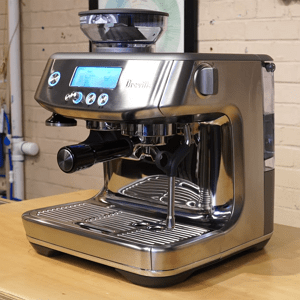
The Barista Pro is a manual espresso station with a current 30-setting grinder, LCD feedback and ThermoJet heater. It is fast because the heater and interface reduce waiting, not because the drink is automatic. You still select the grind, fill the portafilter, distribute and tamp the coffee, decide when the extraction is right, texture milk and knock out the puck. It suits someone who enjoys control but dislikes shopping for and arranging a separate grinder.
The Barista Express Impress keeps the portafilter and steam wand while changing the most awkward preparation jobs. Its dosing system responds to the previous dose and its lever provides an assisted tamp. That can help several users repeat puck preparation with less mess. It does not select the correct grind for a new bean, weigh the beverage in the cup, judge taste or texture milk. Think of it as guardrails around manual espresso, not a compact automatic café.
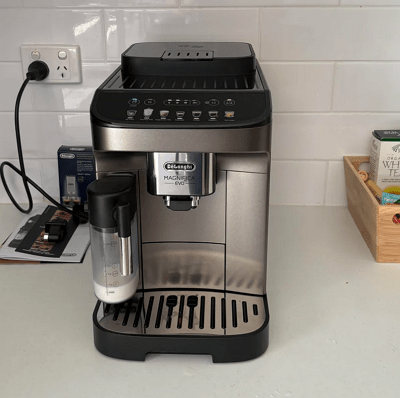
Magnifica Evo and JURA E8 are true bean-to-cup machines. Each contains a grinder and an internal brewing unit. The owner chooses a recipe and settings, then the machine handles the physical puck. Their limits are different from the Breville pair. You give up direct access to distribution, tamping and flow in exchange for repeatability across users. You also gain internal rinsing, waste containers, milk circuits and cleaning programs that must be maintained.
Choose Barista Pro when speed and manual control matter. Choose Express Impress when shared users want visible espresso with preparation assistance. Choose Magnifica Evo when simple one-touch milk at a much lower price than premium automatics is the goal. Choose E8 only when its current fifth-generation menu, polished interface and ownership model justify the large premium. If the household cannot agree, write down who will make, clean and troubleshoot the second drink on a rushed morning. That answer will be more predictive than the grinder headline.
02Quick comparison
Four integrated systems, three different levels of involvement
| Machine | Complete setup | Milk | Best fit | |
|---|---|---|---|---|
| Breville Barista ProBES878 | $849.95 official US reference Fast 54 mm semi-automatic with an integrated grinder | Manual steam after brewing; ThermoJet shortens the transition | Best fit for one practiced user who wants manual espresso, an LCD shot timer and a quicker routine in one station. | Review → |
| Breville Barista Express ImpressBES876 | $799.95 official US reference Assisted 54 mm semi-automatic with dose feedback and tamp lever | Manual steam; sequential thermocoil workflow | Best fit for a shared manual station where dosing mess and uneven tamping stop people from making coffee. | Review → |
| De’Longhi Magnifica Evo with LatteCremaECAM29084SB | $899.95 official US reference Superautomatic with integrated grinder, brew group and milk carafe | Automatic LatteCrema carafe for direct milk recipes | Best fit for a household that wants simple fresh-bean coffee and milk without a portafilter or steam pitcher. | Review → |
| JURA E8 Midnight Silver NADArticle 15722, fifth generation | $2,599 authorized-retailer reference; unavailable when checked Premium superautomatic with P.A.G.2 grinder and HP3 milk system | Automatic milk and foam through the HP3 hose system | Best fit for a premium shared household that will use the 27 Hot, Light and Sweet specialties and guided care. | Review → |
Open the detailed comparison
| Machine | Grinder | Maintenance | Avoid if | Decision |
|---|---|---|---|---|
| Breville Barista Pro | Current 30-setting Baratza European precision burr system; timed dosing | Clean burr path, group, wand and tray; replace filter and descale as required | Avoid if several users need preparation help, you expect one-touch milk or you already plan to buy a separate grinder. | The speed-first manual choice and the strongest general Breville integrated value at the checked prices. |
| Breville Barista Express Impress | Built-in 25-setting conical burr grinder with learned dose correction | Clean grinder path, tamp system, group and wand; follow filter and descale prompts | Avoid if heat-up and steam pace matter more than preparation guidance or if nobody wants to texture milk. | The best assisted-manual choice, but assistance stops before extraction judgment and milk texture. |
| De’Longhi Magnifica Evo with LatteCrema | Built-in 13-setting conical burr grinder plus preground bypass | Rinse removable brew group, clean carafe, empty tray and waste bin, descale on prompt | Avoid if manual espresso texture, grinder upgrades, deep profiles or a broad specialty menu are priorities. | The value one-touch choice when seven direct recipes and removable brew-group care are enough. |
| JURA E8 Midnight Silver NAD | Integrated P.A.G.2 grinder with automatic bean-to-cup dosing | Use guided cleaning and descaling programs; clean milk system after use | Avoid if immediate stock, a removable brew group, low ownership cost or manual espresso control matters. | The premium automatic benchmark, subject to exact article availability and a far higher complete cost. |
Prices were checked September 25, 2026. Tax, color, stock, seller, bundles and promotions can change. Compare the complete station, not the machine-only number.
03Scope and evidence
How we chose four systems that answer different versions of the query
Inclusion criteria
Every recommendation needed an exact current or clearly supported identity, a permanent Coffeedant review, official operation or support documentation, dated North American price context and enough independent evidence to describe the daily workflow. The shortlist also had to cover meaningfully different labor choices. Recommending four nearly identical portafilter machines would not answer a shopper who meant one-touch coffee; recommending four superautomatics would not help a buyer who wants to learn espresso but save counter space.
The exact identities are Breville Barista Pro BES878, Breville Barista Express Impress BES876, US De’Longhi Magnifica Evo ECAM29084SB with LatteCrema and fifth-generation North American JURA E8 Midnight Silver article 15722. Regional Sage names, earlier JURA E8 generations, other Magnifica Evo panels and unrelated Breville Impress machines are not treated as identical. Family reviews can explain a concept, but current official records control the model, menu, package and care instructions.
Exclusion criteria
We excluded machines that merely include a blade or general-purpose grinder, products with unclear model codes or support routes, discontinued units presented as ordinary current stock and marketplace-only brands with uncertain warranty handling. We also excluded grind-and-brew drip machines because they do not make pressure-brewed espresso, and we did not treat a separate machine-and-grinder bundle as “built in.” A modular setup can be the better purchase, but it answers a different counter-space and upgrade question.
Current price and stock had to be described honestly. Breville listed Barista Pro at $849.95 and Express Impress at $799.95 in the current US records used for this guide. De’Longhi listed ECAM29084SB at $899.95. The current JURA page establishes article 15722 and its features, while the $2,599 authorized-retailer reference was unavailable to order when checked. E8 remains a valid premium comparison, but the guide does not imply that the observed price guaranteed immediate stock.
No machine earned its place from pump pressure, drink count or a manufacturer taste claim alone. Grinder steps matter only in the context of the dosing and brewing system. A long menu matters only when the household will use it. Metal panels do not establish service life, and owner praise or complaints do not establish reliability rates. The evidence hierarchy is deliberate: official sources for identity and procedure, independent evaluation for observed workflow, and community reports for questions worth asking.
Drink queue
Count the actual drinks and whether milk follows every shot.
Task ownership
Name who dials in, steams, cleans and responds to prompts.
Complete budget
Include grinder, scale, water and care from the first day.
Upgrade path
Decide whether components should improve independently.
04The integrated trade-off
Judge the grinder by adjustment, dosing and escape routes
Integration saves a purchase decision and creates a tidy dose path. It also ties the grinder’s capacity, adjustment and service life to the rest of the appliance. That trade is easiest to accept when one bean stays in the hopper and the owner values a repeatable routine. It is hardest to accept when the household changes between regular and decaf, explores very different roasts or expects to upgrade one component at a time.
Current Barista Pro documentation specifies 30 settings and Baratza European precision burrs. That is important because older reviews may describe a previous grinder specification. The LCD shows grind and extraction information, while dosing remains time-based. More settings improve the chance of finding a usable point, but they do not weigh the finished drink or eliminate distribution and tamping. The user must still make controlled changes, record the result and adjust as coffee ages.
Express Impress lists 25 grinder settings and adds an intelligent dose feedback loop. The system uses the previous dose outcome to help correct the next one, and the tamp lever applies a repeatable force through its assisted mechanism. This reduces loose grounds and preparation variability. It does not taste the espresso or know whether the grind is correct. A user can repeat the wrong setting very neatly. The benefit is confidence and consistency across people, not automatic dialing in.
Magnifica Evo’s 13 grinder settings operate inside an automatic recipe. De’Longhi instructs users to change the grinder only while it is running and to allow drinks before judging the result. The machine forms and ejects the puck internally, so the user adjusts strength, volume and grind without direct access to distribution. That is simpler but less diagnostic. ECAM29084SB also provides a preground bypass for an occasional alternative, not a second hopper for frequent switching.
JURA E8 uses the P.A.G.2 grinder and a 5 to 16 gram brew unit within a closed automatic system. The owner chooses recipe parameters rather than transferring grounds to a basket. Current fifth-generation details must not be backfilled into earlier E8 reviews. Its bypass chute can accommodate a different preground coffee, while the main hopper remains the practical daily bean. The grinder is part of a premium coordinated appliance, not an upgradeable standalone tool.
Before choosing any integrated machine, run a bean-switching test on paper. If one medium roast fills the hopper for a week, integration is easy to defend. If two people alternate caffeinated and decaf every morning, a bypass chute may be acceptable, but measuring preground coffee adds work. If the household buys small light-roast bags and changes recipes constantly, a separate single-dose grinder may be the cleaner long-term answer.
05Milk and drink queues
Manual steam and one-touch milk solve different household problems
Barista Pro gives the user a manual steam wand and a quick ThermoJet transition. The heater can reduce waiting between coffee and milk, which matters when the barista already knows how to introduce air, create a vortex and stop at the desired endpoint. Speed does not remove technique. A household member who will not hold a pitcher or wipe and purge the wand will not be rescued by a faster heater.
Express Impress also keeps milk manual, but its thermocoil routine is slower. The assisted dose and tamp system can make the coffee side easier for a second user, while the steam wand remains the confidence test. This asymmetry is useful to understand. A machine can reduce preparation mess and still be the wrong choice for someone who expects a latte from one button. Its best shared-household case is several people willing to steam but inconsistent at puck preparation.
Magnifica Evo ECAM29084SB uses the LatteCrema carafe for direct milk drinks. The exact US panel lists espresso, coffee, over ice, cappuccino, latte macchiato, My Latte and hot water. Milk is portioned without a pitcher, so another person can repeat the same saved routine more easily. The trade changes from skill to hygiene. The carafe needs its clean setting, appropriate refrigeration and regular disassembly and washing. Automatic milk is less visible work, not no work.
JURA E8 uses the HP3 milk system and offers 27 Hot, Light and Sweet specialties. Its menu supports a broader premium routine, including sweet and lighter-style recipes. Milk travels through a hose and internal path, which makes guided cleaning part of every milk day. The system is attractive when several people genuinely use the menu. It is expensive overhead when the household makes only black coffee and one simple cappuccino.
Queue size changes the recommendation. One experienced person making a double espresso and a small flat white can move quickly on Barista Pro. Four people with different milk drinks create repeated grinding, portafilter preparation and manual steaming. Express Impress reduces part of that labor but does not automate milk. Magnifica Evo and E8 can reduce visible drink labor, yet each works serially and eventually needs the tray, grounds container or milk path handled.
Temperature preference also matters. Manual steam lets the user stop at a preferred endpoint and create finer texture with practice. Automatic carafes favor repeatability and the manufacturer’s programmed range. Do not assume one system is universally hotter or better. Independent results belong to the test unit, milk and protocol. Decide whether the household values craft, repeatability or the ability for anyone to press the same drink.
06Cost after checkout
One appliance can simplify the counter while concentrating ownership risk
The purchase price is only the first ownership number. Beans, water treatment, filters where specified, cleaning tablets, descaler, milk-system cleaner, seals, burr wear and professional service all belong in the total. Integrated machines reduce boxes and cords, but they concentrate several functions in one chassis. If the grinder needs service, the espresso machine may be unavailable too. A separate setup can fail one component at a time, while requiring more space and buying decisions.
Barista Pro and Express Impress require the visible care of a semi-automatic: wipe and purge the steam wand immediately, rinse baskets and portafilter, clean the group area, empty the tray and follow cleaning and descale guidance. They add hopper and grinder-path care. Oily beans can make a hopper messy and are not an excuse to wash grinder parts that the manual says must remain dry. Keep the exact instructions close and do not improvise water around burrs or electronics.
Magnifica Evo hides the puck but not its residue. The owner empties the grounds container and tray, rinses the removable brew group, cleans the LatteCrema parts and completes prompted cycles. The removable infuser gives the owner a direct inspection and rinsing route. It does not make internal valves, grinder or electronics a casual home repair. Use the support route for faults and keep a record of water, filters and cleaning.
JURA E8 uses guided programs and a non-user-removable brew unit. That ownership model depends on prescribed cleaning products and service rather than weekly removal of the infuser. The milk system needs attention every day it is used. Buyers should confirm local authorized service, shipping or transport arrangements and the exact warranty before paying a premium. A polished prompt system is valuable only when the household follows it.
Water can dominate long-term care. Hard water increases scale risk, while unsuitable distilled or very low-mineral water can create other operating and taste problems. Use the manufacturer’s exact guidance and a local water result instead of assuming that any bottled water is safe. Record the hardness setting and filter choice so another user does not reset the machine casually.
Before checkout, call or verify the seller’s remedy. Ask who pays return freight, whether an opened coffee appliance can be returned, who handles warranty labor and whether the exact color or bundle changes the model code. Save the receipt and rating-plate photo. Integration earns its place when one coordinated system is used and maintained. It becomes expensive clutter when its routines are ignored or its service path was never checked.
07After delivery
Use the return window to test the workflow, not to chase every setting
Day one is for identity and condition. Match the rating plate, model code and voltage to the order. Photograph the packaging and machine, inspect the included parts and confirm the return deadline. Read the exact manual before washing, filling or adjusting anything. Regional videos can be useful demonstrations, but they cannot override the North American instructions or prove that an accessory belongs in your box.
Choose one fresh medium-roast coffee and keep it stable for the first week. Integrated hoppers make random bean changes especially confusing because old and new coffee remain in the path. Do not begin with a very oily dark roast or an unusually dense light roast simply to test the limit. Establish a repeatable baseline first, then decide whether the machine’s adjustment range matches the coffee you actually enjoy.
On Barista Pro, weigh the dose and finished drink even though the machine provides timed information. Record grind setting, grind time, beverage mass and taste. Change one variable, then repeat. Learn the manual steam sequence with the same milk quantity and pitcher. The goal is a routine another morning can reproduce, not a single lucky shot.
On Express Impress, let the dose system establish its feedback cycle before making broad changes. Check that the portafilter is inserted and tamped according to the instructions. Use the assisted tamp as a consistency tool, then evaluate whether the grind still needs adjustment. Teach every household user to purge and wipe the steam wand immediately. The preparation system cannot compensate for neglected milk residue.
On Magnifica Evo, begin with the factory drink logic and shorter coffee volumes. Adjust the grinder only as directed while it is running, then allow several drinks before judging. Learn how to remove and rinse the brew group during the return period. Practice the LatteCrema clean position and full disassembly before residue builds. Decide whether seven direct recipes are enough without imagining features from Magnifica Plus, Evo Next or another regional panel.
On E8, confirm that the machine is exact article 15722 and follow the guided setup. Save one or two realistic recipes rather than editing the entire menu. Run the milk-cleaning procedure on the first milk day so its time and consumables are known. If the ownership model or local service route feels unclear, resolve it while return options remain open.
08Owner context
Community evidence clarifies recurring questions without proving failure rates
Use community reports to ask better questions. For a Breville, ask how owners handle dose changes, grinder cleaning, decaf and a later separate-grinder upgrade. For Magnifica Evo, ask how often the tray and grounds bin need attention in a household with the same daily volume as yours. For JURA, ask about local service logistics and the true cadence of milk cleaning. Keep the exact generation visible in every discussion.
Do not convert a collection of posts into a failure rate. People with problems and enthusiasts with unusually long service are both more likely to write. Water, beans, maintenance, region, production year and local repair access differ. An individual report can show that a part or annoyance exists. It cannot establish how often every owner will experience it.
09Four useful answers
The recommendations, with category boundaries left intact
Breville Barista Pro BES878: best for fast manual control
Barista Pro is the manual integrated machine to choose when one capable user values pace. The current US version combines a 30-setting Baratza-burr grinder, LCD with shot timing, ThermoJet heating and a 54 mm portafilter. At the checked $849.95 price, it costs $50 more than Express Impress and $150 more than the older Barista Express. The premium is defensible when faster transition and more grinder steps matter every day. It does not tamp, stop by beverage weight or texture milk for you.
Breville Barista Express Impress BES876: best assisted manual workflow
Express Impress is the better household tool when loose grounds, inconsistent dosing and crooked tamping prevent people from using a manual machine. Its 25-setting grinder, learned dose correction and lever tamp create a cleaner repeatable preparation path. The $799.95 checked price is lower than Barista Pro, but the thermocoil routine is slower and the interface is less speed-focused. Choose the assistance deliberately. It still requires grind judgment, portafilter handling, shot evaluation and manual milk.
De’Longhi Magnifica Evo ECAM29084SB: best one-touch value
Magnifica Evo is the right category change when nobody wants a basket or pitcher. The exact US ECAM29084SB provides a 13-setting grinder, removable brew group, seven direct recipes and LatteCrema at a checked $899.95 manufacturer price. It lacks profiles, app control and the breadth of premium automatics. That restraint can be an advantage when a household wants espresso, coffee and familiar milk drinks without a long menu. Choose it for task removal and accept the carafe, tray, infuser and descale routine.
JURA E8 article 15722: best premium automatic benchmark
The fifth-generation E8 is a different financial decision. It adds a P.A.G.2 grinder, 27 Hot, Light and Sweet specialties, a 3.5-inch display, HP3 milk and a premium guided workflow. The $2,599 authorized-retailer reference was unavailable to order when checked, so it is not presented as a guaranteed checkout. Choose E8 when its exact menu, interface, service model and finish will be used for years. Skip it when a simpler Magnifica routine covers the actual drinks.
Breville Barista Pro
Best fit for one practiced user who wants manual espresso, an LCD shot timer and a quicker routine in one station.
Avoid if several users need preparation help, you expect one-touch milk or you already plan to buy a separate grinder.
Read the full review →Breville · BES876Breville Barista Express Impress
Best fit for a shared manual station where dosing mess and uneven tamping stop people from making coffee.
Avoid if heat-up and steam pace matter more than preparation guidance or if nobody wants to texture milk.
Read the full review →De’Longhi · ECAM29084SBDe’Longhi Magnifica Evo with LatteCrema
Best fit for a household that wants simple fresh-bean coffee and milk without a portafilter or steam pitcher.
Avoid if manual espresso texture, grinder upgrades, deep profiles or a broad specialty menu are priorities.
Read the full review →JURA · Article 15722, fifth generationJURA E8 Midnight Silver NAD
Best fit for a premium shared household that will use the 27 Hot, Light and Sweet specialties and guided care.
Avoid if immediate stock, a removable brew group, low ownership cost or manual espresso control matters.
Read the full review →10Visible answers
Espresso machines with a grinder FAQ
What is the best espresso machine with a built-in grinder?
Barista Pro BES878 is the strongest speed-first manual choice, Express Impress BES876 is best for assisted puck preparation, Magnifica Evo ECAM29084SB is the value one-touch choice, and JURA E8 article 15722 is the premium automatic benchmark. The best one depends on which jobs you want to keep.
Is a machine with a grinder the same as a bean-to-cup machine?
No. Barista Pro and Express Impress grind into a removable portafilter and still require manual puck preparation, brewing judgment and milk. Magnifica Evo and JURA E8 also form, brew and eject the puck internally, so they are true bean-to-cup machines.
Is a built-in grinder good enough for espresso?
It can be good enough for the machine’s intended routine. Barista Pro has 30 current settings and Express Impress has 25 with dose feedback. An integrated grinder becomes limiting when you need frequent bean switching, finer control or an independent upgrade path.
Can I use decaf in a machine with a built-in grinder?
Yes, but frequent switching is awkward. Magnifica Evo and JURA E8 provide preground bypass routes for occasional decaf. The Breville hoppers retain some coffee in the path. A separate single-dose grinder is cleaner when regular and decaf alternate often.
Does Barista Express Impress make lattes automatically?
No. It assists dosing and tamping. The owner still locks in the portafilter, manages extraction and textures milk manually with the steam wand.
How often must an automatic milk system be cleaned?
Follow the exact manual every time milk is used. Magnifica Evo requires the LatteCrema clean routine and regular part washing. JURA E8 uses guided milk-system cleaning. Milk residue should never be left for the next day.
Is the JURA E8 worth more than Magnifica Evo?
Only when the household will use the fifth-generation E8 menu, interface, premium build and service model. Magnifica Evo covers seven familiar recipes for far less and offers a removable brew group. The E8 price reference was also unavailable when checked.
Should I buy a separate grinder instead?
Choose a separate grinder when you switch beans often, want finer adjustment, expect to upgrade the brewer or want one component to remain usable while the other is serviced. Choose integration when one bean, one counter station and a shorter buying decision will lead to more consistent use.
See the automatic category
An independent bean-to-cup comparison
James Hoffmann
The Best Bean To Cup
An independent comparison of six automatic machines that demonstrates how internal grinding, brewing, milk and interface choices change the cup and routine. The video predates the current shortlist and does not supply their exact specifications or prices.
Watch on YouTubeHow the guide was built
Exact models first, workflow categories kept separate
I checked current official pages, exact manuals or support routes, dated US price context and regional model codes for all four recommendations on September 25, 2026. Manufacturer documents control model identity and specified operation. Independent evaluations add observed workflow. Owner discussions identify questions about cleaning, bean switching and upgrade limits without establishing failure rates.
This is a research-led guide, not a Coffeedant side-by-side test. I did not treat integrated semi-automatics as identical to bean-to-cup machines, transfer specifications between generations, invent measurements or turn anecdotes into reliability statistics. The shortlist represents three different divisions of labor. Confirm the exact model, stock, seller, voltage, bundle, warranty and return terms before paying.
Check the evidence
Sources and further reading
- Breville US: Barista Pro BES878
Exact current US identity, $849.95 price, 30-setting Baratza-burr grinder, ThermoJet, LCD, 54 mm system, accessories and dimensions; checked September 25, 2026.
- Breville: Barista Pro BES878 instruction book
Official setup, grinding, brewing, steaming, cleaning and safety procedures for the US machine.
- Coffeeness: Breville Barista Pro review
Independent hands-on espresso, grinder and milk workflow. Reviewer recipes and observations remain attributed.
- Lifestyle Lab: Barista Pro review
Independent use and direct comparison with Barista Express; older machine-generation limits are disclosed.
- Breville US: Barista Express Impress BES876
Exact current US identity, $799.95 price, 25 settings, dose correction, assisted tamp, thermocoil, 54 mm system and package; checked September 25, 2026.
- Breville: Barista Express Impress BES876 instruction book
Official intelligent-dose, assisted-tamp, extraction, steam and care procedures.
- Serious Eats: Barista Express Impress review
Independent hands-on assessment of the assisted preparation workflow.
- WIRED: Breville Barista Express Impress review
Independent use and control trade-offs; older price context is not treated as current.
- De’Longhi US: Magnifica Evo ECAM29084SB
Exact US identity, $899.95 price, seven recipes, LatteCrema and warranty context; checked September 25, 2026.
- De’Longhi: Magnifica Evo ECAM29084SB instructions
Official exact-model operation, grinder adjustment, brew-group care and milk cleaning.
- Whole Latte Love: Magnifica Evo comparison
Independent family comparison; exact US panel remains controlled by De’Longhi.
- Reviewed: De’Longhi Magnifica Evo test
Independent drink and automatic-milk evaluation. Results belong to its unit and protocol.
- JURA US: E8 Midnight Silver NAD 15722
Official fifth-generation North American identity, 27 specialties, P.A.G.2 grinder, display, controls and article number.
- JURA: E8 NAD instructions
Official setup, recipe, milk-system cleaning, filter, descale and troubleshooting procedures.
- Abt: JURA E8 article 15722
$2,599 authorized-retailer reference and unavailable status checked September 25, 2026.
- WIRED: blind coffee-machine test
Independent May 2026 protocol including a current E8. Its results are not generalized to every unit or recipe.
- r/espresso: integrated Breville discussion
Recent self-selected discussion about integrated grinders, upgrade paths and use cases; not a reliability rate.
- r/BrevilleCoffee: Barista Pro owner notes
One detailed owner workflow with modifications and dose observations; not representative prevalence.
- r/espresso: Express Impress buyer discussion
Mixed owner and buyer views on assistance versus a separate grinder.
- r/superautomatic: Magnifica Evo owner discussion
Self-selected setup and performance reports; user measurements were not adopted as Coffeedant findings.
- r/superautomatic: JURA E8 search and owner context
Mixed generations and self-selected owner questions about recipes, cleaning and service.
- James Hoffmann: The Best Bean To Cup
Independent six-machine automatic comparison published March 15, 2022, running 35 minutes 23 seconds. It explains the category but does not define current specifications or prices.
The buying decision
Buy the integration only after naming what it replaces
Choose Breville Barista Pro when a hands-on user wants the fastest manual routine in this shortlist. Its current 30-setting grinder, LCD and ThermoJet system address daily pace without pretending that puck preparation or milk is automatic. It is the broadest recommendation for someone who already wants to be the household barista and simply prefers one coordinated station.
Choose Breville Barista Express Impress when dosing and tamping consistency are the real barriers. The assisted system can make a manual station friendlier to several users, and its checked price undercuts Barista Pro. Accept the slower heater and keep expectations precise: extraction judgment and milk still belong to the person.
Choose De’Longhi Magnifica Evo ECAM29084SB when the goal is fresh-bean coffee with the least visible handling at roughly the same price as the manual integrated machines. Seven recipes, LatteCrema and a removable brew group form a coherent value package. It is not the choice for manual espresso exploration, multiple profiles or a premium menu.
Choose JURA E8 article 15722 when a current fifth-generation premium automatic, 27 specialties and guided ownership justify a $2,599 reference and the exact unit is actually available. Confirm local service and stock before treating it as a checkout recommendation. Its strongest case is a household that will use its menu, not a buyer seeking the most specifications.
Choose none of them when you expect to replace the grinder, switch beans constantly or keep the grinder through several machine upgrades. A separate grinder and brewer will occupy more space but preserve modularity. The best espresso machine with a grinder is not the machine that contains the most components. It is the one whose integrated tasks match what the household will repeat and maintain.