01Start with the routine
Build the shortlist from the jobs you want to keep
Breville
Bambino Plus
Automatic milk, manual coffee, separate grinder.
Read the review →A beginner machine is not the one with the fewest buttons. It is the one whose repeated jobs match the household. A semi-automatic asks you to grind, dose, distribute, tamp, start or stop the shot, manage milk and clear the basket. An integrated-grinder machine removes a shopping decision and some counter sprawl, but it keeps the same coffee and milk skills. A superautomatic moves grinding, dosing and brewing inside the appliance, then replaces visible puck preparation with drink programming, internal cleaning and periodic brew-group care.
Start with the drinks. Straight espresso exposes grind and temperature choices quickly, so the grinder and repeatable preparation deserve more money than automatic milk. A daily latte adds a second system: milk temperature, texture, wand cleanup and the time between brewing and steaming. A household making four drinks in a row should care about sequencing and cleanup more than a person making one cappuccino. “Three-second heat-up” can be useful, but it does not grind coffee, warm the portafilter, texture milk or clean the station.
Then choose the division of labor. Bambino Plus keeps coffee manual and can automate milk. Classic E24 keeps almost everything manual and rewards a stable routine. Barista Express integrates the grinder but still asks the owner to dial in, tamp and steam. Magnifica Evo removes the portafilter entirely, while asking the owner to keep its grinder, brew group, waste bin and milk carafe clean. None is a universal upgrade over the others because each removes a different job.
The practical shortcut is simple. Choose Bambino Plus when milk confidence and grinder flexibility matter. Choose Classic E24 when learning a traditional platform is the goal. Choose Barista Express when one-box organization matters more than modular upgrades. Choose Magnifica Evo when nobody in the household wants to become the barista. If two people answer those questions differently, agree on who will dial in, clean milk parts and respond when the machine asks for maintenance before buying.
02Quick comparison
Four different beginner workflows
| Machine | Complete setup | Milk | Best fit | |
|---|---|---|---|---|
| Breville Bambino PlusBES500 | $499.95 machine only Compact 54 mm semi-automatic with a separate grinder | Automatic presets or manual steam; sequential with brewing | Best fit for milk-drink beginners who want fast startup, automatic milk and a grinder they can upgrade separately. | Review → |
| Gaggia Classic Pro E24Current North American E24, 110–120 V | $549.00 machine only Traditional 58 mm brass single-boiler semi-automatic | Manual steam after changing the boiler to steam mode | Best fit for a patient beginner who wants to learn a traditional 58 mm workflow and values a long accessory path. | Review → |
| Breville Barista ExpressBES870XL | $699.95 complete station 54 mm semi-automatic with integrated grinder | Manual steam; sequential with brewing | Best fit for a beginner who wants one familiar station, manual learning and no separate-grinder shopping decision. | Review → |
| De’Longhi Magnifica Evo with LatteCremaECAM29084SB | $899.95 complete automatic Superautomatic with integrated grinder and internal brew group | Automatic LatteCrema carafe | Best fit for a shared household that wants fresh-bean coffee and milk without handling a portafilter. | Review → |
Open the detailed comparison
| Machine | Grinder | Maintenance | Avoid if | Decision |
|---|---|---|---|---|
| Breville Bambino Plus | Separate espresso grinder required for fresh beans | Wipe and purge wand, empty tray, clean group, descale to water conditions | Avoid if the $499.95 machine price leaves no room for a capable grinder or if you want adjustable brew temperature. | The easiest manual-coffee route for regular lattes, provided the grinder budget is protected. |
| Gaggia Classic Pro E24 | Separate espresso grinder required | Backflush, clean wand and group, manage water, cool boiler after steaming | Avoid if you want instant milk drinks, automatic dosing, a factory PID or several drinks with little waiting. | The strongest craft-first platform here, but it asks the owner to provide the consistency. |
| Breville Barista Express | Built-in 16-setting conical burr grinder | Clean grinder path, group and wand; replace filter and descale as required | Avoid if you expect push-button drinks, switch beans often or already know you will upgrade the grinder soon. | The clearest all-in-one learning route, with integration as both its strength and its ceiling. |
| De’Longhi Magnifica Evo with LatteCrema | Built-in 13-setting conical burr grinder | Rinse removable brew group, clean carafe, empty tray and waste bin, descale on prompt | Avoid if you want to learn puck preparation, change grinders later or chase traditional café-style espresso texture. | The lowest-learning option, bought for repeatable convenience rather than manual control. |
Prices were checked September 25, 2026. Tax, color, stock, seller, bundles and promotions can change. Compare the complete station, not the machine-only number.
03Scope and evidence
How we chose the shortlist, and what we excluded
Inclusion criteria
Every recommendation had to have a current or clearly supported exact model, a canonical Coffeedant review, accessible official documentation, a defined US or North American identity, a realistic first-owner workflow and enough independent evidence to describe limits rather than repeat marketing. The shortlist also had to represent meaningfully different choices. Four nearly identical thermoblock machines would make a poor guide even if all four were good.
We included one compact separate-grinder machine, one traditional single boiler, one integrated-grinder semi-automatic and one superautomatic. Each has an official product or support route, current manuals, a dated price context and independent evaluations. The guide uses the exact BES500, North American Classic Pro E24, BES870XL and ECAM29084SB. Regional siblings, earlier generations and similarly named variants are supporting context only.
Exclusion criteria
We excluded machines whose current identity could not be separated safely from older generations, marketplace-only brands with unclear parts or warranty routes, discontinued products sold as if they were normal current stock, and models whose main advantage was an unsupported pressure or temperature claim. We also excluded capsule machines because they answer a different question about portioned coffee, and premium prosumer machines because their cost, warm-up and maintenance do not match the first-station intent of this guide.
“Beginner” does not mean cheapest. A very low machine price can become expensive when the included basket, grinder, steam system or seller remedy fails the intended routine. Conversely, a $899.95 automatic is not automatically better than a $499.95 semi-automatic. The extra cost buys task automation and an integrated system, not a guarantee of better espresso. Price observations were checked on September 25, 2026 and are snapshots, not permanent offers.
The shortlist also avoids pretending that every buyer needs traditional espresso. Someone who wants dependable coffee and milk before work may be better served by Magnifica Evo than by a celebrated manual platform. Someone who wants to learn extraction may find an automatic frustrating even when it is easier. We judge beginner fit by alignment, documentation and ownership consequences, not by how little the user touches the machine.
Drink queue
Count the actual drinks and whether milk follows every shot.
Task ownership
Name who dials in, steams, cleans and responds to prompts.
Complete budget
Include grinder, scale, water and care from the first day.
Upgrade path
Decide whether components should improve independently.
04The hidden half
Protect the grinder budget before comparing machine features
For Bambino Plus and Classic E24, the grinder is not an accessory. It is part of the brewing system. Espresso needs fine adjustment near the point where a small change can move a shot from fast and thin to slow and harsh. A grinder that is excellent for drip coffee may have steps too coarse for this work. Buying the machine first and hoping to add a suitable grinder later often leaves a beginner blaming pressure, baskets or coffee for a problem created by grind control.
A complete Bambino Plus station therefore costs more than $499.95. Add an espresso-capable grinder, a scale, beans and basic care supplies. The machine remains attractive because the grinder can survive a future brewer upgrade, and the automatic wand reduces the second learning curve. Classic E24 has the same separate-grinder requirement, but its traditional boiler and manual steam add temperature and sequencing practice. Its $549 price is only the first line of the budget.
Barista Express turns the machine and grinder into one $699.95 station. That is real convenience: the hopper, grinder, dosing cradle, tamper, gauge and brewer occupy one coordinated counter area. The limit is structural. The grinder cannot move to another brewer, and the brewer remains on the counter if a separate grinder arrives later. Sixteen settings can be enough for a stable medium-roast routine, but buyers planning frequent bean changes or lighter-roast experimentation should price the modular route before paying for integration.
Magnifica Evo also contains a grinder, but its purpose differs. The 13 settings tune an internal automatic recipe rather than feed a removable portafilter. Changes should be small and allowed to settle across drinks according to the manual. The owner still chooses beans, strength and volume, but the machine controls dose formation and puck disposal. That is easier to operate and harder to separate into upgradeable parts.
Use the complete-station rule: compare machine, grinder, scale, milk hardware, water treatment and initial care supplies together. A cheaper machine with the right grinder can be the stronger espresso purchase. An integrated system can be the better household purchase when one station gets used and two separate appliances would not. The budget should follow the repeated task, not the largest number on the machine box.
05Milk and pace
Count the drinks, then count the sequential steps
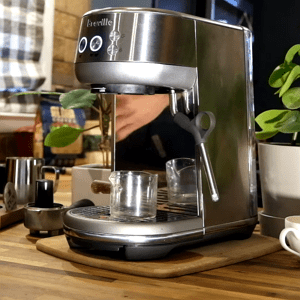
Bambino Plus is the easiest semi-automatic here for a household that makes milk drinks most days. The current BES500 documents three milk temperatures, three texture choices and manual steaming. The sensor reduces the attention required to reach a repeatable endpoint. It does not turn the machine into one-touch automation: coffee must still be ground, prepared and extracted before milk, and brewing and steaming remain sequential.
Classic E24 uses one brass boiler for brewing and steaming. After espresso, the owner switches to steam mode, waits for the temperature change, textures milk and then cools the boiler back toward brewing conditions. That sequence is manageable for one or two drinks when the ritual is welcome. It becomes tedious when several people expect fast cappuccinos. The rotating two-hole wand gives real manual control, but it does not provide automatic temperature or texture guidance.
Barista Express also uses a sequential manual workflow. Its integrated grinder can speed station organization, while the steam wand still requires practice. The owner learns air introduction, vortex, pitcher position and endpoint. That skill can produce the preferred texture and transfers to later manual machines. It can also become the reason another household member stops using the station. “Built-in grinder” should not be confused with “automatic latte.”
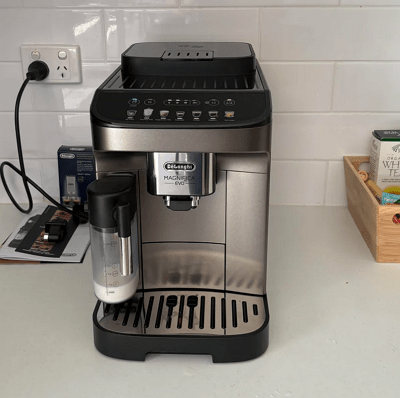
Magnifica Evo ECAM29084SB attaches a LatteCrema carafe and provides direct recipes including cappuccino, latte macchiato and My Latte. It can repeat a programmed routine without a pitcher or steam technique. Convenience moves to carafe handling: fill it, attach it, use its clean setting, refrigerate remaining milk appropriately and wash the parts. Automatic milk is not maintenance-free milk.
For one daily flat white, choose based on desired involvement. For four drinks, time the entire sequence. Semi-automatic users must clear and redose the basket for each coffee, then work through milk. Magnifica Evo removes those visible tasks but fills an internal waste bin and tray. A machine that makes one drink quickly can still be the wrong group-service machine. The best beginner choice is the one whose queue and cleanup the household will actually tolerate.
06Cost after checkout
Ownership costs are water, coffee, cleaning, parts and attention
The purchase price is only the easiest number to compare. Ongoing costs include beans, water treatment, cleaning products, filters where used, descaler, milk-system cleaner, replacement seals or wear parts, and service. The most important variable is often attention: a neglected inexpensive machine can cost more in poor coffee and premature failure than a more suitable system maintained on schedule.
Bambino Plus and Barista Express follow Breville care routines for the group, steam wand, water tank, filter and descale cycle. The automatic purge on Bambino Plus sends water to the tray, so frequent milk users should expect to empty it often. Barista Express adds grinder-path cleaning and hopper management. Neither machine’s compact appliance design proves a specific lifespan or repair cost. Keep the receipt, register where appropriate and confirm local service before assuming every internal part is owner-replaceable.
Classic E24 exposes more of a traditional espresso routine. Backflushing, group cleaning, wand care and appropriate water remain normal work. Switching from steam back to brewing requires a deliberate cooling routine. The brass boiler, 58 mm portafilter and conventional controls support a long accessory and service conversation, but they do not remove scale risk or make electrical and boiler repair a beginner task. A parts diagram is not a promise of local stock or affordable labor.
Magnifica Evo hides puck preparation and adds internal pathways. The owner empties the coffee-grounds container and drip tray, rinses the removable brew group, keeps the LatteCrema carafe clean and completes prompted descale cycles. The removable infuser is an advantage for inspection and rinsing, but the integrated grinder and automatic valves make the system more complex than a simple portafilter machine. Convenience depends on following the care prompts rather than postponing them.
Water deserves its own plan. Do not assume bottled, distilled, softened or reverse-osmosis water is automatically appropriate. Follow the exact manufacturer guidance and local service advice. Hard water increases scale risk; unsuitable low-mineral water can create other operating and taste problems. Record the filter or treatment choice so another household member does not improvise.
Before ordering, ask five ownership questions: Who cleans milk parts daily? Who changes grinder settings? Where will wet tools land? What happens when the machine requests descaling on a busy morning? Who provides warranty and paid service locally? A beginner setup succeeds when those answers are boring and repeatable.
07After delivery
A first-week plan that prevents random adjustment
Day one is for identity, condition and water. Match the model code and voltage to the order, photograph the rating plate, inspect accessories, read the exact manual and confirm the return window. Wash only the parts the manual permits. Set up water treatment before scale starts accumulating. Do not copy a settings video made for a different model, country or basket.
For a semi-automatic, begin with one fresh medium-roast coffee and one recipe. Use a scale, hold the dose and target beverage mass steady, and change the grind before changing several other variables. Record the setting, dose, yield and taste in plain language. Thin and sharp usually calls for a finer grind or better puck preparation; slow and harsh usually calls for coarser grinding or a lower dose. Those are diagnostic starting points, not promises about every coffee.
With Bambino Plus, learn the manual coffee path even if milk is automatic. Repeat one milk quantity and preset before deciding the sensor is inconsistent. With Classic E24, separate warm-up, brewing, steam and cooling routines so temperature changes are deliberate. With Barista Express, avoid filling the hopper with more coffee than you will use while learning; large changes waste beans and make the last adjustment hard to interpret.
With Magnifica Evo, begin with the factory guidance and a moderate recipe. Change grinder settings only as directed and allow several drinks for the internal path to reflect the change. Start with shorter drinks before judging espresso strength through a large volume. Rinse the removable brew group and learn the carafe-cleaning sequence during the return window, not after residue has accumulated.
By the end of the week, the goal is not café perfection. It is a routine another person can repeat. Write down the bean, grinder setting, drink button or yield, milk choice and cleaning finish. If the routine already feels too demanding, use the return window honestly. A machine aligned to the household will become simpler as the variables settle; a category mismatch will continue asking for work nobody wants.
08Owner context
Community evidence is useful for questions, not failure rates
Use owner evidence to build an inspection list. Ask how often trays fill, whether milk parts are easy to clean, how people switch beans, what service actually costs locally and which exact generation an account describes. Do not treat a forum consensus as controlled comparative testing. Enthusiast communities naturally overrepresent people solving problems and people proud of unusually long service.
The same caution applies to retailer reviews. A large review pool can reveal recurring questions about setup, packaging and controls, while mixing incentives, bundles and model codes. Manufacturer reviews can be useful for discovering unclear instructions but should not decide the verdict alone. Official documentation controls identity; independent evaluations provide observed workflow; owner accounts add long-term questions. The guide keeps those roles separate.
09Four useful answers
The recommendations, with their limits left intact
Breville Bambino Plus BES500: best for automatic milk with a separate grinder
Bambino Plus combines a very short claimed heater-readiness time, a 54 mm portafilter, programmable shot volumes and automatic or manual milk. It is forgiving where many beginners feel least confident, yet it keeps the coffee path visible. That makes it a strong first machine for latte households that still want to learn grind, dose and yield. Its fixed brew-temperature design and sequential workflow set the ceiling. At $499.95, it is good value only when the grinder remains funded.
Gaggia Classic Pro E24: best for learning a traditional platform
The current North American E24 is the brass-boiler successor, not the 2023 coated-boiler Evo. It uses a 58 mm stainless portafilter, nine-bar calibration, three-way solenoid and manual steam wand. The machine rewards a consistent warm-up, dosing and temperature routine. It has no factory PID or shot timer, and milk follows a single-boiler sequence. Choose it when those manual decisions are the reason for buying espresso equipment, not chores you hope to escape.
Breville Barista Express BES870XL: best one-box learning station
Barista Express puts the grinder, dosing cradle, tamper, pressure gauge, 54 mm brewer and steam wand into one familiar station. The current US record lists 16 grinder settings and a $699.95 price. It remains a clear beginner proposition because the workflow is understandable and widely documented. The grinder is also the fixed boundary. Choose it when one bean and one coordinated station matter more than easy component upgrades.
De’Longhi Magnifica Evo ECAM29084SB: best when nobody wants a portafilter
The exact US ECAM29084SB grinds, doses, brews and ejects the puck internally, while LatteCrema handles milk for direct recipes. Seven listed recipes cover common hot drinks and an over-ice route. It is the correct category change for a household that values repeatability across users. It cannot teach puck preparation, and its traditional-espresso ceiling is lower than a well-dialed separate-grinder setup. Buy it for task removal and clean the system it creates.
Breville Bambino Plus
Best fit for milk-drink beginners who want fast startup, automatic milk and a grinder they can upgrade separately.
Avoid if the $499.95 machine price leaves no room for a capable grinder or if you want adjustable brew temperature.
Read the full review →Gaggia · Current North American E24, 110–120 VGaggia Classic Pro E24
Best fit for a patient beginner who wants to learn a traditional 58 mm workflow and values a long accessory path.
Avoid if you want instant milk drinks, automatic dosing, a factory PID or several drinks with little waiting.
Read the full review →Breville · BES870XLBreville Barista Express
Best fit for a beginner who wants one familiar station, manual learning and no separate-grinder shopping decision.
Avoid if you expect push-button drinks, switch beans often or already know you will upgrade the grinder soon.
Read the full review →De’Longhi · ECAM29084SBDe’Longhi Magnifica Evo with LatteCrema
Best fit for a shared household that wants fresh-bean coffee and milk without handling a portafilter.
Avoid if you want to learn puck preparation, change grinders later or chase traditional café-style espresso texture.
Read the full review →10Visible answers
Beginner espresso machine FAQ
What is the easiest espresso machine for a beginner?
For a beginner willing to handle a portafilter, Bambino Plus removes milk uncertainty while keeping the coffee workflow learnable. For a household that wants no portafilter work, Magnifica Evo ECAM29084SB is easier because it is a superautomatic.
Do I need a grinder with a beginner espresso machine?
Yes for fresh-bean espresso unless the machine includes one. Bambino Plus and Classic E24 require a separate espresso-capable grinder. Barista Express and Magnifica Evo include grinders with different workflows and upgrade limits.
How much should a complete beginner setup cost?
Use the complete station, not the machine price. Add the grinder where required, a scale, beans, water treatment and initial care supplies. A $499.95 Bambino Plus station can cost more than a $699.95 Barista Express once the grinder is included.
Is 15 bar better than 9 bar for beginners?
No. Maximum pump pressure is not a quality ranking. Grinder control, coffee preparation, temperature behavior and flow through the coffee matter more. Gaggia documents nine-bar calibration for the current E24.
Should a beginner buy a machine with a built-in grinder?
Choose a built-in grinder when one coordinated station and one main bean matter more than upgrades. Choose a separate grinder when adjustment range, bean switching and the ability to keep the grinder through a future machine matter.
Is a single-boiler machine good for milk drinks?
It can be good for one or two drinks when the owner accepts switching from brew to steam and cooling afterward. It is a poor fit for a rushed queue of milk drinks.
Are superautomatic machines real espresso machines?
They brew under pressure from fresh-ground coffee, but the internal dose, puck geometry and control model differ from a portafilter machine. Buy one for its automated routine, not as a shortcut to the same manual result.
Which beginner machine has the best upgrade path?
A separate grinder plus a grinder-free machine is the most modular route. Classic E24 also uses a broad 58 mm accessory standard. Barista Express and Magnifica Evo integrate the grinder, so an upgrade can leave part of the original system unused.
See the fundamentals
An independent beginner technique overview
Prima Coffee Equipment
A Beginner’s Guide to Espresso: Part 1
An independent technique overview that explains the variables a first semi-automatic owner must control. It is not a comparison of the four current machines, so exact specifications and prices remain anchored to current manufacturer sources.
Watch on YouTubeHow the guide was built
Exact models first, observed workflow second, anecdotes kept in proportion
I checked current official product pages, exact manuals or support routes, dated prices and regional model codes for all four recommendations on September 25, 2026. I then compared independent hands-on evaluations and owner discussions, using each for the question it can answer. Manufacturer documents control identity and specified operation. Independent reviews add observed workflow. Owner accounts identify questions but do not establish failure rates.
This is a research-led buying guide, not a Coffeedant side-by-side test. I did not invent measurements, transfer specifications between generations, treat a retailer review pool as representative, or rank the machines with an arbitrary score. The shortlist is intentionally small because it represents four different divisions of labor. Prices are dated observations, and buyers should confirm the exact model, seller, voltage, bundle, warranty and return terms.
Check the evidence
Sources and further reading
- Breville US: Bambino Plus BES500
Exact US identity, current $499.95 price, features and package; checked September 25, 2026.
- Breville: Bambino Plus BES500 US manual
Official operation, milk settings, baskets, cleaning and safety.
- Serious Eats: Breville Bambino Plus review
Independent hands-on workflow and milk context.
- Coffee Kev: Bambino Plus long-use review
Independent long-use perspective; Sage regional details are not transferred to the US model.
- Gaggia North America: Classic Pro E24
Current North American E24 identity, $549 price, brass boiler, 58 mm platform and specifications.
- Gaggia North America: Classic E24 manuals
Official current manuals and care documentation.
- Whole Latte Love: Gaggia Classic Pro E24 review
Independent retailer evaluation of the current brass-boiler machine.
- CoffeeGeek: Gaggia Classic family evaluation
Independent workflow context; 2023 Evo architecture is not assigned to E24.
- Breville US: Barista Express BES870
Current US identity, $699.95 price, grinder, 54 mm system, accessories and official dimensions.
- Breville: Barista Express BES870 manual
Official setup, grinder, brewing, steaming and care instructions.
- GearLab: Breville Barista Express tested review
Independent comparative test; measurements belong to its unit and protocol.
- CoffeeGeek: Barista Express first look
Independent grinder and manual workflow context from an older unit.
- De’Longhi US: Magnifica Evo ECAM29084SB
Exact US identity, $899.95 price, seven recipes, LatteCrema and warranty context.
- De’Longhi: Magnifica Evo ECAM29084SB instructions
Official exact-model operation and care.
- Whole Latte Love: Magnifica Evo comparison
Independent comparison across variants; exact US panel is controlled by De’Longhi.
- Reviewed: De’Longhi Magnifica Evo test
Independent drink and automatic-milk evaluation.
- r/espresso: beginner machine discussion
Self-selected owner discussion about grinder budget, single-boiler pace and upgrades.
- r/gaggiaclassic: current E24 owner experience
One current-machine owner account; not a reliability rate.
- r/espresso: Barista Express owner longevity discussion
Mixed-generation self-reports about use and upgrades.
- r/superautomatic: Magnifica Evo owner discussion
Self-selected setup and performance discussion; measurements were not adopted as Coffeedant findings.
- Prima Coffee Equipment: A Beginner’s Guide to Espresso, Part 1
Independent 11 minute 44 second technique overview published March 25, 2015.
The buying decision
The best beginner machine is the one that removes the right friction
Choose Breville Bambino Plus when the household wants traditional espresso preparation, quick startup and easier milk. It is the broadest recommendation here because it removes a common beginner frustration without fixing the grinder permanently to the brewer. The catch is financial: a proper separate grinder belongs in the same order plan.
Choose Gaggia Classic Pro E24 when learning the machine is the hobby. Its brass single boiler, 58 mm platform and manual controls create a clear traditional path. It is not the convenient answer for rushed group milk drinks, and the lack of factory PID means routine matters. That is a feature for the right learner and a warning for everyone else.
Choose Breville Barista Express when one station and one familiar bean will make the household more likely to use the equipment. The integrated grinder simplifies purchase and counter organization. It does not automate dialing in, tamping or milk, and it narrows the upgrade path. Buy the integration deliberately.
Choose De’Longhi Magnifica Evo ECAM29084SB when the real request is fresh-bean coffee with minimal handling. It is easier because it changes categories, not because it is a more advanced semi-automatic. Its owner must accept internal maintenance, integrated components and less direct control over espresso.
If the decision still feels close, do not compare more specifications. Make a one-minute morning script for each candidate and assign every task to a person. Include grinding, milk, tray emptying and cleaning. The machine whose script the household will repeat is the best beginner espresso machine for that home.