
01Start with the routine
Measure the work area before comparing compact machines
Start with a paper rectangle the size of the machine and add the grinder, scale, knock box, milk pitcher and a safe place for a hot portafilter. Then mark the direction in which the tank, hopper or cup tray must move. A narrow machine that needs open space above it can be harder to place than a wider machine with front access.
Compact machines also concentrate trade-offs. A smaller boiler or rapid heater can shorten warm-up and reduce the footprint, while limiting simultaneous work or repeated milk service. A traditional metal chassis can feel stable while requiring more warm-up and top clearance. An automatic milk system can reduce technique while adding purge water and tray-emptying work. Compare the complete morning sequence, not the exterior volume alone.
The grinder remains part of the station. Three of these picks require a separate espresso grinder, and that grinder may be wider than the brewer. Preserve working room for adjustment and bean loading. Buying a small machine and then pairing it with an unsuitable grinder is not a space-saving decision.
02Quick comparison
Four compact approaches, from assisted milk to factory PID control
| Machine | Complete setup | Milk | Best fit | |
|---|---|---|---|---|
| Bambino PlusBES500 | $499.95 Semi-automatic espresso machine | No. Make espresso, then texture milk. Automatic frothing reduces attention, not the number of steps. | Best fit: A household that wants repeatable milk drinks with less milk-steaming practice | Review → |
| GO original generationCurrent US original GO, 115 V retailer stock; excludes GO 2.0 | Current specialist price $1,199 PID single-boiler espresso machine | No. One brass boiler handles both jobs sequentially, so the machine must heat for steam and then cool back to brew temperature. | Best fit: Espresso-first buyers who want PID temperature control and visible pressure without modifying a machine | Review → |
| Anna PL41TEMEU PL41TEM, polished stainless steel, type E+F plug | €549 PID single-boiler manual espresso machine | No. Coffee and steam share one 250 ml brass boiler, so the machine heats into steam mode and must be refilled and cooled before another espresso. | Best fit: Espresso learners who want PID temperature control without installing a modification | Review → |
| Steel Uno PIDSTEEL-UNO-PID-120V | $1,695.00 reference Single-thermoblock semi-automatic espresso machine | No. One thermoblock changes between brewing and steam. Make the espresso, enter steam mode, texture milk, then cool or prime the circuit before another shot as the manual directs. | Best fit: An espresso-first household that wants 58 mm accessories, PID control, a gauge, and programmable pre-infusion | Review → |
Open the detailed comparison
| Machine | Grinder | Maintenance | Avoid if | Decision |
|---|---|---|---|---|
| Bambino Plus | A separate espresso-capable grinder is required unless the reviewed machine is an integrated automatic. | Follow the exact manual, use suitable water and confirm local service. | Avoid if: The machine would consume the money you need for an espresso grinder | I would choose the Bambino Plus for a household making lattes and cappuccinos most days. Its quick-start heater and automatic milk remove two chores, but you still grind, dose and tamp. If you mostly drink espresso, the standard Bambino leaves $200 more for your grinder at the Breville US prices checked for this review. |
| GO original generation | A separate espresso-capable grinder is required unless the reviewed machine is an integrated automatic. | About 2.8 L removable reservoir; manufacturer dimensions 210 × 362 × 381 mm without portafilter and 210 × 410 × 381 mm with it | Avoid if: You make several milk drinks back to back or require simultaneous brewing and steaming | Buy the original US Profitec GO when a 58 mm group, front PID with shot timer, visible brew pressure and top-access OPV matter more than simultaneous brewing and steaming. Clive Coffee displayed the black, blue, red and yellow original GO at $1,199 with Add to Cart on September 24, 2026. Profitec launched GO 2.0 in Europe in June 2026, so confirm the generation, color-specific 2025 updates, voltage, included portafilters and warranty before comparing prices. |
| Anna PL41TEM | A separate espresso-capable grinder is required unless the reviewed machine is an integrated automatic. | 2.7 L tank with side level window; multidirectional steam and hot-water wand with anti-burn handle | Avoid if: You already own many 58 mm baskets, tampers or puck-preparation tools | Consider EU PL41TEM for adjustable boiler temperature, a pressure manometer, three-way valve and 2.7 L tank in a 230 mm wide machine. Its 250 ml brass boiler handles coffee, steam and hot water sequentially, while LELIT57 has fewer third-party tools than 58 mm rivals. Coffee Friend listed it at €549 on September 24, 2026. |
| Steel Uno PID | A separate espresso-capable grinder is required unless the reviewed machine is an integrated automatic. | 67 fl oz / about 2 L, removable | Avoid if: You regularly make two or more milk drinks and dislike waiting or cooling the heater between modes | The Steel Uno PID makes sense when you want Ascaso’s 58 mm group, adjustable temperature, programmable pre-infusion, volumetric buttons, gauge, and quick on-demand heating, but milk is occasional and a 1050 W single circuit suits the kitchen better than the Duo. It is harder to recommend at a $1,695 US reference price while the official listing available to verify is refurbished and sold out. Confirm new stock, generation, warranty, and service before treating the reference price as a live offer. |
Prices were checked September 25, 2026. Tax, color, stock, seller, bundles and promotions can change. Compare the complete station, not the machine-only number.
03Scope and evidence
How the shortlist was chosen and what was left out
Inclusion criteria: the machine needed a genuinely compact domestic footprint, a current exact-model record, a permanent Coffeedant review and a workflow that answers a distinct small-kitchen need. Tank access, portafilter clearance, milk method and the grinder requirement all counted.
Exclusion criteria: a machine was not included because one marketing dimension was small while required access made the station impractical. Large integrated-grinder systems, unclear regional variants and machines selected only for appearance were excluded. Dimensions are manufacturer records, not Coffeedant measurements, so verify a tight shelf against the exact delivered unit.
Drink queue
Count the actual drinks and whether milk follows every shot.
Task ownership
Name who dials in, steams, cleans and responds to prompts.
Complete budget
Include grinder, scale, water and care from the first day.
Upgrade path
Decide whether components should improve independently.
04Exact models and costs
Compare the delivered system, not a family name
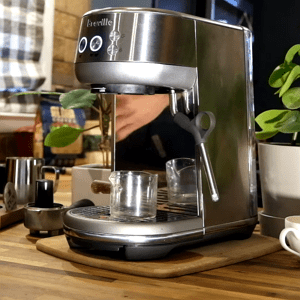
Breville Bambino Plus
Breville US price: $499.95. Machine only; grinder sold separately Price context checked September 25, 2026.
- Heater ready (claimed)
- 3 seconds
- Portafilter
- 54 mm
- Tank
- 1.9 L
- Milk
- Auto + manual
- Grinder
- Separate
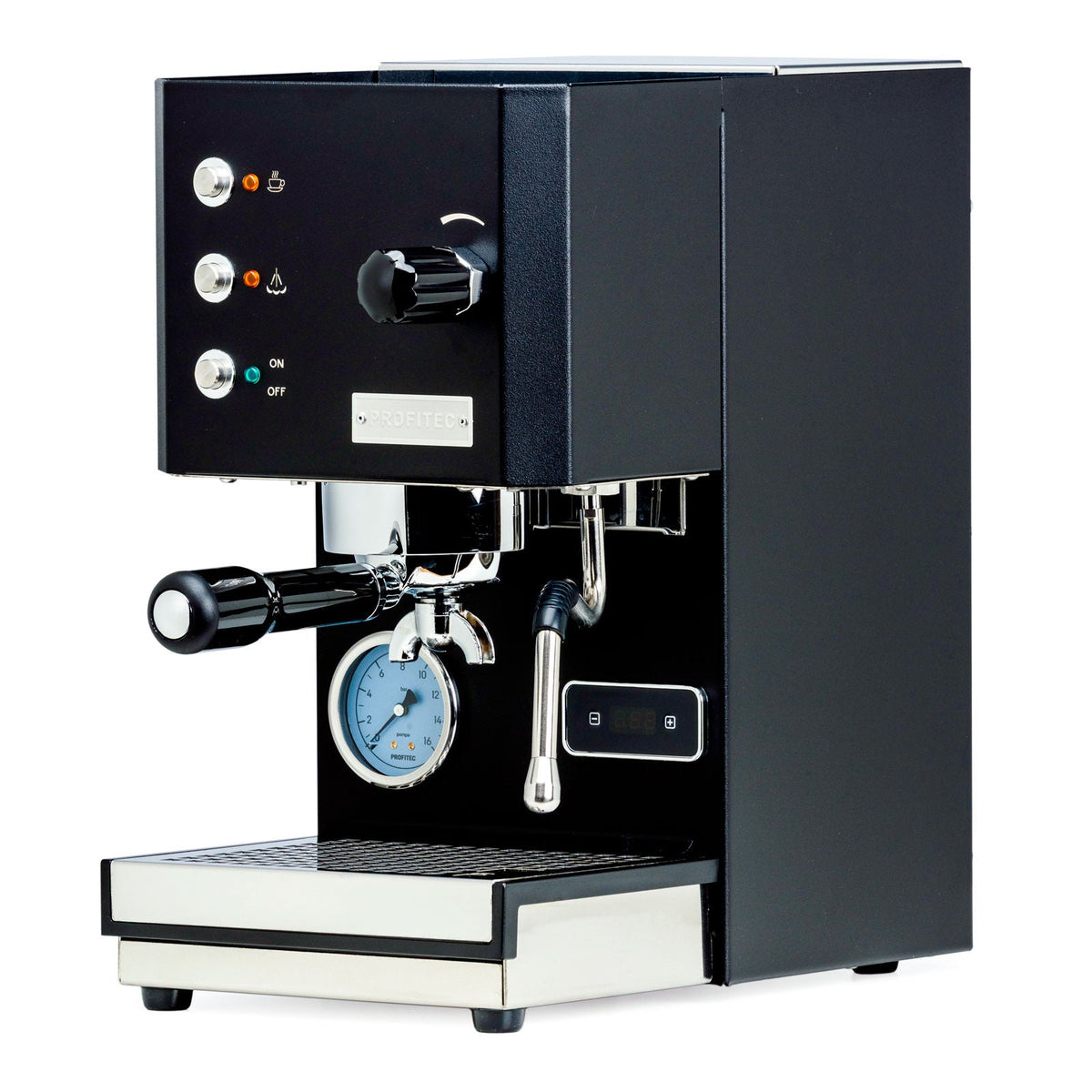
Profitec GO original generation
Current US original-generation price checked: Current specialist price $1,199. Clive Coffee displayed the original GO at $1,199 with Add to Cart on September 24, 2026. Whole Latte Love also displayed $1,199 with a three-year parts-and-labor warranty, but stock and color selection can vary. GO 2.0 European prices are not treated as US original-GO prices. Price context checked September 24, 2026.
- Scored generation
- Original GO sold by current US specialists, not the GO 2.0 introduced in Europe in June 2026
- Brew system
- PID-controlled brass single boiler, 58 mm ring group, vibration pump, three-way solenoid and automatic shot timer
- Pressure control
- Front brew-pressure gauge and externally accessible OPV below the cup tray; adjust only with a suitable blind basket and documented procedure
- Water and fit
- About 2.8 L removable reservoir; manufacturer dimensions 210 × 362 × 381 mm without portafilter and 210 × 410 × 381 mm with it
- Electrical record
- Official product record lists the US version at 115 V and 900 W; verify the rating plate because regional listings and retailer wattage cells conflict
Lelit Anna PL41TEM
Current EU retailer price: €549. Coffee Friend listed Anna PL41TEM at €549 and in stock on September 24, 2026; US PESAN06 was $599.95. Price, voltage, plug, warranty, tools and stock are regional, so compare the exact article and dealer terms. Price context checked September 24, 2026.
- Exact market
- EU PL41TEM, polished stainless steel, 220-240 V, 50 Hz and type E+F plug
- Boiler and group
- 250 ml brass single boiler with PID control, LELIT57 group and three-way solenoid valve
- Pressure feedback
- Front manometer for coffee pressure with a marked green target area; it is not a measurement at the coffee puck
- Water and milk
- 2.7 L tank with side level window; multidirectional steam and hot-water wand with anti-burn handle
- Size and mass
- 230 × 380 × 340 mm and 7.5 kg in current official EU records
Ascaso Steel Uno PID
Ascaso USA reference price: $1,695.00 reference. Official US refurbished listing showed $1,440.75 and sold out; verify new stock and warranty Price context checked September 17, 2026.
- Heating
- One thermoblock for brewing, hot water, and steam in sequence
- Power
- 120 V, 1050 W, 9 A on official US reference listing
- Portafilter
- 58 mm, walnut-handled
- Controls
- PID, two volumetric doses, shot timer, programmable pre-infusion
- Water tank
- 67 fl oz / about 2 L, removable
05Drink workflow
Milk and espresso pace reveal the real architecture
Breville Bambino Plus
Automatic mode needs the supplied jug, cold milk within its marks, contact with the temperature sensor, and the wand lowered into position. You choose one of three temperatures and textures; the machine stops automatically. Manual mode remains available when you want direct control.
Repeat the milk quantity, jug position, and settings before judging consistency. GearLab found automatic milk useful but preferred some settings over others; Tom’s Guide wanted less foam for its flat-white target. Those are unit-specific observations, not proof that one preset fits every milk or drink. [11] [13]
Wipe the wand immediately and lower it for the automatic purge. Purge water lands in the small tray, so easy tray access matters. If everyone in the household wants to learn manual steaming, the cheaper BES450 deserves priority because the Plus premium is paying mainly for automation.
Profitec GO original generation
Pressing steam mode raises the same boiler used for brewing, so milk service is sequential. The articulated wand and two-hole tip can texture a small pitcher, but the routine includes purging water, waiting for steam temperature, steaming, wiping and purging the wand, then cooling the boiler through a flush before another espresso. Owner discussions split between satisfactory daily cappuccinos and frustration with power, wand angle or back-to-back pitchers. Skill, milk volume, steam setpoint and version details matter, so no universal steam time is claimed. [source] [source]
Lelit Anna PL41TEM
Pull espresso first, switch to steam, wait, purge condensation, texture, then wipe and purge. The exact-model manual requires opening the valve and running the pump in hot-water mode until water flows before returning to coffee mode, refilling the boiler. [source] [source] [source] [source] Milk performance is a combination of heat delivery, air control, circulation, recovery, cleaning, and operator attention. A fast system can frustrate a beginner if it gives little time to correct position, while a slower system can frustrate a household making several drinks.
Use cold milk, a consistent quantity, and the recommended vessel or container. With a manual wand, purge condensate, add a controlled amount of air near the beginning, then position for circulation and stop before overheating. With an automatic milk path, start from a conservative documented setting, keep the sensor or hose arrangement consistent, and change temperature or texture one step at a time. Alternative milks differ by formulation, not only plant type.
The cleaning step belongs in the milk rating. Wipe and purge a wand immediately. Rinse or refrigerate a removable container as directed. Complete any prompted milk-path rinse instead of postponing it. Dried milk can narrow openings, change texture, create odors, and turn a convenient system into a recurring maintenance problem.
Ascaso Steel Uno PID
The single heater moves from brew to steam. The older FAQ describes another roughly one to one-and-a-half minutes and lower force than boiler steam, though generation and starting state matter. One cappuccino remains practical: purge, introduce air early, roll a small cold quantity, then wipe and purge. [4]
After steam, the manual says to wait five minutes or run water to refill and cool the circuit before another coffee. Follow the exact procedure, because the heater must return safely to brew condition. [3]
Keep milk, quantity, jug, and setting consistent. If two lattes are routine, compare the Steel Duo PID or a dual boiler rather than expecting technique to remove the serial delay.
06Long-term fit
Ownership costs include water, cleaning, access and time
Small machines need disciplined counter management. Leave room to remove the tank, lock the portafilter without hitting a wall, vent steam safely and remove the drip tray without lifting the machine. Give wet accessories a washable landing place. If the machine must be pulled forward for every refill, include that movement in the daily routine.
Compact does not mean maintenance-free. Milk residue, coffee oils and scale occupy the same pathways as on larger equipment. Follow the exact manual, use suitable water and confirm local service. The total ownership cost includes a grinder where required, a scale, care products and any model-specific tools.
Breville Bambino Plus ownership context
Milk residue, coffee residue, and mineral scale are separate jobs. Wipe and purge the wand after milk, rinse the basket after coffee, and follow the indicated group-cleaning and descaling routines. Breville says the cleaning reminder follows 200 extractions and warns against distilled, demineralized, or highly filtered water. [2]
The official support hub, warranty route, and BES500 parts navigation provide places to begin when something fails. They do not prove comprehensive internal-parts stock, a repair price, or easy decade-long service. The current documents retrieved for this review did not establish an exact model-specific warranty duration, so confirm the seller’s applicable coverage and keep proof of purchase.
For used or refurbished units, ask for a demonstration of espresso, automatic milk, and manual steam. Check for leaks, warning lights, missing accessories, and written return terms. A lower sticker price should still leave a clear remedy if the machine arrives faulty.
Profitec GO original generation ownership context
Longer-term owner threads repeatedly praise espresso control, compact weight, fast practical readiness and access to replaceable parts. Repeated cautions concern the single-boiler delay, steam technique, cup clearance, reservoir or tray rattle, display buttons and version-specific parts. These patterns help form an inspection and workflow checklist. They cannot establish a defect rate, prove service life or predict what another owner will taste.
Retail reviews and forum threads are self-selected. They mix original production, 2025 running changes, colors, countries, grinders, water, recipes and user experience. A two-year report can reveal a concrete owner experience but not population reliability. Diagnoses are rarely technician-confirmed, and praise from a retailer page has a commercial context.
07After delivery
Verify the exact unit and stabilize one routine
On delivery, match the model code, voltage and included accessories to the order. Photograph the rating plate, inspect for shipping damage, read the exact manual and preserve the return window. Set up suitable water before scale begins accumulating.
Use one fresh coffee, one dose and one target yield while learning. Change grind before changing several variables. Record settings and taste in plain language. For milk, repeat one quantity and pitcher before judging steam performance. Finish every session with the documented cleaning sequence.
Breville Bambino Plus workflow
A practical drink sequence is simple: prepare the station, run the manual’s short group purge, dry and fill the basket, tamp level, extract, then texture milk. The heater removes most warm-up waiting, but the full drink still includes coffee preparation and cleanup.
The one- and two-cup buttons offer preset or programmable volumes, and manual control remains available. Serious Eats found the convenience useful but its tested volumetric results less accurate than desired. A scale is therefore valuable while dialing in because it separates a changed drink weight from a changed grind. [10]
For two milk drinks, every coffee and milk step remains sequential. Decide whether to finish one drink at a time or prepare both espressos before milk. A household regularly serving a queue should compare this cadence with a dual-boiler or more automated category, rather than judging only the three-second heater claim.
Profitec GO original generation workflow
The original GO’s front controls are deliberately direct: power, brew, steam, a PID display and two setting keys. Fast Heat Up deliberately overshoots and requests a flush to warm the group and portafilter; this is a sequence, not proof that every component has stabilized at the first ready signal. The timer starts with pump activation, while a scale remains necessary for beverage mass. The top-fill reservoir, removable tray and compact width suit a small station, but overhead access and limited cup clearance belong in the fit check. [source] [source]
08Owner context
Owner reports create an inspection list, not a failure rate
Use owner accounts to identify unclear controls, cleaning friction, access constraints and service questions. Confirm specifications with official documentation and preserve uncertainty when regional packages conflict.
09Four bounded recommendations
Choose by best fit and keep the avoid-if guidance visible
Breville Bambino Plus
I would choose the Bambino Plus for a household making lattes and cappuccinos most days. Its quick-start heater and automatic milk remove two chores, but you still grind, dose and tamp. If you mostly drink espresso, the standard Bambino leaves $200 more for your grinder at the Breville US prices checked for this review.
Evidence boundary: Worth the premium when automatic milk earns its keep.
- Best fit: A household that wants repeatable milk drinks with less milk-steaming practice
- Best fit: Someone who wants a short startup routine and a separate, upgradeable grinder
- Best fit: Beginners willing to learn the coffee preparation even when milk is automated
- Avoid if: The machine would consume the money you need for an espresso grinder
- Avoid if: You want to select brew temperature or brew and steam at the same time
- Avoid if: You expect one button to grind the beans and make the whole drink
Profitec GO original generation
Buy the original US Profitec GO when a 58 mm group, front PID with shot timer, visible brew pressure and top-access OPV matter more than simultaneous brewing and steaming. Clive Coffee displayed the black, blue, red and yellow original GO at $1,199 with Add to Cart on September 24, 2026. Profitec launched GO 2.0 in Europe in June 2026, so confirm the generation, color-specific 2025 updates, voltage, included portafilters and warranty before comparing prices.
Evidence boundary: This is a research-led assessment, not Coffeedant testing. The original GO manual, parts diagram and current US specialist listings establish the scored machine. Profitec’s current site and Kaffeemacher’s purchased GO 2.0 test define the successor boundary rather than supplying features to the original. Coffee Kev and CoffeeGeek provide attributed hands-on original-GO context. Retail reviews and forum discussions are self-selected and cannot establish failure rates, measured performance or expected life.
- Best fit: Espresso-first buyers who want PID temperature control and visible pressure without modifying a machine
- Best fit: One-person or two-person routines with occasional small milk drinks
- Best fit: Compact kitchens that can still provide top access to the reservoir
- Avoid if: You make several milk drinks back to back or require simultaneous brewing and steaming
- Avoid if: You expect GO 2.0 pre-infusion, timed dosing, OLED controls or automatic post-steam cooling
- Avoid if: You need a dedicated hot-water wand, plumb-in operation or an included grinder
Lelit Anna PL41TEM
Consider EU PL41TEM for adjustable boiler temperature, a pressure manometer, three-way valve and 2.7 L tank in a 230 mm wide machine. Its 250 ml brass boiler handles coffee, steam and hot water sequentially, while LELIT57 has fewer third-party tools than 58 mm rivals. Coffee Friend listed it at €549 on September 24, 2026.
Evidence boundary: This is research-led, not a Coffeedant bench test. Current EU PL41TEM records govern specifications; two hands-on reviewers add bounded context. Coffeedant did not measure group temperature, puck pressure, extraction yield, sound, energy, recovery or reliability.
- Best fit: Espresso learners who want PID temperature control without installing a modification
- Best fit: Small kitchens that can accommodate a separate capable grinder and 380 mm machine depth
- Best fit: One- or two-drink sessions where a deliberate brew-to-steam sequence is acceptable
- Avoid if: You already own many 58 mm baskets, tampers or puck-preparation tools
- Avoid if: You regularly prepare several milk drinks and need brewing and steaming at the same time
- Avoid if: You want a shot timer, volumetric dosing, automatic milk or a one-button workflow
Ascaso Steel Uno PID
The Steel Uno PID makes sense when you want Ascaso’s 58 mm group, adjustable temperature, programmable pre-infusion, volumetric buttons, gauge, and quick on-demand heating, but milk is occasional and a 1050 W single circuit suits the kitchen better than the Duo. It is harder to recommend at a $1,695 US reference price while the official listing available to verify is refurbished and sold out. Confirm new stock, generation, warranty, and service before treating the reference price as a live offer.
Evidence boundary: A refined, low-draw espresso platform whose single-heater milk sequence and uncertain US availability narrow the audience.
- Best fit: An espresso-first household that wants 58 mm accessories, PID control, a gauge, and programmable pre-infusion
- Best fit: One or two drinks at a time, with milk made occasionally rather than in a daily queue
- Best fit: A kitchen that values lower electrical draw and short on-demand startup over simultaneous steam
- Avoid if: You regularly make two or more milk drinks and dislike waiting or cooling the heater between modes
- Avoid if: You need confirmed new US stock and a simple current manufacturer purchase path today
- Avoid if: Traditional boiler thermal mass, powerful steam, and broad owner-service evidence are priorities
Bambino Plus
Best fit: A household that wants repeatable milk drinks with less milk-steaming practice
Avoid if: The machine would consume the money you need for an espresso grinder
Read the full review →Profitec · Current US original GO, 115 V retailer stock; excludes GO 2.0GO original generation
Best fit: Espresso-first buyers who want PID temperature control and visible pressure without modifying a machine
Avoid if: You make several milk drinks back to back or require simultaneous brewing and steaming
Read the full review →Lelit · EU PL41TEM, polished stainless steel, type E+F plugAnna PL41TEM
Best fit: Espresso learners who want PID temperature control without installing a modification
Avoid if: You already own many 58 mm baskets, tampers or puck-preparation tools
Read the full review →Ascaso · STEEL-UNO-PID-120VSteel Uno PID
Best fit: An espresso-first household that wants 58 mm accessories, PID control, a gauge, and programmable pre-infusion
Avoid if: You regularly make two or more milk drinks and dislike waiting or cooling the heater between modes
Read the full review →10Visible answers
Small espresso machines FAQ
Which Bambino?
Bambino Plus, BES500. This review covers the US model; the standard Bambino is BES450.
Do I need a grinder?
For fresh-bean espresso, yes. The included dual-wall baskets also let you start with suitable pre-ground coffee.
Which Profitec GO is reviewed?
The original-generation GO still sold by current US specialists at $1,199, not the GO 2.0 introduced in Europe in June 2026.
Does it have a PID?
Yes. The front display sets brew and steam temperatures and becomes a shot timer while the pump runs.
Is this the current PID Anna?
Yes. This covers EU PL41TEM, often called Anna 2 or Anna PID. Earlier PL41EM and PL41LEM machines have different controls and should not inherit this review.
Is the group 58 mm?
No. Lelit specifies its LELIT57 group and compatible LELIT57 tools. Owners find suitable accessories, but the selection is smaller than for standard 58 mm machines.
Can the Steel Uno brew and steam together?
No. One thermoblock changes between brewing and steam. Make the espresso, enter steam mode, texture milk, then cool or prime the circuit before another shot as the manual directs.
Is it the same brewer as the Duo?
It shares many controls and the 58 mm Steel platform, but the heating and milk workflow are materially different. The Duo has independent brew and steam thermoblocks.
See one shortlisted workflow
Independent product context
Coffee Kev
Sage (Breville) Bambino Plus review after nearly four years
Coffee Kev’s long-term perspective adds context beyond a short review. His UK Sage experience is separate from the US specifications and buying terms used here. This is an external review, not Coffeedant testing.
Watch on YouTubeHow the guide was built
Exact models, existing evidence ledgers and type-appropriate comparison
I checked current official product pages, exact manuals or support routes, dated prices and regional model codes for all four recommendations on September 25, 2026. I then compared independent hands-on evaluations and owner discussions, using each for the question it can answer. Manufacturer documents control identity and specified operation. Independent reviews add observed workflow. Owner accounts identify questions but do not establish failure rates.
This is a research-led buying guide, not a Coffeedant side-by-side test. I did not invent measurements, transfer specifications between generations, treat a retailer review pool as representative, or rank the machines with an arbitrary score. The shortlist is intentionally small because it represents four different divisions of labor. Prices are dated observations, and buyers should confirm the exact model, seller, voltage, bundle, warranty and return terms.
Check the evidence
Sources and further reading
- [1] Breville US: Bambino Plus BES500
Official US features, included equipment, and $499.95 displayed price. Checked September 25, 2026; the dimension-axis disagreement remains unresolved.
- [2] Breville BES500 US/Canada/Mexico manual
Current product-linked booklet covering baskets, dose range, controls, milk, water, cleaning, and maintenance. Checked September 25, 2026.
- [3] Breville BES500 support hub
Official setup, extraction, cleaning, manual, support, warranty, and parts route. Checked September 25, 2026.
- [4] Breville North American warranty terms
Official claim route and terms. Checked September 25, 2026; exact BES500 duration was not established.
- Profitec GO product record
Manufacturer dimensions, weight, US 115 V/900 W record and official downloads. The live line has transitioned toward GO 2.0, so original-only claims are cross-checked against the manual and US listings.
- Profitec current home and GO 2.0 boundary
Manufacturer’s current promotion of GO 2.0, used to prevent successor features from being assigned to the original US GO.
- Profitec authorized dealer locator
Official statement that Profitec products are sold through its dealer network; useful for seller verification rather than performance.
- Original Profitec GO user manual
Specialist-hosted manufacturer manual for setup, PID menus, Fast Heat Up, ECO, cleaning, safety and original-generation operation.
- Lelit exact Anna PL41TEM product page
Current EU identity, functions, regional articles, dimensions, mass and package; checked September 24, 2026.
- Lelit Anna PL41TEM technical sheet
Official 2024 sheet confirming core architecture and LELIT57 filters; it lists a blind filter that the current page omits.
- Lelit US Anna PESAN06 product page
Current US regional identity, 120 V article, $599.95 price and under-ten-minute heat-up claim; not transferred to EU PL41TEM.
- Lelit PL41TEM user manual mirror
Retailer-hosted 2017 exact-model manual for first fill, PID, steam reset and care; current EU records govern later changes.
- Ascaso USA refurbished Steel Uno PID product page
Primary US reference for 120 V power, nominal dimensions, tank, controls, materials, accessories, reference price and refurbished status. It was sold out and does not establish current new-machine availability or pricing.
- Ascaso global Steel range and 2026 specification sheet
Primary current-family source for one-thermoblock architecture, control range, nominal global dimensions, weight and manufacturer claims. Regional voltage, package, configuration and availability may differ.
- Ascaso Steel user manual
Official 2022 shared manual for safe use, programming, the Uno post-steam reset, cleaning and water. Exact specifications should be checked against the selected machine label and current offer.
- Ascaso USA Steel Uno FAQ
Official support context for the single-block sequence, older heat-up timing, flowmeter, OPV, steam pressure and cleaning. It appears older and is not treated as a current-generation performance guarantee.
The buying decision
Choose the routine the household will repeat
Choose Bambino Plus when the smallest easy milk workflow matters. Choose Profitec GO when compact width must coexist with PID control and a 58 mm group. Choose Lelit Anna when factory temperature control and a lower purchase price justify the 57 mm ecosystem. Choose Ascaso Steel Uno when fast thermoblock behavior and a slim modern chassis fit the routine.
The best compact machine is the one that remains convenient after the grinder, refill path and cleaning tools are on the counter. Measure that station before ordering.