

02Start with the system
A rotary-pump heat exchanger, not a compact dual boiler
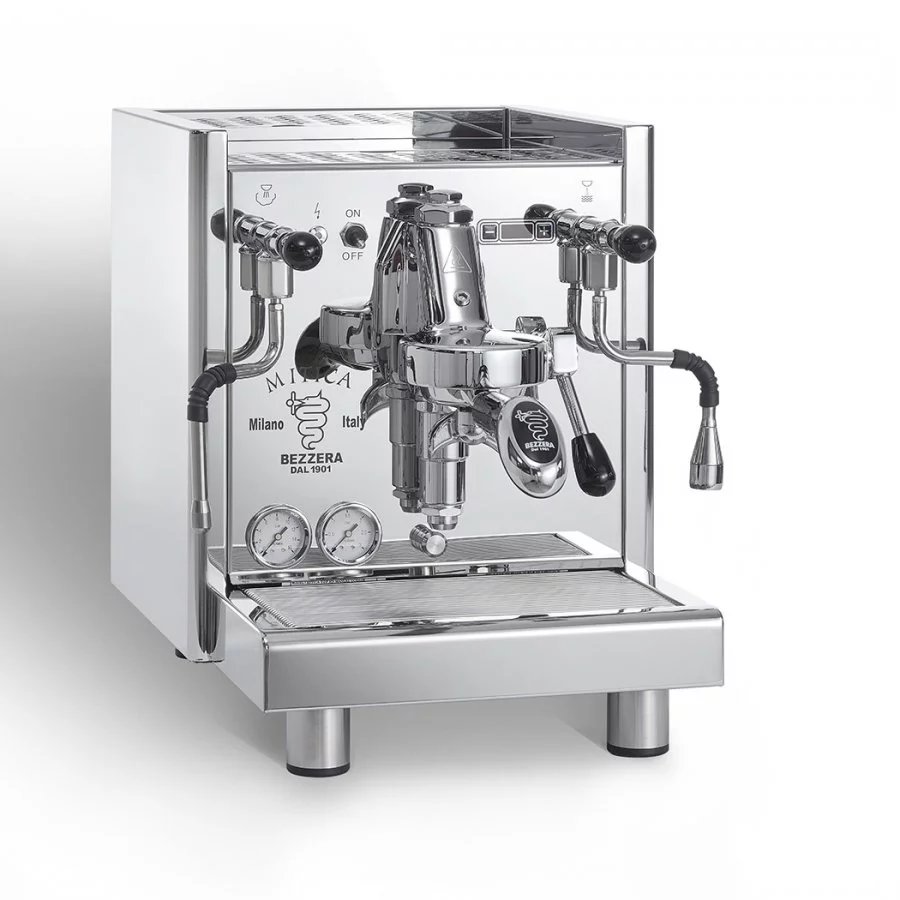
The Bezzera Mitica Top PID belongs to the traditional premium heat-exchanger category: a two-liter copper steam boiler feeds a separate tube that heats fresh brew water, while an E61 thermosyphon group stores and circulates heat. A rotary pump supports quieter operation and a direct-water connection, and the machine can brew espresso and steam milk at the same time. Dual gauges, joystick valves and polished stainless construction complete the familiar prosumer layout. [source] [source] [source]
The word PID requires care. It controls the steam-boiler temperature or pressure regime that supplies the heat exchanger. It does not create an independently set brew boiler at the group. Brew-water temperature still depends on boiler set point, thermosyphon state, idle duration, incoming water, flush behavior and the pace of previous shots. This can be stable in a learned routine, but entering a number on the controller is not the same as guaranteeing that number at the coffee.
The short decision: choose Mitica when rotary-pump calm, plumbing flexibility, powerful simultaneous steam and the E61 ritual are the reasons for buying. Choose the Profitec Pro 500 PID when current dealer support and revision clarity are stronger locally. Choose the ECM Technika V Profi PID for a closely related premium plumbable HX decision. Choose a dual boiler when independent coffee and steam temperatures matter more than tradition.
03Installation first
Plan water, power, drainage and forty-five centimeters of depth
Reservoir mode uses a roughly four-liter tank in multiple retailer specifications. Direct-water mode can remove filling and reduce pump noise, but it adds inlet pressure, filtration, shutoff and drainage responsibilities. The official manual describes mains-water connection details for applicable versions. Have a qualified installer follow the exact regional manual and local plumbing code. A leak detector and accessible shutoff are sensible system choices, especially because an owner report of sporadic leakage involved a plumbed installation. One report does not predict failure; it shows why containment and shutoff access matter. [source] [source]
- Day one: record the rating plate and factory PID setting, select reservoir or line mode correctly, fill and heat according to the manual, and inspect every connection.
- Days two and three: keep one medium-roast coffee, basket, dose and target yield. Use a scale and change grind before controller settings.
- Days four and five: repeat shots after similar idle periods, noting flush length and rebound. Build a routine from the cup rather than copying one universal flush.
- Days six and seven: make the largest household order while overlapping espresso and milk, then complete cleaning and shutdown.
Warmup means more than the controller reaching its set point. The E61 group and portafilter contain substantial metal and need thermal circulation. Use a conservative schedule, keep the portafilter locked loosely in the group and do not treat the first displayed number as complete readiness.
04Rating deep dive
Espresso: strong thermal mass, indirect temperature control
The E61 thermosyphon group is designed to circulate hot water and stabilize a heavy group. The rotary pump supplies extraction pressure with a different sound and flow character from a small vibration pump. Together they can support repeatable espresso across consecutive shots once the machine is warm and the operator understands its state. They do not remove the need for an espresso-capable grinder, even distribution, level tamping and a measured beverage yield. [source] [source]
After a long idle, water sitting in the heat exchanger and an overheated group path can be hotter than water during a run of drinks. A cooling flush replaces standing water and changes the group's immediate state. Flush too little and the first shot can begin hot; flush too much and the group may undershoot before rebound. Home-Barista's technical guide explains this general HX relationship, but no remote source can prescribe the exact number of seconds for every Mitica, room, boiler setting and flow rate. [source] [source]
The PID still adds value. It can hold the steam-boiler regime more consistently than a broad mechanical pressure-stat cycle and lets the owner move the overall thermal zone. Its effect at the puck remains indirect. A buyer who wants to set brew water to a recorded temperature independently of steam should compare a dual boiler such as the Bezzera Duo MN.
Read the gauges by function: boiler pressure describes steam state, while pump pressure reflects hydraulics under flow and puck resistance. Neither displays coffee-bed temperature.
Espresso assessment
Read the PID and flush as machine-state tools
Puck preparation remains the first repeatability requirement.
Idle duration changes what a heat exchanger needs before a shot.
| Signal | What the evidence says | Buying consequence |
|---|---|---|
| E61 thermosyphon mass | Heavy group circulates heat from the boiler. | Plan full warmup and consistent portafilter state. |
| PID on steam boiler | Controller stabilizes the boiler regime rather than a separate brew boiler. | Temperature at the coffee remains indirect. |
| Rotary pump and gauges | Hydraulic pressure is visible during operation. | Use gauges diagnostically, not as a flavor target by themselves. |
Evidence note: No Coffeedant group-temperature or extraction measurements are claimed.
05Rating deep dive
Milk: simultaneous service is the architectural payoff
A large steam boiler is why many owners accept heat-exchanger temperature management. Mitica can pull espresso while the steam boiler drives the wand, so coffee and milk tasks can overlap. Joystick valves open quickly and reduce repeated wrist rotation. This is a genuine workflow advantage over a single boiler when a household serves several cappuccinos or lattes. [source] [source] [source]
Fast steam also punishes hesitation. Begin with cold milk and an appropriate pitcher, purge condensate, add only the needed air near the start and establish a rolling circulation. Close the joystick before removing the tip, wipe immediately and purge again. A beginner can lower the boiler set point only after understanding that this changes the brew side as well as steam behavior.
The machine can work simultaneously, but the person still has two hands. Stage the weighed dose and pitcher, start extraction, then steam only when the coffee workflow is under control. For a pair of drinks, many owners will find a repeatable rhythm. In a larger queue, grinding, knocking out pucks, wiping baskets, pitcher rinsing and drink assembly can become the bottleneck before boiler capacity.
Boiler setting, tip, milk volume and technique prevent a responsible universal steaming-time claim. Judge whether the power is controllable for the normal pitcher and full order.
Milk assessment
Steam capacity shifts the bottleneck to the operator
The machine can brew and steam at once.
Boiler set-point changes affect both steam pace and brew-side heat.
| Signal | What the evidence says | Buying consequence |
|---|---|---|
| 2 L HX boiler | Multiple regional sources agree on the core boiler architecture. | Substantial reserve for repeated milk work. |
| Joystick steam valve | Quick on/off control appears across current listings. | Convenient, but immediate power asks for practice. |
| Simultaneous operation | HX brew path remains available during steam use. | Useful for household queues and entertaining. |
Evidence note: No universal steaming time is claimed.
06Rating deep dive
Workflow: tactile and fast in service, slow to become ready
The everyday interface is classic: PID display, brew lever, two gauges and joystick valves. There is no integrated grinder, volumetric shot button or built-in shot timer in the cited configuration. Once warm, the machine is fast in service because brew and steam can overlap and the rotary pump supports a calmer sound profile. From cold, the heavy E61 group asks for planning rather than impatience.
Reservoir use preserves installation flexibility but keeps top access, tank cleaning and refill checks in the routine. Direct connection removes that chore and can improve convenience for high use, while creating dependence on correct pressure, treatment, drain design and shutoff. The owner must select the correct supply mode and never let plumbing become an invisible assumption. [source] [source]
Cooling-flush technique is not a fixed tax before every shot. It is a response to system state. A machine that has idled for an hour can need a different approach from the third drink in ten minutes. Observe steam and flow behavior, use a consistent measured routine and let taste guide small changes. Randomly flushing large volumes wastes water and can send the group below the desired range.
Joystick and E61 valves remain wear parts. Clean them correctly and use the owner videos only to preview ergonomics, not to override the manual or rating plate. [source] [source]
Workflow assessment
Fast during service, deliberate before service
Warm controller and warm E61 group are not the same milestone.
Tank and plumbed modes create different ownership work.
| Signal | What the evidence says | Buying consequence |
|---|---|---|
| Lever plus joysticks | Physical controls make brew, steam and water direct. | Little menu friction during a drink queue. |
| Large thermal mass | E61 group and two-liter boiler need stabilization. | Use a timer or schedule, not impatience. |
| Direct-water option | Top configuration supports a line connection. | Convenience depends on professional installation. |
Evidence note: Workflow includes installation and reset work, not only lever movements.
07Rating deep dive
Build and service: commercial-minded parts in a heavy home chassis
Polished stainless panels, a copper boiler, E61 group, rotary pump and joystick valves make Mitica feel like traditional café equipment scaled for a serious home station. At roughly 27 to 28 kilograms, it should remain stable under portafilter locking and steaming. The architecture is familiar to many prosumer-machine technicians, which can support repair rather than appliance replacement. [source] [source] [source]
Familiar architecture does not guarantee local parts, current electronics or affordable freight. This model's status in different markets makes dealer selection critical. Before paying, ask who holds stock, who supplies warranty labor, whether the PID controller and control board remain available, what technician travel costs, and whether cross-border purchase voids support. Obtain the exact written term rather than borrowing a warranty from a page in another country.
Owner reports of pump rattle and a plumbed leak provide inspection questions, not failure rates. Ask about mounts, line pressure, fittings and leak detection. [source] [source]
Internal work combines mains electricity, hot water, high pressure and a heavy machine. Owners can clean accessible coffee and milk paths, inspect for external leaks and keep records. Boiler, pump, electrical, safety-valve and plumbing repairs belong to a qualified technician. Close a direct-water supply when the machine will be unattended if the installer or manual calls for it.
Inspect tray, gauges, joysticks, lever, portafilter lock, fill behavior and pump sound. Record shipping damage immediately.
Build assessment
Traditional construction needs modern support
Rotary pump, copper boiler and E61 parts are technician-familiar.
Model status and electronics availability matter as much as metalwork.
| Signal | What the evidence says | Buying consequence |
|---|---|---|
| 27–28.2 kg chassis | Official-era and current regional sources publish close but different weights. | Stable, difficult to ship or reposition. |
| Conventional hydraulic layout | Manual and sellers describe familiar HX components. | Potentially repairable by a qualified prosumer technician. |
| Anecdotal pump/leak reports | Two self-selected owner cases without a denominator. | Create inspection questions, not a failure prediction. |
Evidence note: Local parts access is not guaranteed by generic E61 familiarity.
08Rating deep dive
Features: complete traditional equipment, limited digital guidance
The core feature set is strong: PID-managed boiler regime, two gauges, rotary pump, four-liter-class reservoir, direct-water option, E61 lever group, heat exchanger and joystick steam and hot-water valves. It can brew and steam simultaneously. This is a complete traditional prosumer station rather than a machine awaiting a pump or plumbing upgrade. [source] [source] [source]
What it does not provide is equally important. There is no independently controlled brew boiler, built-in grinder, volumetric dosing, integrated scale, programmed pressure profile or native shot timer in the cited model. The E61 preinfusion effect depends on lever and water-supply conditions; it is not a programmable low-flow recipe. Direct line pressure can change early-shot behavior compared with reservoir and pump use.
PID language is the largest source of feature inflation. The controller regulates the steam-boiler target more tightly. Because that boiler supplies the heat exchanger and thermosyphon, the target affects brewing. It does not directly measure water at the puck. Treat the display as a repeatable machine-state input, not a guarantee printed in degrees.
Seller packages differ. Confirm portafilters, baskets, blind filter, tamper, plumbing fittings, treatment items and regional plug in writing.
Features assessment
A rich traditional specification, honestly named
The PID is useful but often misunderstood.
Direct water is a system feature, not a hose-only feature.
| Signal | What the evidence says | Buying consequence |
|---|---|---|
| PID and two gauges | Current listings consistently show control and pressure feedback. | Good repeatability inputs without a native shot timer. |
| Rotary pump and plumb-in mode | Top configuration supports tank or mains water. | Quieter service and convenience after correct installation. |
| No separate brew boiler | Core architecture remains a heat exchanger. | Cannot select brew and steam targets independently. |
Evidence note: Seller bundles and regional fittings are not assumed universal.
09Rating deep dive
Value: excellent equipment, complicated by market status
The A$4,349.90 checked Australian listing buys a two-liter HX boiler, rotary pump, E61 group, PID, dual gauges, joystick controls and tank or direct-water operation. That is a serious equipment package. The value question is less about missing metal than about model currency, local price, dealer support and whether an HX routine is actually desired. [source]
Compare a complete installed system. Add a precise grinder, scale, water treatment, regulator where required, plumbing labor, drainage, leak protection, cleaning products and future technician visits.
ECM Technika V Profi PID and Profitec Pro 500 PID compete with closely related traditional workflows and may have clearer current support in a particular country. Bezzera Duo MN costs more in many markets but gives separate boilers and more direct temperature control. Rocket Mozzafiato Cronometro R adds its own design and dealer proposition. Choose the model whose local support and architecture fit, not the one with the longest list of polished parts.
For mostly straight espresso, a smaller PID single boiler may be quicker and cheaper. Repeated milk service better justifies Mitica's space, energy and installation.
Value assessment
Price the installed machine, not only the box
An HX rotary-pump station can serve for years when supported.
Plumbing, water, grinder and technician access belong in the budget.
| Signal | What the evidence says | Buying consequence |
|---|---|---|
| A$4,349.90 checked price | Australian retailer listing on September 17, 2026. | Useful only within that market and date. |
| Full prosumer equipment | PID, rotary pump, gauges and plumbing are included concepts. | Fewer architecture upgrades are needed. |
| Market-status uncertainty | Current retailer stock exists without a current public Bezzera product page. | Get parts and warranty commitments in writing. |
Evidence note: Price and availability are snapshots, not global promises.
10The long view
Water and installation discipline decide the ownership story
Every session
Rinse basket and portafilter, brush loose coffee from the group, wipe and purge the steam wand immediately and empty the drip tray as needed. Water-backflush only as the applicable manual directs. Keep the lever and valves moving smoothly without forcing them.
Periodic care
Follow Bezzera guidance for detergent backflushing, shower-screen and group-gasket care. Clean the reservoir even if the machine is sometimes plumbed. Inspect inlet and drain lines, fittings, pressure regulator, filter date and the area under the machine. Record water-test results and service. Do not substitute a generic aggressive descale for a technician's diagnosis.
E61, valves and plumbing
Cams, seals, valves and line fittings are wear points. Cleaning and lubrication schedules must work together. Keep the water shutoff accessible; uncontrolled heat, leaks, unusual pump noise or electrical trips require safe shutdown and professional diagnosis.
What remains uncertain
Retailer pages conflict on exact height, weight, power, accessories and warranty. The official manual spans configurations and predates current dealer stock. This review therefore reports ranges and named regional facts rather than inventing one global specification. The delivered rating plate and written invoice control the purchase. [source] [source] [source] [source]
11Quick answer, then Details
Compare HX tradition with independent control
| Machine | Price position | The quick decision |
|---|---|---|
| Bezzera Mitica Top PID | A$4,349.90 checked Australian listing | Choose for rotary-pump E61 service, plumbing and joystick controls when local support is sound. |
| ECM Technika V Profi PID | Premium plumbable HX tier | Choose when ECM finish and current local dealer support are stronger. |
| Profitec Pro 500 PID | Premium HX tier; market dependent | Choose for a current premium HX alternative with a broad dealer footprint. |
| Bezzera Duo MN | Higher dual-boiler tier | Choose for independent boilers and more direct digital control. |
DetailsOpen the technical and workflow comparison
| Machine | Dimensions | Heating | Coffee setup | Milk workflow | Best fit |
|---|---|---|---|---|---|
| Bezzera Mitica Top PID | About 320 W × 450 D × 375–400 H mm; 27–28.2 kg | 2 L copper heat exchanger; PID manages boiler regime | E61 lever, rotary pump and dual gauges | Simultaneous brew and steam; joystick valves | Traditional multi-drink station with plumbing option |
| ECM Technika V Profi PID | Large polished E61 chassis | PID-managed heat exchanger | Rotary pump, lever and gauges | Simultaneous brew and steam | Finish-focused traditional buyer |
| Profitec Pro 500 PID | Traditional full-depth E61 format | PID-managed heat exchanger | Lever group; pump/revision details must be checked | Simultaneous brew and steam | Buyer prioritizing current support clarity |
| Bezzera Duo MN | Larger modern Bezzera platform | Separate brew and steam boilers | Manual group with digital machine management | Simultaneous with independent temperatures | Bezzera buyer who wants control over HX ritual |
Regional prices, voltage, dimensions, warranty and current stock differ. Confirm the exact delivered variant and local service route.
13Before checkout
Bezzera Mitica Top PID questions answered
Is the Mitica Top PID a dual boiler?
No. It is a heat-exchanger machine with one steam boiler and a separate brew-water tube, so it can brew and steam simultaneously.
What does its PID control?
It manages the steam-boiler thermal regime. That influences brew water indirectly but is not an independent brew-boiler temperature setting.
Does it require a cooling flush?
Flush need depends on idle time, boiler setting and recent use. Build a repeatable routine instead of applying one fixed duration before every shot.
Can it be connected to a water line?
Applicable Top configurations support reservoir or direct-water use. Installation needs correct pressure, treatment, shutoff and drainage.
How long does it warm up?
The controller can reach its target before the heavy E61 group is fully stable. Plan a conservative warmup rather than trusting only the display.
What was the checked price?
A$4,349.90 at an Australian retailer on September 17, 2026. It is not a promise of local price, stock or warranty elsewhere.
Why do specifications conflict?
Manuals and retailer pages cover different regions, dates and variants. Confirm dimensions, voltage, power and package on the delivered rating plate and invoice.
Mitica or Bezzera Duo MN?
Mitica for classic E61 heat-exchanger ritual and rotary-pump plumbing. Duo MN for separate boilers and more direct digital temperature management.
See the machine in use
An independent video perspective
Dario Callejas channel
Bezzera MITICA TOP PID
An independent owner-style video useful for seeing the machine’s scale and physical controls. It is not a controlled test, and regional identity should be checked against the rating plate and official manual.
Watch on YouTubeWhy I trust the verdict
What the evidence lets me say with confidence
I used Bezzera’s official Mitica manual as the primary identity, installation and safety source, then compared an Australian current listing with UK and European seller records. Rather than averaging conflicting dimensions, mass, electrical and package claims, I named their regional context. General E61 and cooling-flush explanations were checked against independent technical guides. Two owner videos informed ergonomics, while two forum repair cases were used only for inspection and safety questions. Price was checked September 17, 2026 in Australian dollars. Coffeedant made no machine measurements and did not infer reliability rates.
Check the evidence
Sources and further reading
- Bezzera: Mitica user manual, revision 02
Official legacy operating manual for identification, safe installation, reservoir and mains-water modes, controls, cleaning and regional electrical data.
- Alternative Brewing: Bezzera Mitica Top PID
Australian price, stock, package and specification context checked September 17, 2026. Regional voltage and warranty should not be transferred to another market.
- Coffee Friend: Bezzera Mitica Top PID
UK-facing retailer account of the E61 heat exchanger, rotary pump, PID, joystick valves and water-source options.
- Fine Coffee Company: Bezzera Mitica Top PID
Regional dealer description used to cross-check boiler, pump, group and daily workflow. Local package and warranty conditions vary.
- Green Plantation: Bezzera Mitica Top PID
European retailer specification and product-positioning cross-check, including heat-exchanger and direct-water capability.
- Baristafabrik: Bezzera Mitica Top PID
German retailer specification and product imagery. Used with regional and translation caveats.
- Dario Callejas channel: Bezzera MITICA TOP PID
Independent owner-style machine video published February 21, 2018. It shows controls and operation but is not a controlled performance test.
- Independent owner video: Bezzera Mitica PID MN Part 1
Owner demonstration published February 26, 2025. Regional machine identity and setup should be checked against the rating plate.
- Reddit r/espresso: rotary-pump rattle on a Bezzera Mitica
One owner repair discussion after several years. It informs inspection questions, not a pump failure rate.
- Reddit r/BezzeraEspresso: Mitica Top sporadic leakage
Single plumbed-installation leak discussion used to illustrate diagnosis and shutoff planning, not expected reliability.
- Seattle Coffee Gear: heat-exchanger espresso machine guide
Independent educational context for the shared steam-boiler and brew-water heat-exchanger architecture.
- Home-Barista: heat-exchanger cooling-flush guide
Established technical guide to idle heating, rebound and cooling-flush logic. Exact routines remain machine, setting and use dependent.
- CoffeeGeek: E61 group history and operation
Independent group-design context. Historical explanation is not a current Bezzera warranty or specification source.
- Barista Hustle: water for coffee introduction
Independent water-chemistry context. Bezzera and the local service provider should determine safe treatment for the installed machine.
The buying decision
Choose Mitica for HX service, not PID shorthand
Bezzera Mitica Top PID is a substantial traditional machine: quiet rotary pumping, plumbing flexibility, a heavy E61 group and steam capacity that supports real multi-drink service. Its boiler PID narrows one variable but leaves the essential heat-exchanger relationship intact.
I would buy it only with confirmed local stock, written warranty, parts access and an installation plan. If independent brew and steam temperatures are the real goal, Bezzera Duo MN or another dual boiler is the more honest purchase.
Check Australian listing